Showing posts with label ducklings. Show all posts

Monday, July 30, 2018

Many, Many Mergansers!


By now, you've probably seen Brent Cizek's viral photo of a hen Common Merganser leading a long train of about 50 fuzzy little babies. (If not, check it out at his photography website, plus his followup visit a couple weeks later, when the group had grown to 76 ducklings. He found the incredible family in Minnesota's Lake Bemidji.

Why was the group so big? This isn't a case of an insanely large nest. Rather, most of the babies probably had different mothers. Common Mergansers often merge multiple hens' broods under the care of one hen-- although not usually quite so many babies at the same time! The new group of babies is called a creche.

It's even possible the hen in Cizek's photo might not actually be the mother of any of the ducklings, but rather their grandmother. Now that's one busy grandma! Baby mergansers can feed themselves as soon as they hatch, so at least she doesn't have to provide food for all her fluffy little followers.

large group of young Common Mergansers on a river reflecting the sunset.
Turns out Common Mergansers on the C & O Canal form creches too!
And remember the merganser family I wrote about back in May? Victor and I saw a large merganser creche reminiscent of Cizek's, when we took a sunset stroll at the C & O Canal a month after our first sighting. These mergansers looked to be about half-grown-- older than the fuzzballs Cizek photographed, but still clustering together as ducklings will. We counted at least forty individuals, which seems to be a large but not atypical group for Common Merganser creches. Presumably some of them were the seven little fluffballs we saw a month before.

I'm really glad to see further evidence of a healthy breeding population in our area. Although most field guides list the Common Merganser as only a winter resident in the MidAtlantic area, the Maryland Biodiversity Project states that they're increasing along the Potomac as a breeder. Cool!

Large group of Common Mergansers swimming to the left on a river reflecting the sunset
Should we go this way?


The group of Mergansers now swimming to the right in a tight cluster
No, wait, maybe over here.


The group of mergansers swimming to the right, some still in a tight cluster but the back of the group getting strung out in a line.
Yep, this looks like a good direction.


Thursday, June 28, 2018

Are You My Mother? (merganser edition)


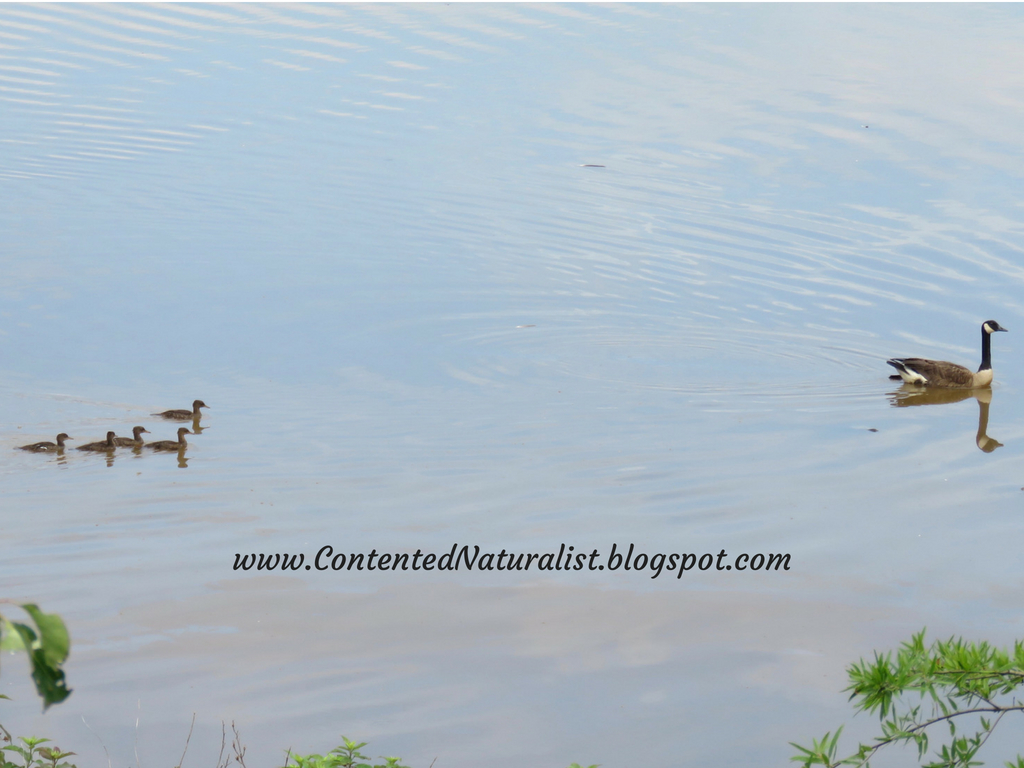
On a recent trip to Huntley Meadows, Victor & I got to see something that not only checked off one of my target species, but was somewhat puzzling. We were on the boardwalk lookout tower when I spotted a Canada Goose swimming along with a group of smaller birds trailing it. “Oh look, goslings!” I said, before I got a good look at the birds. In fact, it was a group of Hooded Mergansers following the goose as if they thought they were indeed goslings themselves. How funny!

Huntley Meadows is an unusual breeding spot for Hooded Mergansers, who normally breed much further north. They've been here for several years now, though, and seem pretty settled in.

I initially thought the appearance of family relations must have been only coincidental, something I imagined or added to the scene without a real basis in actuality. But when I was looking for more information on the algal bloom we also observed there (link here), I found photos of a Canada Goose apparently acting as nanny to a family of Hooded Mergansers both this year and last year, posted on the Huntley Meadows Community Facebook group.

My ornithologist friends suggested a few theories for what’s going on. Hooded mergansers are known for brood parasitism, where the mother bird lays her eggs in someone else’s nest, leaving that nest’s mom to raise her chicks. However, the difference in size between mergansers and Canada Geese makes this seem somewhat unlikely. When I looked closer at my photographs I also realized that the mother merganser was accompanying the juveniles and the Canada Goose, so she didn’t totally abandon her clutch. Another possibility is that the mergansers somehow imprinted on the Canada Goose. This is my favorite so far. I wonder even if the mama merganser herself imprinted on the Canada Goose, when she was young, and now has taught her own babies to do the same.

The mother is at the back of the group in this shot, slightly larger than the juveniles.
Either way, however, I still wonder what the Canada Goose thinks about it! What do you think might have led to this odd partnership? Feel free to suggest more theories in the comments.

Sunday, May 20, 2018

Merganser Mama

Update: We went back to the C & O Canal a month later, and found a huge group of about 40 half-grown Common Mergansers, probably including the ducklings from this family. So of course, I wrote about them again.
  
Victor & I went hiking along the C & O Canal recently. My main intent had been to snag a bunch more new bird species for my year list, since spring migration is in full swing. I was indeed successful-- warblers and other songbirds were singing everywhere. I can't identify every one by call, but I was able to recognize several, and managed to confirm a few others I wasn't sure about by using the Merlin app from Cornell Lab of Ornithology. (This is a great field app, I highly recommend it! I have a post in the works about how I use it, so stay tuned.)

But in addition to the Indigo Buntings, Blackpoll Warblers, Yellow Warblers, Red-eyed Vireos, and Yellow-billed Cuckoos that I logged on eBird that morning, I finally was able to check off a longtime birding bucket list item: seeing a Merganser carrying her babies on her back! I knew mergansers do this sometimes, as do loons and grebes, but I'd never observed it in the wild. Now I have!

When we first entered the trail at Seneca Creek, Victor immediately pointed out a female Common Merganser paddling toward the Potomac. I trained my binoculars on her and discovered she was trailed by several little babies! In fact, one of those babies had already climbed on her back for a break. Victor & I took turns snapping lots and lots of photos as she hustled toward the larger body of water.  As she swam along, more and more of her babies clambered on her back. SO CUTE! Even though I also saw my first ever Magnolia Warbler that morning, the mergansers were still the highlight of the trip.


Not all of our photos came out-- it was pretty humid and misty out, and that gave the camera a bit of difficulty focusing, I think.  But here are a few of the better ones. Enjoy!

Female Common Merganser swims along with one spotted duckling on her back and six more paddling behind.
One baby is riding comfy on the middle of mama's back. Everybody else is hustling to keep up.

Female Common Merganser swims along, with three fuzzy ducklings riding on her back and four paddling behind.
Now three babies have made it onboard.


Female Common Merganser swims on still, gray water, with four fuzzy ducklings riding on her back and three more behind.
Four babies are on her back at this point, with a couple still paddling madly along.

Female Common Merganser swims away into the mist, with seven fuzzy ducklings riding cozily on her back.
Finally, all seven babies are tucked up on top of Mama.  So off she goes into the Potomac. Farewell!

Thursday, June 16, 2011

My (unintentional) Off-trail Adventure


A perfect day for a hike!


It’s been gorgeous this week, with cool nights and slowly warming days, temps peaking barely in the mid 80s. I visited Lake Frank on both Monday and Tuesday. The first day I focused on some blooming milkweed and their attendant butterflies (more on that in a later post). But the next day I came back with a specific goal: I wanted to hike all the way around the lake-- none of this hiking part way and turning back.  In order to do this, I had to bypass my normal “stop and look at everything” philosophy.  Usually I let myself get distracted by things like tiny wildflowers, odd fungi or that secretive Ovenbird I just KNOW is around here somewhere. This time I wanted to explore beyond just my few favorite spots.


Map courtesy Montgomery County Department of Parks, www.montgomeryparks.org


Lake Frank has a somewhat confusing network of trails. There’s the formal park trails, usually well-kept, well-trodden and clearly marked. One section of the Lakeside trail is even paved. Then there are unmarked “connector” trails between the formal trails and nearby neighborhoods.  Both of these types of trail are indicated on the map.  But there are also unmarked fishermen’s access trails down to the water’s edge, plus the usual wildlife trails where deer have trodden recognizable if faint pathways.  Some of the fishermen’s trails are nearly as wide and well-used as the formal trails, while others are barely as wide as the deer trails.  So there’s a somewhat helter-skelter aspect to finding the trail at times. 


One of the semi-official connector trails.


The first and last third of my intended route are quite familiar to me, but I had never hiked the middle section. I had a copy of the map in my pack and thought my route would be straightforward.  Well, not quite.  The trails near a spot I’ve nicknamed the owl grove get hopelessly criss-crossed, and of course most of them are the unofficial or wildlife kinds.  I came to one fork where both paths looked well-trodden.  The right hand trail headed toward where I thought the owl grove was, so that’s the one I took. I followed it through the forest, up and down hills that overlooked the lake, and somehow completely bypassed the owl grove.


One of the nest boxes in the owl grove.


I’ve spent time in the grove before, but not recently, and apparently have forgotten the exact path to get there. After cresting a final hill I descended into a meadow that borders a stream.  I think I entered that meadow once a few months ago while searching for the year’s first spring peepers, but the grasses are now waist-high or taller and I was very disoriented.

I found several spots where I could be on the map.  My intended trail crossed a small stream, then followed a larger one, dancing between the stream’s edge and a meadow, finally crossing the large stream before heading back to the lake shore.  If I was at the big stream, I should keep the river on my right in order to go the correct direction.  But if I was at the small stream instead, I should keep the stream on my left until I reached the crossing.  I could hear children’s distant laughter to my left. Perhaps they were near the nature center and I should head that way, or instead they could be in one of the neighborhoods that border the park and thus be of no use for navigation. It wasn’t much help. I eventually concluded I was at the small stream since I hadn’t crossed any stream yet, or so I thought. I decided to continue to my right, after first checking out the meadow a bit.  I briefly followed the trail upstream, finding yet more milkweed and lots of neat bugs and birds.


Red Milkweed Beetle-- on milkweed, naturally.


Then I resumed hiking through the forest.  Suddenly the trail disappeared in scraggly underbrush.  Huh? I climbed a hill and discovered below me a section of lake shore that I recognized from two hours ago! I must have backtracked on yet another one of the deer trails. Arrgh. I returned to the meadow again. It was looking less and less like I would make a successful circumnavigation of the lake.

I tried once more to figure out where I was on the map.  It was just about noon, so I couldn’t use the sun to determine north.  (Apparently I need to add a compass to my hiking gear!) Finally I realized I could figure out my position and direction by just observing the stream. It seems so obvious now.  The way the streambed curved in front of me seemed on closer inspection to match one part of the map’s big stream. If I were there instead of at the small stream, then walking upstream would keep the river on my right and would put me on the right trail. Aha! I should have just kept going after my initial upstream exploration.  When I reentered the forest by hiking upstream I even found proper trail blazes again, the first I’d seen since way back at the initial trail fork. I’ve never been so relieved to see a simple trail marker before!


Hooray for trail blazes!


Knowing for sure where I was really cheered me up. I felt better with each recognizable landmark and especially the labeled trail intersections.  But then as I continued along, I noticed dark clouds starting to build.  Even if I knew exactly where I was on the map, I’d still be just as soaked if a storm caught me on the trail. I picked up my pace, and soon found myself on the paved part of the trail, right next to one of yesterday’s milkweed patches.  I knew I could make good time from here as long as I ignored the temptations of the milkweed. 


I don't like the looks of this...


When I finally made it back to the dam at the south end of the lake, I realized the dark clouds weren’t actually moving very fast.  I relaxed and took a slower pace the rest of the way to the car.  It didn’t even start raining until long after I made it home. Although I took more time than I’d hoped, and I walked quite a bit farther than intended with all the detours and backtracking, I still achieved my goal! I feel like overcoming my lack of navigation skills made it a bigger accomplishment than following the correct trail would have been. Plus, if I hadn’t done all the detours and backtracks, I wouldn’t have been in the right place at the right time to have these wonderful little encounters:


I found this Common Yellowthroat after my first upstream exploration.

This Wood Duck family explored the lake only briefly.

A  Hummingbird Moth joined the butterflies the second time I walked upstream.


I guess it’s like they say, the journey can be more important than the destination.  Of course the eventual destination is pretty crucial, like getting back to my car, but the quirks and mistakes in my route probably made the hike more fun than if I’d stayed on the correct trail the whole way.  Now to get me that compass, and try following the trail loop again soon!

Today’s park: Lake Frank, Rock Creek Regional Park, Derwood, MD

Wednesday, June 8, 2011

Wood Duck Motherhood

This weekend my husband and I strolled along the C&O Canal for a few miles, starting around Swain's Lock. At one point we were watching some Double-crested Cormorants congregate on rocks in the middle of the Potomac River. I was hoping for something unusual, maybe a breeding pair of mergansers since there are a few breeding pairs in the region.

Double-crested Cormorants, yawn.

I never did find any mergansers, but suddenly we spotted a mother Wood Duck paddling along with eleven tiny ducklings. Adorable! I snapped a quick photograph of the group, but as soon as I did that, Mama suddenly decided we were a threat. She started squawking loudly and paddled off double-time in the same direction, slapping her wings against the water as if she were wounded. The babies, however, took a sharp right turn and headed at an angle to their original heading. They paddled so fast their little bodies were half out of the water. As they escaped, the ducklings stuck together in a tight bunch.  What a neat way for Mama to distract a predator and send the babies to safety!  Here's the sequence of photos; apologies for the backlighting and general haziness of the images-- there was a lot of pollen in the air and on the water.

Before Mama knew we were watching...
Mama just spotted us and decoyed away to the left; the ducklings started their turn.
Mama's squawking far downstream by now; the ducklings keep hustling off to safety.

Pretty cool to watch the decoy technique in action! I've seen Killdeer parents try to decoy me away from a nest, but never Wood Ducks before. Motherhood is pretty powerful.

This entry's park: C & O Canal National Historical Park
Blogger Widget