Showing posts with label Florida. Show all posts

Sunday, February 25, 2018

More Great Backyard Birdcount-- and Beyond!

As I mentioned in my last post, I had a lot of fun on this year's Great Backyard Bird Count. Since I first wrote about it from the road, without the ability to include pictures, I thought I'd follow up with  photos of a few favorite sightings.

One of our first stops was at Disney World, where we spotted this Palm Warbler searching the waterline for tasty bugs.

We spotted this Snowy Egret at our next stop, St. Petersburg. I love the bird's yellow feet, or "golden slippers" as my field guide calls them!

St. Petersburg turned out to be very good for birding, with lots of small parks and canals. Crescent Lake held a lot of domestic-type ducks that were clearly well-fed by locals, but also this American Coot, White Ibis, and Wood Stork (left to right).

St. Pete also has a colony of Eurasian Collared-doves, not native to the U.S. but still fun to see. We also spotted another non-native, the Monk Parakeet I mentioned last post, but couldn't get good photos of it. Cool to see, though!

As we continued to explore the city, we stumbled onto a park whose mudflats held several kinds of gulls and sandpipers, but most excitingly, hundreds of Black Skimmers! Their weird-looking beaks let them skim food right from the water as they glide just above the surface. I think they were my favorite sighting from the trip.

The GBBC is over for this year, but you can still log your project data at eBird.org through March 1, if you haven't gotten around to it yet! Non-GBBC sightings are important to enter too, to help scientists understand long-term patterns or changes. How will birds' migration paths and timing change as our climate changes? Those are just a few of the issues ornithologists are studying with the help of eBirders. 

Ebirders can help document shifts as they happen by logging bird sightings all year round. That's what I'm trying to do by entering at least one checklist every day. Bonus: I've already added several new species to my life list, including the above-mentioned Monk Parakeet, Black Skimmer, and this fussy little Orange-Crowned Warbler we saw in Jackson Square in New Orleans!

The warbler was very active and rarely stayed still for very long. Eventually I got good enough looks at it for identification, and for Victor to get this adorable photo.

If you want to join eBird too, it's super easy to get started. Go to eBird.org and create a free account. Next, identify birds you see in your yard, from your office, or wherever you like, and report them. That's it! If you don't have a bird field guide already, the Cornell Lab of Ornithology even created a great app to help you identify birds, called Merlin. As I mentioned above, I used it this trip to help me identify that Orange-Crowned Warbler! I highly recommend checking it out.

Happy birding! I'd love to hear in the comments what you all are seeing in your area.

Monday, November 14, 2016

Five Fantastic Nature Parks in Florida


To me, nature in Florida is exotic and amazing. The lush tropical swamps and marshes, the tangled mangroves, the bright aroma of citrus orchards, and of course the year-round cacophony of vivid flowers and verdant foliage.  It's a far cry from the chilly winters in Maryland where I now live, to say nothing of Massachusetts where I grew up!

So I love going birding and/or butterflying in Florida when I have the chance. I used to visit the Sunshine State frequently while growing up, since my maternal grandmother lived in Delray Beach. My husband & I got married in Disney World as well, so the two of us spent lots of time in Florida while planning the wedding, and in the years since.

Over the years we've explored many parks all over the eastern United States in search of butterflies and birds. Some were successes, some not. If, like me, you enjoy exploring nature and wildlife, Florida is a great state for it! Sometimes it's hard to narrow down park recommendations when you're just starting to explore an area and don't already have a local contact. Florida has so many awesome parks, it's hard to choose which ones to visit. So to help with that, here are five of my favorite places (so far) to look for either birds or butterflies in Florida.

1. Orlando Wetlands-- Orange County
This park isn't actually in Orlando or even very close-- it's more than an hour's drive east of Orlando, in a tiny town called Christmas. (That was a bit of a surprise to me the first time, I planned our inital visit when we were also at Disney World and I thought it would be a quick side trip. Not very quick, but definitely worth it! We've been back many times since.)

Juvenile Little Blue Heron at Orlando Wetlands

The network of canals and shallow lagoons holds waterfowl galore, plus of course many alligators. The Environmental Education center also has a small butterfly garden around it with interpretive labels. The park offers buggy rides to get you further out than you might go just walking. Make sure you check the Wildlife Sightings list outside the visitor center before you head onto the trails, too, in case any good species have been spotted that you could target. I always try to make an entry in these kinds of lists when I finish a visit, to make sure other folks know what's there and also to let park staff know how much we appreciate their conservation work.

Sneaky Sandhill Crane beneath the birdfeeder

The most recent trip we made included a close encounter with a Sandhill Crane who had found the bounty of the birdfeeder next to one of the picnic shelters. Clever bird!

2. Boyd Hill Nature Preserve-- Pinellas County
Despite being right in the midst of St Petersburg, this park has a huge diversity of habitat, from dry scrub to wetland to lake's edge. Thus it hosts lots of butterflies and birds. The Nature Center also has an aviary with several raptors such as peregrine, harrier, osprey and Bald Eagle, all of which also occur naturally at the park. I have to admit, though, my favorite part of this park is encountering the adorable Gopher Tortoises lumbering across the paths.  I don't know why they strike me as particularly cute, but they do, they're so grumpy and curmudgeonly. Just look at this individual:

This grouchy Gopher Tortoise wasn't so pleased to encounter us!

3. Fred & Idah Schultz Preserve-- Hillsborough County

This park was down a tiny gravel road, if I remember correctly. Like Boyd Hill, it consists of a mix of sandy scrub and wetlands. There were tons of flowers blooming when we last visited, and butterflies everywhere. This is where I got my first Oak Hairstreak, a real thrill. Other butterfliers in the area visit the park regularly, and sometimes post their lists to the sightings page for NABA (North American Butterfly Association). That's how I first heard of the park, by finding a trip report there that included some of my target species.

My first Oak Hairstreak butterfly. Sorry for the obscured view, I chased this little devil quite a bit before getting a decent look.

4. Loxahatchee NWR-- Palm Beach County
This is definitely a sentimental favorite, as my grandmother used to volunteer here and we frequently visited with her. It's made up of both cypress swamp and a network of sloughs, or canals, and thus has lots of waterfowl, waders, and alligators. I didn't pay attention to butterflies back when I was a kid, but in 2015 V and I went on a grim, cloudy day and still found good butterflies. Sadly, few of the photos from that day were worth anything. Check out their website for more information, though!

5. Wakodahatchee Wetlands-- Palm Beach County
This small park is  run by the Palm Beach County water management folks. It's actually designed to help process and filter wastewater from one of their water reclamation plants.  The main attraction is a 3/4 mile long boardwalk the winds through the wetlands so you can get right up close to birds and other wildlife. It's really cool being able to walk right through the marsh and watery areas. Honestly I have not visited Wakodahatchee since before I got into butterflies. I used to visit frequently with family when we were visiting my grandmother, though, and remember loving the birding opportunities there.

What are your favorite parks in Florida to find birds and butterflies? Share in the comment section, and I'll add them to my "must visit" list for next time!

Saturday, February 27, 2016

Eleven and Counting! My first butterflies of 2016

Phaon Crescent

I went to New Orleans for Mardi Gras February 4-10 with a bunch of friends (including of course my husband). That was fun and we thankfully had sunny, not-terribly-cold weather on Mardi Gras itself for our marching in the Rex parade.

We march with a great bagpipe band, Kilts of Many Colours. I'm holding the flag.


Victor & I drove all the way to Louisiana, instead of flying, so that we had road trip options on the way back. In order to try and get my year's first butterflies, we decided to drive down into northern Florida before heading home. Since this was the Great Backyard Bird Count weekend as well, I thought we might also get some pretty nice birds along the way.

First we stopped at Mississippi Sandhill Crane NWR, since it was right off the highway. It was clearly far too early for butterflies here, but I hoped for a Sandhill Crane or two. Didn’t get the cranes, but still got some pretty awesome birds for the Great Backyard Bird Count: a Brown-headed Nuthatch, and several Eastern Meadowlarks, along with a Savannah Sparrow. (I’ve seen the latter in Maryland and Virginia before, but it was kind of cool to see them in the habitat they’re named for!)

It was hard to get a decent shot of the meadowlarks, they all kept thrusting their heads into the grass after bugs.

Even cooler though were the carnivorous plants we saw here: a couple species of pitcher plant and dwarf sundew. Very cool! I'd never seen these in the wild before.

I looked closely but didn't see any bugs trapped in the sundew. Too bad.

Next we went to Paynes Prairie Preserve State Park. It still looked a bit sparse here, with not much blooming yet, but a few things were out and we managed to find the first butterflies of the year: Cloudless Sulphur, Little Yellow, and Carolina Satyr. (A ton of the latter, actually, I’m sure I undercounted them as we walked through a wooded trail.) We also explored an open prairie section where I had high hopes for additional species. We saw no butterflies here, though, and really hardly anything was blooming. But we had our second bald eagle and also found massive piles of bison poop along the trail, which made me giggle.

Little Yellow

I briefly checked some roadsides along our drive and at the motel we stayed overnight, but found no more butterflies until we got down to Saint Petersburg. The western-facing Gulf Coast was much further along than the panhandle area of Florida or even the north-central section. We stayed overnight in Saint Petersburg and spent a giddy few hours birding and butterflying at Boyd Hill Nature Preserve there. I got several more butterfly species here as well as quite a few songbirds, raptors, and so forth.  I've seen Gopher tortoises here before and hoped I'd see another this trip, but Victor was the only one who spotted one this time; it was gone before I caught up. I love those silly tortoises, wish I’d seen one this trip. Maybe next time.

Gulf Fritillary

Our next park was all the way on the other coast of Florida: Orlando Wetlands Park, in Christmas, FL. Unfortunately by the time we got there the day had become almost completely cloudy and quite breezy, not prime weather for butterflies. We tried anyway but only found two: another Phaon Crescent and another Dainty Sulphur. To be honest, though, that was really made up for by the amazing variety of birds we saw though! Tons of charismatic species, both big and little: Roseate spoonbill, bald eagle, painted bunting, various herons, egrets, and ibises; my first-ever American White Pelican (yippee!) and that longed-for Sandhill Crane. The latter we even saw up close as it grazed under the birdfeeder hung near the picnic shelter! So funny.

White Pelican. Later we saw about a dozen flying in formation, pretty cool.

Even Sandhill Cranes like bird feeders, who knew?

On the way home we stopped briefly at Jennings State Forest in Middleburg. Again the weather was not conducive to butterflies, completely cloudy. We spooked a brown something about the right size and shape for an Elfin, but lost it before either of us got a good look. Phooey. However, we still saw some fun birds, including Red-shouldered hawks and another Brown-headed nuthatch. Not bad.

My final trip lists:
Birds
Blue-winged Teal
Pied-billed Grebe
White Pelican
Double-Crested Cormorant
Anhinga
Great Blue Heron
Great Egret
Snowy Egret
Little Blue Heron
Tricolored Heron
Green Heron
White Ibis
Glossy Ibis
Roseate Spoonbill
Black Vulture
Turkey Vulture
Osprey
Bald Eagle
Red-shouldered Hawk
Common Gallinule
American Coot
Sandhill Crane
Killdeer
Least Sandpiper
Herring Gull
Eurasian Collared-Dove
Belted Kingfisher
Red-bellied Woodpecker
Eastern Phoebe
Blue Jay
American Crow
Fish Crow
Tree Swallow
Tufted Titmouse
Brown-headed Nuthatch
Blue-gray Gnatcatcher
Eastern Bluebird
American Robin
Gray Catbird
Northern Mockingbird
Yellow-rumped Warbler
Palm Warbler
Savannah Sparrow
Scarlet Tanager? (heard only)
Northern Cardinal
Painted Bunting
Red-winged Blackbird
Eastern Meadowlark
Boat-tailed Grackle

Butterflies
Sleepy Orange
Dainty Sulphur
Little Yellow
Cloudless Sulphur
Orange-barred Sulphur
Gulf Fritillary
Phaon Crescent
White Peacock
Carolina Satyr
Long-tailed Skipper
Whirlabout

Other
Pitcher plant sp.
Dwarf Sundew
Raccoon
Gray Squirrel 
Armadillo
Cricket Frog (heard)
Gopher Tortoise
American Alligator
Sweat Bee sp.
Honeybee
Bumblebee sp.

I’d hoped to get maybe 20 butterfly species this trip for the Butterfly Bigger Year, but I’ll be satisfied with 11 to start off.

Tuesday, July 12, 2011

Thrills at Merritt Island


On our recent Disney World vacation, we enjoyed Disney’s Epcot, Magic Kingdom and Hollywood Studios parks but never made it over to Animal Kingdom.  You might wonder why a naturalist would give up the chance to visit a zoo that has exciting rides AND live animals. It’s not that I have an ethical bias against zoos, that I didn’t like this park on our last visit, or even that we couldn’t wake up in time to see early-rising animals. Instead, we found just as much discovery, beauty and excitement (maybe more excitement than we’d bargained for) as Animal Kingdom would have offered, with lots less crowds too. 

Instead of Animal Kingdom, we decided to visit Merritt Island National Wildlife Refuge and Canaveral National Seashore, both in Titusville. You need a car to get there from Disney World in Orlando, but it’s definitely worth the hour drive. We arrived at the refuge roughly mid-day. Even that late, there were still lots of animals out and about, including some of my target species.

It had rained every day of our visit so far, and we’d already pushed the Merritt trip back a day.  The morning looked fine when we set out, but soon a huge ominous bank of clouds appeared over the horizon.  By the time we got to the refuge, the air felt like a storm was about to break, and dark angry clouds were nearly overhead.  So we ducked into the VC for the briefest of chats with the staff, then optimistically slathered on bug repellent and entered the short boardwalk trail.  The threatening storm front definitely added as much urgency and danger to our wildlife watching as we found on any thrill ride back at Disney.  Although our pace was rushed, we still found lots of cool critters along the boardwalk: tiny lizards, tropical butterflies, dragonflies, and of course those tremendous spiders I mentioned last entry.

Queen butterfly


Wandering through oaks, palms and Spanish moss.

A non-native Brown Anole

After we finished the boardwalk we could hear distant thunder but still no rain had fallen.  Our next destination was the Scrub Ridge trail, where I hoped to spot a Florida Scrub-jay. We didn’t find any Scrub-jays, but did see several Gopher Tortoises, so named because they dig long burrows. They were pretty shy, and usually we’d spot them from about 15 feet away, at the same time they saw us. At that point they’d trundle hastily into the underbrush. Once under cover they were invisible but we could easily tell their location from the scuffling sounds.  After maybe the fifth similar encounter we couldn’t help but giggle every time we saw or heard another one. Apparently the Gopher Tortoises are pretty important for the scrub ecosystem: lots of other animals use their burrows for homes too, whether as daily shelter or to escape the fires that regularly sweep the area in order for it to remain scrubby, not forested.

Gopher tortoises on the trail. The far one just spotted us.

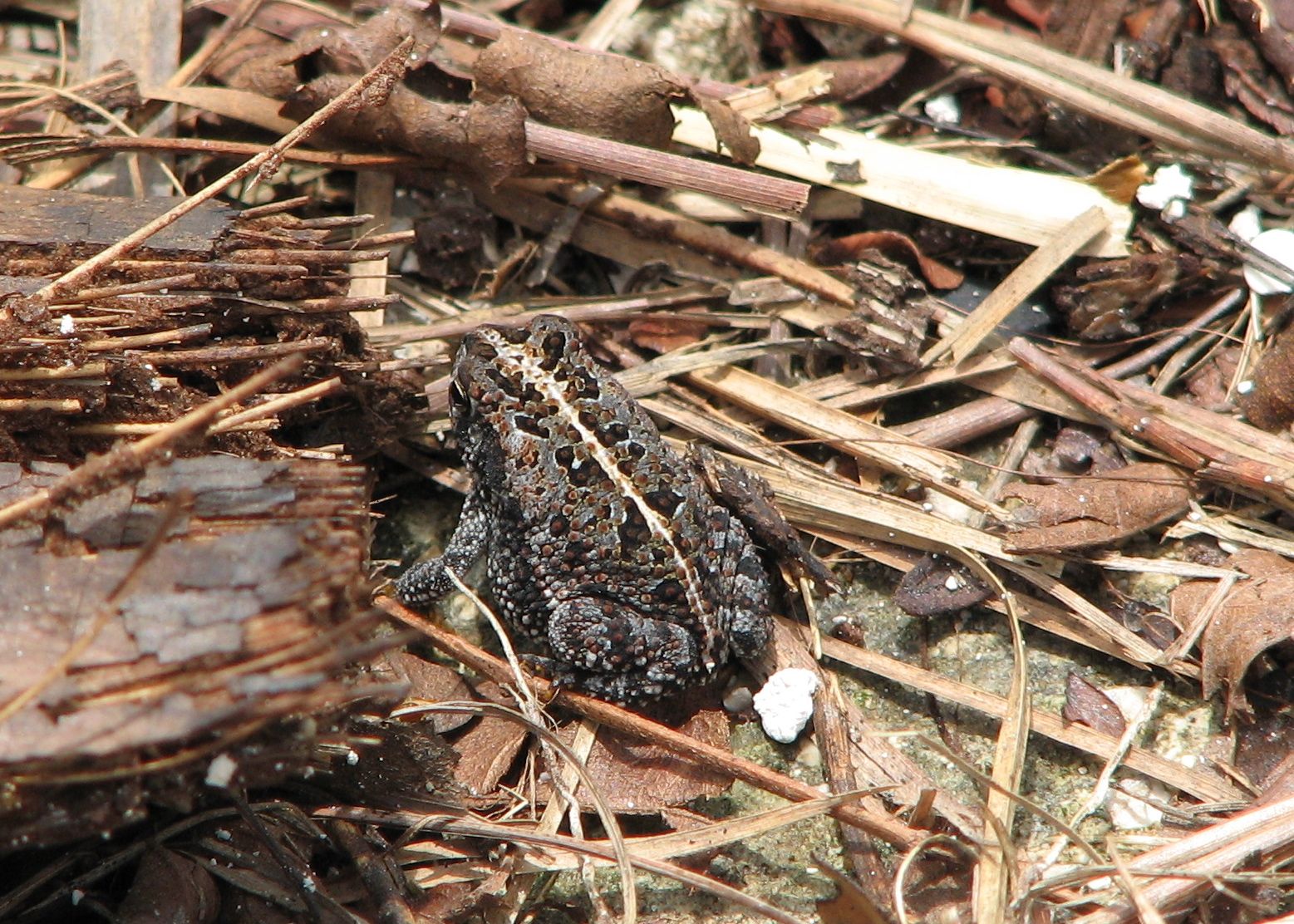
Another animal we saw everywhere on the trail was the tiny Oak Toad, only about an inch long.  They were so abundant in spots, and so well camouflaged, that I barely avoided stepping on a few. I remember thinking the toads seemed nearly to glimmer against the trail (although maybe that was just air shimmer from the heat). These are the smallest native toads in the US, and are one of the few that is active in daytime. Pretty cool.

Oak Toad

Roughly halfway down the trail we decided the clouds looked way too scary and close for comfort, so we turned back. We made it to the car in a cloud of mosquitoes, but still no actual raindrops had fallen.  (Note to anybody considering a visit to Merritt: wear long pants and a long-sleeved shirt even in the hottest weather! My pants did a much better job protecting me from mosquitoes than bug repellant did on bare skin, probably because I kept sweating off the repellant no matter how often I applied it.)

Threatening clouds over the scrub habitat.

Next we headed to look for endangered West Indian Manatees.  I’ve always wanted to see wild manatees. We’d seen captive ones the day before at Epcot’s Living Seas exhibit, but it's just not the same. The area we were directed to was much further away than I had thought; in fact Victor had just said “I think we’ve gone too far, let’s turn back” when I finally spotted a sign for the turn-off. We pulled into the gravel parking lot and joined a couple other families already on the concrete overlook. Right below our feet we saw manatees lolling in the warm shallow water.  Wow! There was even one a bit farther away munching on floating plants.

The manatees were very tough to photograph. Mostly they floated just under the murky water surface, occasionally coming up for air.  We were still anxious about the weather, and hadn’t yet gotten over to Canaveral to see the shuttle, so we didn’t spend a lot of time at the manatee spot.  In the picture below, you can see white scars where the manatees had been hit by motorboats.  That’s pretty common, I’ve heard, and is a big reason why they are on the federal endangered species list.  The captive ones at Epcot were individuals who’d had severe injuries in the wild and were being treated and rehabilitated before release.
Two West Indian Manatees

After the manatees we drove to the adjacent Canaveral National Seashore. We briefly checked out one of the beaches that had good views of the shuttle.  There we also got a closer look at another Gopher Tortoise in the dunes, although it was as shy as the ones on Scrub Ridge trail and quickly scooted back under cover. There wasn’t a whole lot of other wildlife on that beach though; it’s not the season for migratory sandpipers and such.

Space Shuttle Atlantis

Gopher Tortoise hiding in the dunes

After the beach, we headed for Bio Lab Road, recommended to us by Canaveral’s contact station attendant.  This turned out to be roughly five miles of skinny dusty road through marshy habitat, with occasional views of the seashore.  It was thick with wildlife.  Without leaving the car, we saw a Florida Wood Rat, a Marsh Rabbit, a Roseate Spoonbill, two Alligators, an Anhinga, both Great Blue & Little Blue Herons, Tricolored Herons, White Ibises and of course the ubiquitous Golden-silk spiders.
Marsh Rabbit
Roseate Spoonbill
White Ibis and Little Blue Heron

Victor generously drove the whole time, allowing me to be wildlife lookout.  This was my first time birding by car, and to be honest I was skeptical about the idea.  How could I have a productive birding experience if we drove past wildlife before I even spotted it? But Victor was very good at driving slowly and stopping promptly when asked.  Since we only saw two other cars the whole way, we could even safely back up to get better views or photos if we passed something before my mind registered “Hey, there was an alligator back there!”
A lurking alligator

Around 4:00 we turned around and headed back for the refuge.  I had wanted to pick up a T-shirt or two in the gift shop.  But when we got to the VC area (at about ten past 4), we found even the gates into the parking lot were closed and locked.  The posted hours were 10:00-4:30, and nobody answered the phone when we called the listed number.  It was very disappointing and frustrating.  I understand that sometimes things come up, but I really wish staff could at least have posted an explanation if not an apology. I had looked forward to buying that T-shirt as a way to support the park as well as to have a tangible memento of our visit. Instead, I ended up with a sour final impression. I didn’t even have the heart to take a last photograph of those locked gates.

But that’s the only thing that Merritt didn’t do as well as or better than Disney: customer service. And until that point, the customer service at Merritt & Canaveral had been pretty good. Everybody we talked to was polite and helpful, sending us correctly to interesting spots for wildlife. Even those ominous storm clouds never loosed a single raindrop, just added that spark of excitement.

I highly recommend visiting Merritt Island NWR and Canaveral National Seashore. Although you may have to work at it a little more, what with the longer drive and a grittier experience, for both wildlife and excitement I think a visit to Merritt Island & Canaveral beats a visit to Animal Kingdom. We had just as much fun and discovery at Merritt as we would have with Animal Kingdom’s rides and animal exhibits.  Disney might have more animals in total and more guaranteed sightings, but because we discovered all the refuge animals ourselves, Merritt Island felt like more of a genuine adventure.

Side note: I found Merritt via the Great Florida Birding Trail, a compilation of excellent birding sites throughout Florida, with tips for best times and key species or habitats. Virginia has one too, the Virginia Birding & Wildlife Trail.  They’re handy whether you live in the area or are planning a visit. The American Birding Association has compiled a list of similar birding trails throughout the US too. Over thirty states are included. I’ll definitely check the listings before my next vacation.

This entry’s locations:

Tuesday, July 5, 2011

Predators

Last week I was frolicking in Orlando, Florida, with my hubby to celebrate our one-year wedding anniversary. Yay!  We spent most of our time at the Disney parks, but also took a day for some local nature. We drove out to Merritt Island National Wildlife Refuge and Canaveral National Seashore in Titusville. 

A boardwalk trail behind Merritt Island's Visitor Center.

We saw nature as well as the last foreseeable space shuttle at Canaveral.
At one point we drove down Canaveral's tiny, dusty Bio Lab Road in search of birds, Victor driving while I served as wildlife lookout. He isn't as fascinated with birds and bugs as I am, but had mentioned that he'd really like to see an alligator. So when we finally spotted one I was both relieved and excited.  The alligator was resting near a little streamlet along my side of the road.

The first alligator of the trip.

I had a hard time getting my camera to zoom properly on the alligator.  I thought the autofocus was just being persnickety, but when I downloaded the pictures I discovered the real cause: there were several large spiders a few feet from the car, between me and the alligator! The camera kept trying to focus on them, not the more distant reptile.  This photo reminds me of those old picture games I loved when I was a kid, finding various objects camouflaged in a sketch. How many predators can you count here?


From spiders to alligators, there's a predator in Florida for any size!

I count five predators in all, with a possible sixth just creeping in at the top of the spiders' web. These Golden-silk Spiders were each about one inch long including their legs-- pretty small for their species, so I'd guess they're pretty young. We also saw full-grown and honestly gargantuan females on the wildlife refuge.  The females measured about three or four inches long including the legs, with swollen bodies at least one inch long.  Males were barely one-third to one-half that large, and hung near the edge of the females' webs.  Check out this romantic pair:


Yikes! Those are some monstrous hairy-kneed legs.

Although late June/early July is supposedly one of the worst times for wildlife watching in Florida, what with the heat,  voracious mosquitoes, and a relatively low number of bird species in residence, we still had a great and very productive time.  I'll post more about the trip later this week, then resume my usual Maryland-area explorations.

This entry's sites:
Blogger Widget