Showing posts with label caterpillars. Show all posts

Sunday, April 2, 2017

How to raise caterpillars from eggs to butterflies

So you want to raise caterpillars. Congratulations! Maybe you want to help support the Monarch butterfly migration, or you want to share a biological investigation with your children, or you think it looks like fun. Whatever your reasons, I'm happy to help.

For the purposes of this post, I'm not going to go into how to get butterflies into your yard, that's another post. I'll assume at this point that you have a caterpillar or eggs in hand.

Please don't buy caterpillars online-- they may be sickly and you are very likely to find caterpillars in your own yard or garden, or in that of someone you may know. Many gardeners, if you ask them, would be overjoyed for you to remove caterpillars from their plants!

A Black Swallowtail caterpillar about to devour carrot greens.

Finding and Feeding caterpillars
Different types of butterflies need different hostplants for their caterpillars to eat. In my area the most common kind of butterfly is the Cabbage White (Pieris rapae). They aren't native to the U.S., but I think they're fine for your first try. It's easy to find a plant they'll eat: anything in the cabbage family -- radishes are probably the easiest and quickest to grow, and they're happy in a flowerpot if you don't have an in-ground garden. If you spot a radish whose leaves look pretty chewed up, that's a good clue you might find Cabbage White caterpillars on it.

Other caterpillars that are popular to raise include Black Swallowtails, which eat anything in the carrot family; and Monarchs, which eat any species of milkweed. My posts about raising caterpillars are collected here. Always make sure to identify caterpillars you find so you can provide the right hostplant. When I was a little girl I tried to raise caterpillars every summer by feeding them grass, because I didn't know they wouldn't eat just any plant. Of course, they all died. But you can do better!

Releasing one of my successful Black Swallowtails a few years ago.

Caterpillar Cages 
You'll need a container of some sort to keep your caterpillars in, that's closed to keep them safe. A jar  is fine with a paper towel or pantyhose fastened over the top. Your caterpillars will poop (a lot!), so to make cleanup easier, line the container with a piece of paper towel or even a coffee filter. Newly-hatched caterpillars are tiny, and their poops are barely bigger than dust, but soon the larvae will grow and so will the size of their frass (the actual name for caterpillar droppings). Leaving frass in the bottom of the container provides a great medium for nasty bacteria to grow, not a good idea.

My first set-up, with floral vial and paper towel.

When you are ready to move up in commitment (or your caterpillars get too big for their first container), you could use an old fish tank, even one that's no longer watertight. You can also buy professional caterpillar cages made of mesh. I have several of these cages-- one purchased at the thrift store, and four of different sizes that I bought online. You can see one above, where I'm releasing a butterfly. The benefit of the professional cages is that they let plenty of air through. They're collapsible too, so you can easily store them in the off-season.

Some DIY instructions are available here; a good discussion of different ways to set up a cage is here. The latter link is to Raising Butterflies' web site; their store also has good and relatively affordable cages. I can't remember where I originally bought my cages, but they look like the ones on Raising Butterflies.

This very hungry caterpillar is about to devour my carrot greens!

Feeding caterpillars, part 2
When raising caterpillars, you need to provide pesticide-free food for it. Ideally you'll have grown the plants yourself, but I realize not everybody has the space or time to do so. You may get permission from your neighbors, or even be lucky enough to find a vacant lot with the right hostplant.

If you don't have enough hostplants and neither do folks you know, another way to find food is to ask people you DON'T know. Join the Facebook group Raising Butterflies and Moths for Conservation; you'll find lots of helpful information there as well as like-minded folks. A simple post asking folks who live near you for help finding caterpillar food may solve all of your problems, as the friendly members tell you where you can find safe plants or offer you some from their own yards. Don't buy plants at the grocery store, even if they're organic. Organic farmers may treat their crops with Bacillus thuringiensis (or Bt), a bacterium that's deadly to caterpillars but harmless to people.

You don't need to put an entire plant in your caterpillar cage, cuttings are fine. Keep them fresh by placing stems in a cup of water, and make sure you protect the top of the cup so caterpillars can't fall in and drown. I use floral vials I get from buying roses; these are available online or at craft shops.

I prop my floral vials in a small glass inside the cage to keep them from falling.

Pupating
Your caterpillar will go through several instars, or stages, and molt each time between instars. Some species look different in different instars, like the Black Swallowtails I raise.The final molt will be into chrysalis.

Early instars of Black Swallowtails, like this little guy, are black and white; later they get green stripes as well.

When your caterpillar is close to that last molt, it will start wandering around. This is when it's essential to have your cage securely closed. My Black Swallowtail caterpillars walk a really long way, it seems, although I've never measured it. They're looking for just the right spot to make their chrysalis. At this point you should add a few twigs to the cage leaning against the walls at roughly a 45 degree angle.  If you can find twigs that have a few branches, that will give your caterpillars plenty of choice.

This little guy nearly escaped when I took the cage lid off for photographs.

One sign that your caterpillar is almost ready will be a final poop-- this will be very liquidy, not the compact frass you're used to. The caterpillar needs to get rid of any waste before spending days or even months in the closed case of its chrysalis.

Waste voided, this caterpillar is nearly ready to pupate.

Next the caterpillar will attach itself to a twig or the wall of the cage. It will spin a small button of silk and attach its abdominal end (cremaster) to that. Monarchs will then hang down vertically, eventually curling into a "J" shape. Swallowtails will spin themselves a sort of safety belt to support their front end and hang parallel to the wall or twig.

You can see the white silk belt the caterpillar spun to hold itself to the twig.

It takes a few days before the caterpillar actually molts. If you watch it closely you may see it occasionally twitching, like someone dreaming. I'm not sure what's going on here, but perhaps it's separating inside from the old caterpillar skin. When they molt, the chrysalis shell has already formed underneath the skin.

Halfway through shedding its caterpillar skin, you can see the chrysalis already emerging.

Depending on the species and generation, you may have to wait a couple weeks to several months for the butterfly to emerge, or eclose, from the chrysalis. I'll talk about that another time, plus what to do if a chrysalis falls.

Have fun! Let me know how your caterpillars fare.

Friday, August 21, 2015

Those Sneaky Spicebush Swallowtails

Not a bird dropping, but a sneaky Spicebush Swallowtail caterpillar, exposed!

Recently, it’s been taking me a long time to get home from work most evenings. It’s not that I’m running into a lot of traffic or other typical delays. No, it’s that the path I take back to my car is lined with native Spicebushes. This summer I finally figured out how to ID them when they’re not in flower, plus I learned the sneaky trick that Spicebush Swallowtail caterpillars use to avoid being spotted. So of course I have to check every spicebush, every branch I can reach, nearly every leaf, on my way back to the car. I’m looking for folded-over leaves, or just small sections of leaf that have been folded longitudinally to make a shelter for (I hope) a tiny Spicebush Swallowtail Caterpillar. It’s a bit like a treasure hunt every evening!

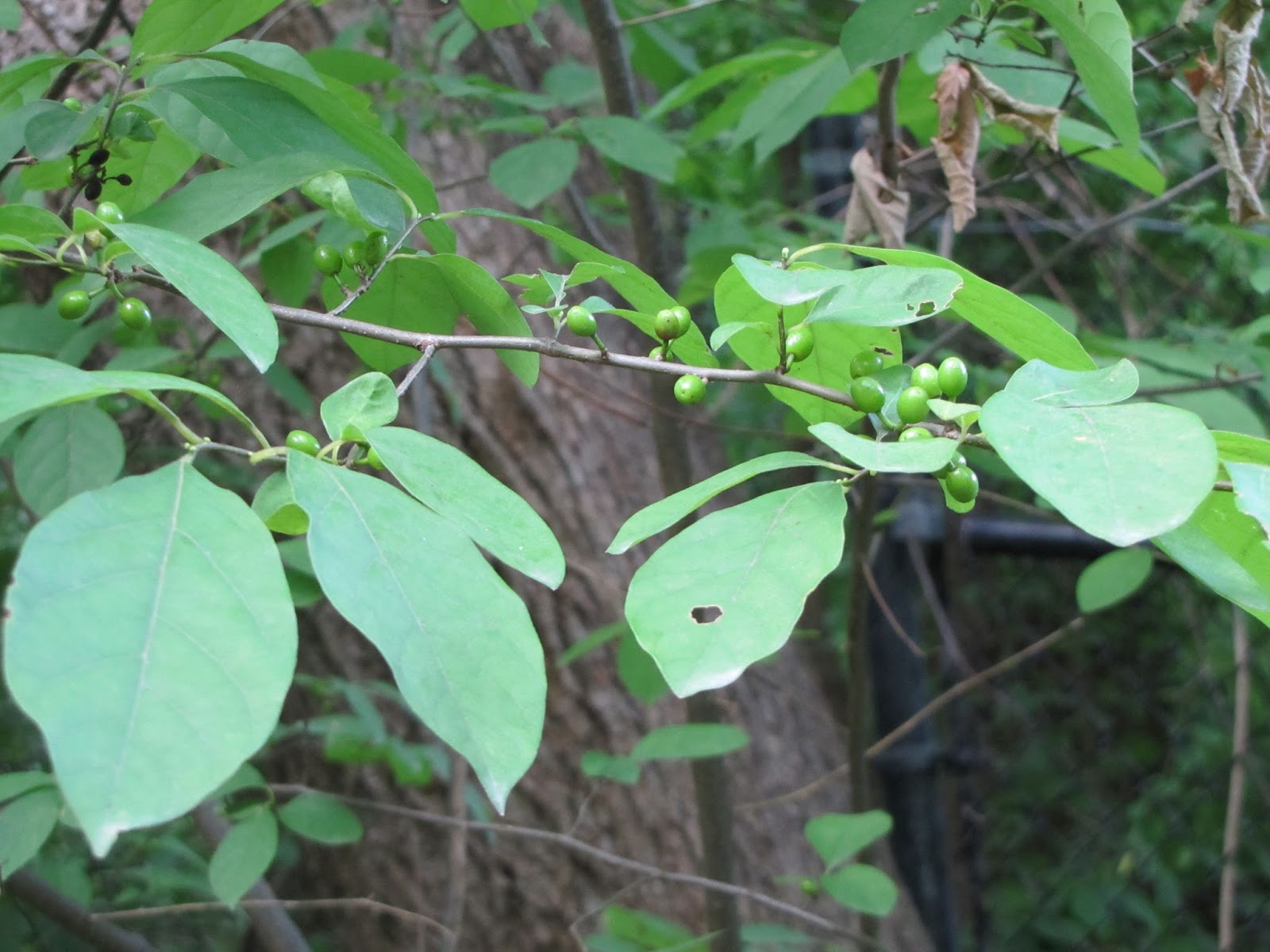
One of the many Spicebushes (Lindera benzoin) near where I work in Maryland.The ones along this trail are about six feet or so tall and wide, although they can get twice that size. Ovate leaves are alternate, and lots of oval berries sprout along the branches.


Here's a closer view of a Spicebush branch, showing the many berries. They're green right now, and turn red when ripe.


A Gift With A Bonus

This all started with a gift from my boss: a small potted Spicebush that came with a bonus: a caterpillar already in residence. My boss had bought several bushes for his yard and ended up not needing them all. Most had already been visited by breeding Spicebush Swallowtails, who depend on  spicebush as their larval host plant. Knowing that I love raising caterpillars, he offered one of the extra bushes to me.
A folded leaf containing my new Spicebush Swallowtail caterpillar. The caterpillar makes this shelter by laying silk across the leaf, so the sides will close up as the silk dries out and shrinks. Pretty crafty!


I brought the bush and caterpillar home, and over the next few weeks raised the caterpillar to a butterfly. By the time I released the adult butterfly, I was hooked on my second caterpillar species. I was having so much fun, I forgot to even take photos as the caterpillar grew up.
Gleefully releasing my first-ever Spicebush Swallowtail. The branch inside the cage is spicebush that I'd hoped would be a pupation site, but of course my caterpillar decided to adhere to one of the cage walls instead. It worked out though!


I’m currently in between generations of Black Swallowtails, so my caterpillar craving has gone unanswered for a while. It seemed like Spicebush Swallowtails might make a good supplement to the Black Swallowtails.

Now everywhere I go I’m checking spicebushes for the tell-tale leaf shelters. Spicebushes are native and grow throughout the eastern United States, so I'm seeing a lot of them anywhere I hike. I did actually find one tiny caterpillar while I was visiting my mom in Ohio a few weeks ago. (I was too excited to remember to photograph it, though!)
           

Extra Defenses

I mentioned that the caterpillars hide by rolling up in leaf shelters, which is cool enough. What’s even more amazing to me is that they only come out to eat at night. Before this summer I had no idea there were nocturnal caterpillars! While I was raising the one I got from my boss, after sunset I’d sneak into my now-dark home office and flip on the light to surprise the caterpillar and catch a glimpse of it. As I mentioned, though, I neglected to photograph the caterpillar as it changed over the days.
I peeled open the leaf shelter to photograph the caterpillar when I first received it. Surely I'm not the only one who thinks the newly forming eyespots are kind of adorable!

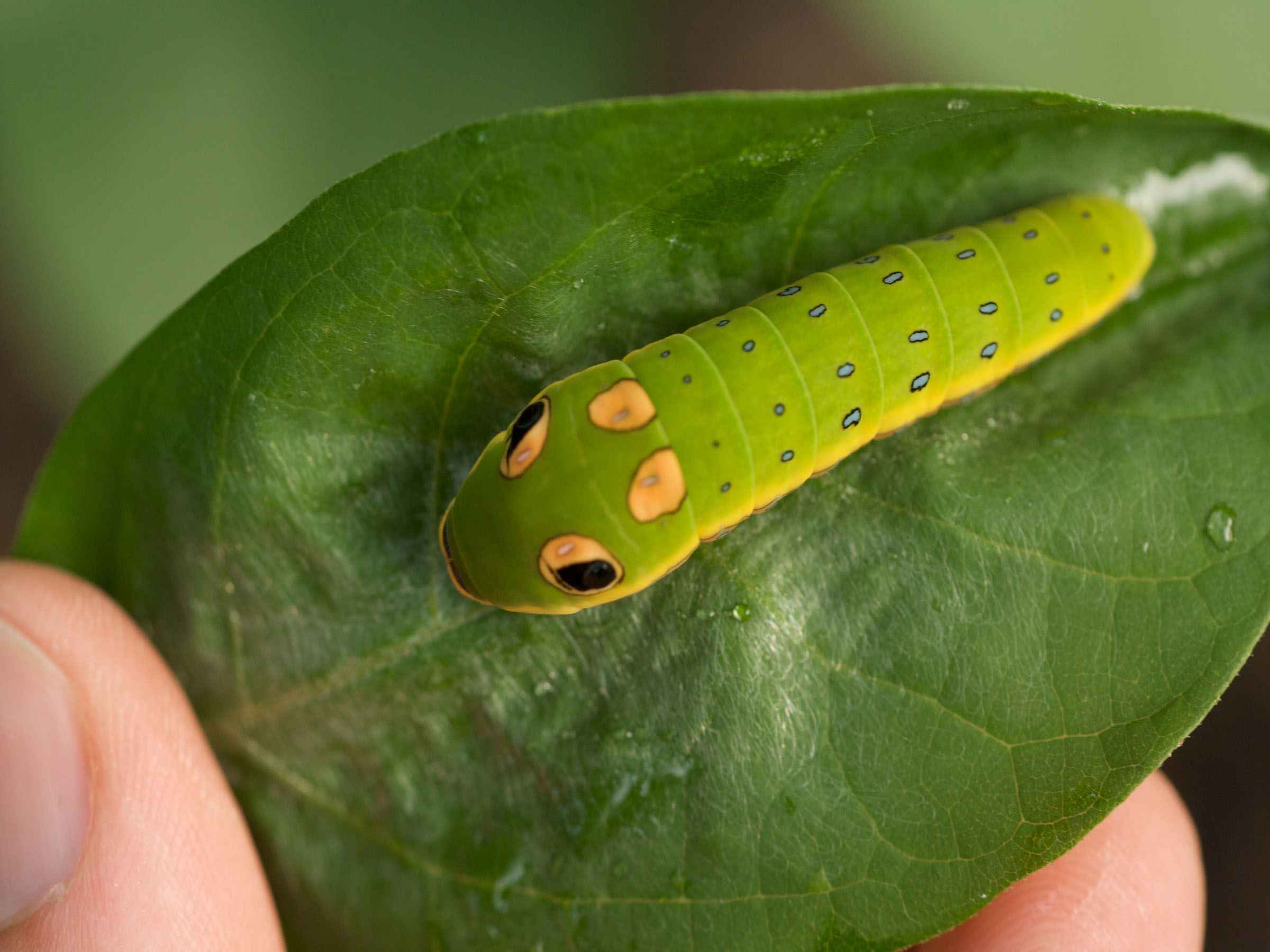
The caterpillars also have special disguises just in case they get seen: the early instars are bird-dropping mimics, like many other swallowtail species. Later instars have these really cool fake eyes that make them look like tiny fierce snakes. They hide inside their leaf shelter with their head pointing up so the snake eyes will look back at any predator smart or curious enough to peek inside the shelter. Yikes! As you see in the above image, my caterpillar was a middle instar that had both the bird poop camouflage and fake eyes starting to show, complete with false light reflection. Pretty cool.

Since I didn't photograph my caterpillar in later instars, here's one taken by Hagerty Ryan, U.S. Fish & Wildlife Service [Public Domain], via Wikimedia Commons. Those eyespots have gotten much more prominent!

I Have Hope           

So I’ve spent a lot of time over the past few weeks looking for these awesome little critters. But I haven’t found any others besides the one in Ohio. I have found many other tiny things hiding in similar leaf shelters, however: mortally offended spiders as well as a terrified tree cricket, for example. I’ve also found lots of empty leaf shelters whose caterpillars have long since moved on, and I’ve seen tons of nibbled leaves that give me hope. I’m sure not all the nibbling is done by Spicebush Swallowtail caterpillars, of course, some is also done by beetles and other hungry insects. But I have been seeing a lot of adult Spicebush Swallowtails flying around Brookside Gardens lately, nectaring on the many flowers in bloom. So there must be caterpillars eventually, right?
Adult Spicebush Swallowtail nectaring on Cardinal Flower (Lobelia) at Brookside Gardens, in Wheaton, MD.


For that matter, there must also be eggs at some point. The Spicebush Swallowtail’s eggs are usually laid on the underside of spicebush leaves, and are very pale so they blend in. Yet another piece of evidence of the sneakiness of  these canny creatures! Honestly, I don’t even bother to look for eggs on the spicebushes, they are so well camouflaged I feel like it would be hopeless unless I actually get to watch the butterfly oviposit.
Three tiny white eggs on the pale underside of Spicebush leaves. Photographed at the Wings of Fancy Live Butterfly and Caterpillar Exhibit at Brookside Gardens, Wheaton MD (see below for exhibit details). The red ribbon is added by staff to call attention to points of interest like small caterpillars and eggs. Look to the right of the ribbon to find the eggs, if you don't see them at first!


Still Searching

For now I’ll just keep looking for the hidden Spicebush Swallowtail caterpillars, and keep coming home late for dinner. It’s a good thing I’m using my slow cooker a lot this summer, I’ve already started the meal eight hours ago and I know it will be done whenever I get home.

Have you ever spotted Spicebush Swallowtail caterpillars in the wild? Leave a note in the comments if you have! If I manage to find another one I’ll remember to take a picture this time to share with you all. But even if I never find another caterpillar, I’m still enjoying the daily treasure hunt. It’s a very peaceful, mellow way to wind down after work. I hope you too have a chance to see the tiny hidden things in nature, no matter how sneakily they might be disguised.

If You Want To Visit Wings of Fancy

If you're interested in checking out the Wings of Fancy exhibit for yourself, it runs through October 25, 2015. Normally it's May through mid September, but the schedule is different this year. The exhibit is at Brookside Gardens in Wheaton, MD, and is open seven days a week from 10:00 am to 4:00 pm. Tickets are $8 per adult and $5 per child age 3-12. You can purchase your tickets at the gift shop in the Conservatory. Please keep in mind that parking may be limited at the moment; consult the Brookside Gardens web page (www.brooksidegardens.org) for any updates or for suggested parking alternatives. The street address for the Conservatory and the exhibit is 1500 Glenallan Avenue, Wheaton, MD 20902.

I personally think one of the best things about the exhibit is the Caterpillar House, where we have various larval hostplants with eggs and/or caterpillars on them, as well as a special container for chrysalises once the caterpillars get to the wandering stage. The species in the Caterpillar house change periodically, but are always North American native species. It's so cool to see the caterpillars up close, plus the display also has photos of each caterpillar species in adult form.

The Conservatory (where Wings of Fancy is located) often gets very hot in the summertime, as it's a greenhouse. But this year with the later season I'm hoping we get lots of comfortable cooler days to enjoy the exotic butterflies. I hope you get a chance to visit too!

Saturday, November 23, 2013

Recap-- I'm back!

Hi again all, it's been a long time since I had the time/energy to post. But I haven't been completely neglecting my nature explorations over the past several months. Here are a few photos and stories for you. Enjoy, and hopefully I'll get back on a regular posting track soon!

A not-very clear shot of the first ever Rose-breasted Grosbeak to visit my yard feeder, back in May. Yay! I was so excited I hauled my husband over to the window to show him. He's not as bird-crazy as I am but he politely admired the bird with me. Awww. :-)

We found this spotted turtle at Huntley Meadows, sunbathing on a moss-covered log in the woods rather far from the water. I snapped several photos of the less-than-impressed turtle, as I have only ever seen one spotted turtle before (and that was injured on the road, so hardly counts). Eventually the turtle got sick of the paparazzi, however, and scuttled off into the underbrush.

 I take a walk at lunchtime every day at Brookside Gardens, and much of the summer I watched hummingbird clearwing moths (exact species unidentified). One day in July, however, I discovered something completely new to me: that the moths actually mate while flying, and continue to fly around in tandem for quite a while! I knew dragonflies & damselflies did this, but had never realized any moths did. This was the best shot I managed to get of the mating pair-- look about a third of the way down from the center top of the image.  Pretty cool.

 Here's a clearwing moth a bit closer, since you can't make out much detail in the paired shot above. They're really fun to watch as they hover and zip around. I spent many of my lunch hours trying to get good photos of them.

 I continued raising several generations of Black Swallowtails at my house, allowing dill (their larval foodplant) to practically take over my vegetable garden. Here's a shot of a chrysalis mere hours before the butterfly ecloses. You can really see the spots and stripes on the wing through the newly transparent chrysalis shell.

 Here's the butterfly an hour or two after eclosure. Behind it you can see a more recent chrysalis that's not yet transparent (so not eclosing anytime soon) and a caterpillar that's about to pupate as well. I invested in cheesecloth butterfly cages this summer, which are much easier to use than the tupperware, paper towel, and rubber band set-up I used last summer.

 Getting ready to free a butterfly. I bring the cage outside, still zipped up, then when we're safely out of doors I open it and reach in to coax the butterfly onto my fingers. If my husband is home to share the experience with me, sometimes he photographs the occasion, like for these shots.

A closer view of the butterfly being released. This one is a female-- you can tell by the extensive blue on the hindwings. Male Black Swallowtails have more yellow there. 

Dill wasn't the only thing I grew in my garden, even if it sometimes seemed that way. I planted the zucchini on purpose, but the delicata squash and other winter squash in this picture were actually volunteers from the home-made compost I added to the soil. So was the tomato; I planted a few tomatoes on purpose but none of them did as well as the volunteers did. Go figure! The delicata squash was delicious, by the way, especially sliced and roasted with a bit of salt. I'm definitely growing some on purpose next year!


 Another photo from my lunchtime walks at Brookside Gardens. I like to take photos of interesting and/or beautiful sights and share them in the evenings with my husband. Sort of like show and tell, I guess! His grandmother is in a nursing home at the moment, and can't get outside very much let alone see anything beautiful from her window. So I also like to share my Brookside Gardens pictures and stories with her when we visit.


I'm not a very strict weeder in the garden, I tend to let a lot of plants remain that technically shouldn't be there. Violets, shown here, are very hard to eradicate once they've moved in. However, several fritillary butterflies' caterpillars eat violets, so I always keep way too many violets in the garden. I've done this for years with no evidence that it was working, but this summer I finally found the spiky little caterpillar of a Variegated Fritillary. Woo-hoo! My lackadaisical weeding has been vindicated.


 This last picture isn't exactly in the way of nature studies, but it's too funny not to share. Earlier this fall my cat, Caleb, developed some sores that he kept biting and scratching. So the vet decreed he needed to be in this e-collar for a few weeks. Boy, did Caleb hate it! He did manage to figure out how to eat, drink, sleep, and use the litterbox successfully (the fact that it was a floppy collar, not one of the hard plastic ones, helped). But he despised the experience and thoroughly resented us for putting him through it, as you can see above. Poor kitty!

So that's some of what I've been up to since my last post. I hope you enjoyed the trip through my memories! I'll try to post again soon.

Monday, September 12, 2011

Caterpillars Continued: From Poop to Pupation


So to catch you up since my last entry, I did go outside and bring in the original Black Swallowtail caterpillar to raise by hand, the littler one. Good thing I did, too, a few days later we started about a week of straight rain thanks to tropical storm Lee. How do caterpillars survive this much moisture? Even if they could find shelter I’d still think mold or fungus would be a serious threat with all the humidity. Anyway, now I had two caterpillars in the Tupperware container on my desk. (My apologies for taking so long to post, too-- this all happened last weekend, not the one just finished.  The school semester has started, so this week I've been a bit busy.)

Big caterpillar's in the far right of the carrots, little one's hanging under a far left dill stem.

Initial Observations
Boy, do caterpillars poop a lot! I have to say, these caterpillars’ poop, or frass, is some of the nicest smelling I’ve found from any critter. It reminds me of a rich field or forest, all decomposing plant material and fertile soil.  As they moved around and ate they also bruised the dill and carrot greens, releasing those scents too.  My office has been wonderfully fragrant this week! 

I noticed that the little caterpillar didn’t move around much; the big one was more active, roaming from carrot frond to carrot frond and of course eating a ton. The little caterpillar must have eaten too, judging from the two different sizes of frass pellets, but since its head was smaller I guess I couldn’t see the behavior as well. The two caterpillars were distinct individuals with their own preferences.  The big caterpillar, whom you’ll remember I had found in the carrot patch, preferred to eat carrot fronds.  The little caterpillar, who had been on the scraggly dill plants, occasionally tasted the carrots but would always go back to dill and obviously much preferred it.  This kind of worried me since there isn’t a whole lot of juicy dill left in my garden, most of it is dry and yellowed stems. But I picked what flowerheads I could find, and luckily some of the seeds from earlier flowers have sprouted into tender seedlings as well. If I must, I can always buy some organic dill at the grocery store. I’d rather use my own garden produce exclusively though.

My late summer dill patch.


The Drama Begins
I’ve had so much fun watching the caterpillars.  But I didn’t anticipate how much suspense and excitement there could be in caring for these little invertebrates. Since I had placed their container on my desk, I could see them as I worked on the computer.  Early Sunday morning-- two days after I adopted it-- I noticed the big caterpillar was even more active than normal.  It wandered restlessly all over the container, up the carrot stems, across the underside of the paper towel that topped the container, and back down to wander through the foliage again. Occasionally it would explore the dried dill stalk I had intended for a pupation site, but seemed unimpressed by it.

Checking out the dill stalk, with the little caterpillar in the background.


When the afternoon rolled around and the caterpillar was still wandering, I wondered if the dill stalk didn’t suit its preferences.  So I fetched a maple twig from our back yard, one as different from the smooth, pale stalk as possible: rough, dark gray bark, with a fork at the end to provide a choice of different vertical angles even. I wanted to be a good host! Soon the caterpillar discovered the new twig, meandered along it a few times but continued its restless wandering.  It must have walked the caterpillar equivalent of a couple miles, relative to its own length. I am impressed!

I kept both twigs in for a while; later I removed the dill stalk.


But Wait, There’s More
Eventually I realized that the smaller caterpillar hadn’t moved for quite some time.  I hoped it might be getting ready to molt, since I’d read that a period of inactivity often precedes molting. So now I made sure to watch both caterpillars all afternoon. As the hours ticked by, though, the big one just kept hiking around while the little guy rested on a dill flower stem.

Is is something in the air? Both caterpillars get ready.


Finally, at 3:20 Sunday afternoon, the big caterpillar stopped near the top of the new twig, as you see above. It spent the next couple hours in the same spot, turning back and forth every few minutes. Occasionally it would also rear its head and thorax back, leaning out into midair and waving gently back and forth. I also noticed it fussing on the lowest spot of its chosen site, apparently creating a button of silk to anchor its rear end to the twig. (The way a Black Swallowtail makes its chrysalis is first to spin a bit of sticky silk that will hold its rear to the twig, then create a loop of silk-- sort of a safety belt-- that will support it at the thorax while it's busy transforming.  After that it molts into its new chrysalis skin.) While it was working, gentle waves of faint movement also rippled down the caterpillar’s body from time to time, like tiny muscle contractions.

Safety Belt
Two long hours later, the caterpillar seemed satisfied that its hindmost prolegs were anchored securely on the twig.  More lengthwise convulsing ensued for a while. At 5:45 the caterpillar started rearing again, leaning way back into midair and waggling back and forth there. This time though when it returned to the twig it reached way around to the upper side. After fussing there, it reared again, wiggled, and reached around the twig again, this time in the opposite direction. Then it repeated this pattern. It was spinning its safety belt! It worked on the silk loop until 6:25, when it finally stopped. I hope caterpillars aren’t camera-shy, because I took a lot of pictures. 

Spinning the safety belt.

Still working on the safety belt; meanwhile the little guy stays motionless.

Finally done with the safety belt, it's time to rest.

Over the next couple hours it was mostly calm, relaxing in the safety belt that suspended it from the twig, with occasional twitching and fidgeting. I also noted more lengthwise contractions, like it was straining. I assume these were all because it has to loosen its old skin-- from the inside! By 10:00 pm it had pretty much stopped all movement and was no longer physically gripping the twig.

Look Ma, no prolegs!


Do Caterpillars Dream?
Now it hung totally dependent on the safety belt and the silk button. Once in a while it still twitched almost as if it was dreaming, but pretty much it just rested.  I expected it would start molting any minute, but hours ticked past. I stayed up long as I could, but eventually I had to give in. Even though I worried the caterpillar would molt overnight and I’d miss it, I really needed some sleep.

Monday morning when I came downstairs, I was torn between hope that the caterpillar had successfully transformed and trepidation that I had missed seeing it happen. But I discovered pretty much nothing had happened overnight after all.  It was still in the same position. The only change was its skin looked a bit drier and slightly flaccid, and it had taken on a brownish tinge instead of the bright grass green it wore the night before. 

Turning a bit brownish...


The other caterpillar, however, seemed to have come out of its quiescence. I saw it take a few tiny steps upward, then it rubbed its head against the dill stem.  I thought the caterpillar was eating, and that the previous inactivity had been just ordinary torpor. That was it for another several hours though, so I figured the little caterpillar just really liked to sleep.

Surprise
Not a whole lot happened in the container for most of the day. The prepupating caterpillar gradually appeared drier and more flaccid, and both caterpillars periodically twitched a tiny bit, almost as if they were dreaming. I mostly focused on my schoolwork, glancing at the caterpillars occasionally in case anything should happen. I expected there wouldn’t be any excitement until chrysalis time, but then at 4:19 the smaller caterpillar came out of its torpor once again, stretching vertically up the dill stem where it was perched. What was this—was I right the first time in thinking my little caterpillar was about to molt?  I started paying closer attention to it, but the real action took a long time to start. Finally, almost forty minutes later, the actual molt started for the little guy.

The head pushes out first-- the black thing in front  is its old head shield.

First it reared back, wriggling its head back and forth. Then it pushed its head upward, straining, and a new, pale green head finally popped out. The old head covering fell down against the stem, like a discarded mask. The caterpillar proceeded to climb slowly up the stem, squirming and straining to get out of the old skin, and finally waggled its tiny rump to get the last bit clear.  It only took about three minutes total once the shedding started!

The plump caterpillar pulls itself out of the old, wrinkly skin.

All clear! The old face covering fell away too.

The Excitement Doesn’t Stop
Next the caterpillar rested for almost an hour-- to allow its delicate new skin to harden some, and let the pigments in its head develop. You can see in these early photos that it has a completely pale green head. The dark stripes slowly developed over the next forty minutes. Finally at 5:42 the newly molted caterpillar, now sporting bright green stripes rather than the whitish stripes of yesterday, turned around & headed back down toward its shed skin.  I was excited to see the caterpillar devour its old skin (a growing caterpillar can’t afford to abandon those nutrients), so I got ready to take more photos. Just then, however, I noticed the big caterpillar had finally started to split its skin! I took a couple hasty shots of the little caterpillar and switched focus to the big caterpillar. 

Does shed skin even taste good?

You can just barely see the skin splitting over the caterpillar's back.

I’m a Caterpillar Paparazzo
I was so excited this was finally happening. I took a photo every couple seconds so I could record the full sequence. The caterpillar sort of shrugged the skin off over its hump with only a little wiggling, but then needed a whole lot of writhing and thrashing about to get it the rest of the way off.  It was still attached to the twig at the button and its safety belt of course, but within those limits the caterpillar moved a LOT. Imagine trying to wriggle yourself out of a too-tight mummy sleeping bag without being able to use your arms or separate your legs! What an ordeal.

The chrysalis starts to push itself out with great effort.

You can still see the legs on the skin as it peels off the chrysalis.

Just five minutes later the skin had been shucked all the way down to where the caterpillar was still attached to the twig by that silk button.  The caterpillar (now a chrysalis) swung itself back and forth a couple times and finally flung the discarded skin off, letting it fall to the bottom of the container. I guess the old skin must have split around the button, since the caterpillar/chrysalis remained attached to the twig the whole time.

The chrysalis just has to kick the shed skin off now...

Success!

The fallen skin. The other caterpillar didn't seem interested-- maybe it's rude to eat someone else's skin.


Last Step: Camouflage
The chrysalis wriggled a couple more times and then was pretty much still. The fresh chrysalis skin was mostly light green, veined almost like a leaf. I noticed tiny twitches periodically, much like the dream-twitches I noticed earlier when the caterpillar was loosening inside the old skin. By the next morning the chrysalis dried into a crispy-looking pale brown with darker markings.  It also seemed to shrink a bit over the next few days, ending up a tiny shriveled-looking thing. It looks much like a dry, curled-up leaf, to hide its presence over the winter.  It is astonishingly small, especially when I compare it to the freshly molted “little” caterpillar who is quickly growing big and plump. How on earth can the whole caterpillar fit in there, let alone develop those large gorgeous wings? Amazing.

The chrysalis turns brown overnight.


What’s Next
Usually we have about another month of warm weather around here, but Black Swallowtails have to overwinter as pupa. So in order to reproduce successfully, not only do my caterpillars have to make it through pupation, they also have to eclose (emerge from the chrysalis as an adult butterfly) with enough time to find a mate, lay eggs and then have those eggs hatch and make their own way all the way to chrysalis before the bitter winter hits.  The alternative is to enter diapause, where their development stays completely suspended all the winter. They’ll resume metamorphosis in spring. 

The online discussions of rearing Black Swallowtails that I’ve read indicate that Black Swallowtails are very unpredictable, but I suspect I will be chrysalis-sitting at least one, if not both, individuals all winter.  Quite a project! The other butterfly folks imply it’s not too hard though. An unheated shed, like my garden tool shed, is perfect for the almost-butterflies, who’ll stay safely in diapause until the weather warms.  Still I’ll have to check on them regularly, especially if we get any warm spells midwinter, which is common around here. For the time being, I'm still watching the "little" caterpillar grow rapidly bigger and plumper.  As of this posting, it's at least as big as the "big" caterpillar was at chrysalis time, maybe a little bigger. 

Just In Case
But what will I do if my butterflies eclose in the middle of the winter? I suppose I’ll build a large cage in my office for them, with flowering plants to feed the adult butterflies, and even dill or carrot plants to give them a spot to lay eggs if chance should favor me with one male and one female. Who knew that two tiny caterpillars could require so much responsibility? I definitely don’t regret taking them in, however. I’m glad to give them a much better chance of becoming adults than if they’d had to fend for themselves.  Even if they’d survived this week’s rain, their chrysalis perches could have been destroyed during autumn yardwork. I always look for interesting cocoons on dead vegetation before I remove it, and frequently even leave dead plants in place through spring to provide habitat for winter critters, but my neighbors tend to clean out their gardens before frost hits. 

This entry's location: My yard, Montgomery County, MD.
Blogger Widget