Showing posts with label Brookside Gardens. Show all posts

Tuesday, September 6, 2016

Not the Best Day to Be A Butterfly!

I went for a walk at lunchtime recently at Brookside Gardens. This isn't abnormal for me, but I needed it more than usual that day, after two days of back-to-back meetings. I'd fought a headache most of the morning so I hoped that a dose of nature would help me feel better. However, my wildlife encounters were a little more alarming than I quite expected.


First, while I was counting Sachems and other small Skipper butterflies around some zinnias, I spotted a desparate fluttering below one pink flower. As I looked closer I saw a very tattered Monarch butterfly struggling in the clutches of a praying mantis. As if it wasn't enough to be caught and know you were going to become somebody else's lunch, it looked like the mantis was eating the Monarch still alive! I watched in combined fascination & horror for a few minutes, during which time the butterfly never stopped struggling and fighting for its life. It was still fluttering wildly when I walked away.

Amazing to watch the battle between hunger and desperate survival.

I next headed down to our butterfly garden. I anticipated looking for more Monarchs in a happier state, maybe spotting some fat larva munching on succulent milkweed. But then I spotted a faded Tiger Swallowtail struggling on the ground. I leaned down for a closer look and saw that it was battling for its life! The struggle was so vicious I couldn't make out the aggressor very clearly right then, so I took photos to get a better look later. The butterfly was clearly soon to be a goner so I picked it up to hold it for better photos and observation. If that makes me a horrible monster, so be it-- for science! :-)

This shot of the hornet biting into the butterfly is so creepy and fascinating to me.


When I looked at the photos back at my office I saw a Bald-faced Hornet was attacking the butterfly. I had no idea they were even predators let alone would attack a butterfly. I looked for more life history information and found that yes indeed, they do sometimes kill and eat other insects in addition to also eating nectar & pollen, and serving as beneficial predators. Wow.


Yes, I'm heartless sometimes. You have to be, to study nature!


It's great finding new things to see and learn no matter how many times I explore the same bit of territory. I do feel somewhat sad for the butterflies but hope their predators continue to thrive. That's what keeps the balance in the ecosystem.

I spotted the same praying mantis on my way back, now sated and cleaning butterfly gore off its forelegs.
Today's location:

Friday, January 15, 2016

Hooray! I'm gonna be a professional naturalist

So I haven't been posting as often as I'd hoped this year, at least not so far. As often happens, I'm working on lots of drafts but never get around to finalizing and publishing. There's just so much else going on.

But some of what I've been doing has resulted in really good news: I got a job offer to be a seasonal (part-time) naturalist at Locust Grove Nature Center. Yippee! I'll be working there all week in the summer, but fall through spring I'll be there half the week and still work at Brookside Gardens the other half. I am really happy about that. I want to advance my naturalist career but I would feel bad abandoning the library and volunteer program here.  So now it's the best of both worlds.


I don't yet know when I'll start at Locust Grove, we're still working that out. Probably in the next month or so. An additional benefit to taking this job is now I get to check off one of my 2016 goals and we're not even done with January! I had decided this was the year I would either get a naturalist job or start a regular gig volunteering as a naturalist. Ta-da! All set.

So stay tuned for my adventures at Locust Grove. I'll also be posting soon about my goals and plans for 2016, which include of course writing here more frequently. :-)

Thursday, September 3, 2015

Seen at Brookside Gardens

It's been kind of a rough week, so I don't have any pithy insight for you all today. Just pretty eye candy from my recent lunchtime walks. Hope you enjoy! I'll be back on Monday with, I hope, something a little more meaningful.

A color-coordinated butterfly that landed on my ankle at Wings of Fancy yesterday. I walk through the exhibit daily to check on our volunteers, since I'm the assistant volunteer coordinator. Life is so hard! :-) I'll have to find out what species this is.

Female praying mantis with a deformed leg. She didn't seem to have any difficulty moving around, although here she's just waiting hopefully for a tasty fly or moth to land on the wood aster flowers.

Cute little Gray Hairstreak on some fuzzy Ageratum, or Mistflower.

Twelve-spot skimmer I found cruising around the stream at Brookside Gardens.

More creepy than pretty, massive quantities of Milkweed Tussock Moth caterpillars had overrun this common milkweed. Yeesh, they're like a little fuzzy army.

A pretty pink moth on a lovely coreopsis. Hopefully that makes up for the invading caterpillars, above.

Check out the aphid on the side of this monarch caterpillar! I presume it was only incidentally riding on the caterpillar, rather than actually hoping to get any food substance from the caterpillar itself. You can see lots more of the aphids elsewhere in this shot.
Hope you all can get outside and explore! There's a lot to be seen if you just take a minute to look around.

This post linked up with Saturday's Critters #93--

http://viewingnaturewitheileen.blogspot.com/

Monday, August 31, 2015

9 Plants That Will Add Fireworks To Your Fall Butterfly Garden

An American Lady enjoying the nectar of a Liatris flower.

Fall can sometimes be a disheartening season. The days are growing shorter, evenings darker, and the summer's bounty is drying up. But there are still a whole lot of insects busy at work out there, Monarch butterflies and honeybees being two of the most charismatic and well-known. If you're gardening specifically to support pollinators like these, you should think about adding fall-blooming plants to your garden. Here are nine of my favorite plants and plant groups for fall blooms in the butterfly garden:

1. Joe Pye Weed  (Eupatorium species). A very tall plant stretching 5 to 7 feet high, the reddish-pink fuzzy blooms are often covered with Tiger Swallowtails and other butterflies.

I also grow native Boneset (Eupatorium perfoliatum) in my garden, but find that its white flowers are not as popular with butterflies as the pink flowers are. Many kinds of bees do love the Boneset flowers, though. Be warned, Boneset is a pretty aggressive reseeder in my experience. I pull seedlings out of the driveway, the lawn, and my vegetable garden every year. My Joe Pye Weed isn't very good at reseeding, on the other hand.

Joe Pye Weed at Brookside Gardens, with several skippers and a bumble bee

2. Ironweed  (Vernonia species). I love the vibrant purple of Ironweed flowers! Like Eupatorium, they look like fuzzy little clusters. I'd say they are less popular with my pollinators on a pure total insects basis, but probably on a ratio of pollinators per square inch they're pretty close.

To be honest, I'm not sure whether I'm growing New York Ironweed (Vernonia novaboracensis) or Tall Ironweed (Vernonia gigantea), or even another species, since I got them at a plant swap a few years ago, where they were labeled simply "Ironweed."

Vernonia, like Eupatorium, is very tall, so I grow both against a fence between my yard and my neighbor's yard. The contrast of the purple with a butter-yellow Eastern Tiger Swallowtail or orange Monarch Butterfly is really something. For that matter, they'd look pretty sharp in a bouquet with the next two flowers.

Ironweed with a Peck's Skipper, a Tawny-Edged Skipper, and a honeybee

3. Goldenrod-- Solidago genus. There are tons of different goldenrod species. Some have flat-topped clusters of flowers, while others are like wands or fans. Some grow very tall while others stay fairly short. All of course have the classic tiny yellow individual flowers that are so popular with bees and butterflies. This is another plant that has been a vigorous spreader in my garden.

Different species of goldenrod seem to have very different bloom times; some varieties I see at Brookside Gardens are already in bloom, while my plants are still budding up. So the earlier varieties could help to feed the last local generation of Monarch butterflies in my area, while the later ones can help migrators as they pass through the area in a couple weeks or so.

Bees also love goldenrod, as evidenced by the bulging pollen basket of this bumblebee!

4. The state flower of Maryland, Black-Eyed Susan (Rudbeckia hirta), is another great flower for your late summer and early fall pollinators. There are actually several different varieties of Rudbeckia, and it seems like more are developed each year by plant breeders. I would use any one in order to add a cheerful pop of yellow to the butterfly bed, and do in fact grow at least two or three varieties.  Goldfinches love the seeds of these if you allow the flowers to ripen, so you'll also have the bright yellow flashes darting through your garden to add to the flowers' own beauty in that case.

Black-eyed Susan with a hungry Pearl Crescent

5. Several native Asters are good additions to a late-season pollinator garden. New England Asters (Aster novae-angliae) are covered with purple daisy-like flowers. New York Asters (Aster novi-belgii) has flowers that range from purple to pink to white. Both of these asters are very popular with bees and butterflies.

New England Aster with bee


6. I used to think that Liatris were native only to the Midwest, but it turns out there are several species that are native to the midAtlantic. Dense Blazingstar (Liatris spicata) and Rough Blazingstar (Liatris aspera) both bloom in late August through at least September. During my recent visit to Meadowside Nature Center in Rockville, MD, Liatris flowers were highly popular with skippers as well as bees of many types. Both species grow medium-tall stalks of pinkish to purplish flowers. They're nowhere near as tall as the Joe Pye Weed or Ironweed, though, so they might be a nice counterpoint in your pollinator garden. (I did not note the exact species of the Liatris I used for this post's lead photo, but clearly it was satisfactory to the American Lady butterfly!)

Dense Blazingstar with skipper

7. Woodland Sunflower (Helianthus strumosis) is just as popular with songbirds as it is with pollinators. It's another fairly tall plant, holding clusters of bright yellow flowers up to six feet off the ground. Sunflowers are one of my all-time favorite flower groups: the cheery yellow always puts a smile on my face. Plus it turns out they are particularly important for many of our native bee species and other pollinators, according to the Xerxes Society.

I couldn't find a Woodland Sunflower to photograph, but this Syrphid Fly sure thinks this similar looking flower is a great source of nectar anyway!


8. Cardinal Flower (Lobelia cardinalis) Until now, you might have wondered at my purple and yellow color theme so far. Cardinal Flower, however, is a vivid scarlet and is beloved by hummingbirds as well as many bees and butterflies. I often see Spicebush Swallowtail nectaring on the Cardinal Flowers at Brookside Gardens, like the one below. Unfortunately, Cardinal Flower seems to be not as vigorous a plant as some of the others on my list. The Prairie Nursery seed catalog warns, "Short-lived, it may require replanting every few years, but is well worth the effort." I did indeed experience this: the Cardinal Flower I planted lasted maybe two or three years before disappearing. If you don't have any red blooms in your late-summer garden it might be worth adding this to your garden, to help support migrating hummingbirds as they pass through your yard, as well as to round out your color scheme.

Spicebush Swallowtail on Cardinal Flower

9. Asclepias or Milkweed species are nearly mandatory for any pollinator garden plant list, in my opinion. There are so many to choose from, regardless of where in the US you live. Although their flowers are probably going to wind down near the end of August, I think they still merit a mention here as they will certainly attract Monarch butterflies, a fireworks-like species if there ever was one! You may still have breeding Monarchs in your area in August and September, as I often do, so if you hope to attract them for the food you might as well get them to stay for their larval host plant. Then when their offspring are ready to migrate, or when the migrating monarchs from further north come through your area, they will certainly be glad of the late-season buffet you are providing with the above list of plants.

This Monarch caterpillar is so plump, I think it must surely be close to pupation! This late in the season, it might be destined to be a migrating butterfly and will soon be on its way to Mexico.


Did I leave out any of your favorite fall flowers? Let me know in the comments.

Catalogs I consulted for this entry:
  • Wildseed Farms Sells most if not all of the plants listed here. Their FAQ also has lots of good information about planting and maintaining wildflower gardens.
  • Prairie Nursery's American Natives This is a wholesale site, but it does have a lot of good plants and information. You could probably use this as a reference and then look for individual or local retailers who carry their plants and seeds. 
Locations I visited for this entry's photographs:


Tuesday, August 25, 2015

This Silver-Spotted Skipper Found the Sweet Life!

Last weekend I led a couple training sessions for new volunteers at Brookside Gardens' Wings of Fancy Live Butterfly and Caterpillar Exhibit, in Wheaton, Maryland. The exhibit contains hundreds of live butterflies from North America, Asia, and Africa, flying freely throughout the greenhouse (which we nickname the flight house while the exhibit is running). It's pretty cool! See below for details on coming to visit.

Anyway, as part of the training we go into the flight house to review duties associated with each volunteer station. The first morning, at one point I glanced at a damp area on the floor and saw a butterfly extremely familiar to me: a Silver-Spotted Skipper. There are scores of this butterfly currently flying wild throughout the gardens. I figured this individual was just a new addition to the exhibit, maybe recently eclosed from one of the chrysalises we buy from butterfly farms, and continued with the training. I saw the skipper again the next morning during training, but again didn't think much about it. I'm not closely enough involved with the exhibit to know what species we have or plan to have any given week, so the skipper's presence seemed entirely plausible to me.
A Silver-Spotted Skipper enjoying lantana blossoms at Brookside Gardens. This isn't the one I found inside the Wings of Fancy exhibit, rather it was outside in the gardens nearby.

It wasn't until a couple days later, however, that I found out the truth. While chatting with exhibit staff I learned they weren't importing Silver-Spotted Skippers at all. In fact, this little butterfly had snuck in on its own, unbeknownst to us! We're very careful at the exhibit to have each exiting visitor check himself or herself thoroughly for hitchikers, as butterflies are known to sometimes hide in folds of clothing or even sneak under pant legs in an attempt to hide from potential predators. Part of the USDA permit we have for this exhibit says we must be very careful about that so no butterflies could escape. The butterflies in our exhibit could be carrying parasites or disease from another part of the country or even the world, and we don't want that introduced to our local butterfly populations. However, we don't check visitors on their way IN. This wily little skipper must have stowed away on somebody's clothing, and now finds itself in the exhibit.
This Tawny Emperor landed on my pants leg during a hike recently. The salts and minerals from my sweat must have been pretty tasty, it came back several times. The butterflies in Wings of Fancy do this frequently too.

Now, if you ask me, that skipper is the smartest darn butterfly in Maryland! Now that it's been exposed to whatever disease or parasite that could theoretically be present in the imported species, we can't let it leave. It is a permanent resident of the exhibit now (well, permanent from the butterfly's perspective, anyway). At its disposal are all the nectar-rich flowers grown by our professional horticulturalists, the plates of overripe fruit slices refreshed several times daily, and of course the small army of staff and volunteers making sure no predators creep in (like mice or toads). The only thing missing is the chance to find a mate, but other than that this Silver-Spotted Skipper is now living a very sweet life! One of the staff members even told me that she found the skipper damaged one morning, with one of its wings askew somehow. So she repaired it and off it went to enjoy tasty nectar elsewhere in the exhibit. Really, what a life!

I'm not sure whether the skipper is still alive at this point, I haven't seen it again since the training sessions. When I asked staff a few days ago, they couldn't think of seeing it lately either. But of course, it's only one small butterfly in a throng of 400 or so, and there are plenty of hiding spots in the exhibit for species that prefer to hang out under cover. I was probably pretty lucky to spot it at all, let alone on two consecutive days. However, if you'd like to visit the exhibit yourself in hopes of seeing this tiny clever little butterfly, I've posted Wings of Fancy information below.

Even if that Silver-Spotted Skipper turns out to be no longer around, I think visiting Wings of Fancy would still be worth it. You'll see hundreds of butterflies flying around you, perhaps even landing on you if you're lucky. Don't miss the cage with chrysalises pinned up in the main exhibit, either, it's amazing watching a new butterfly emerge from chrysalis right in front of you. New this year as well is an ovipositing station, where appropriate larval hostplants are set out in hopes of attracting mated butterflies to lay eggs on them. Sometimes you actually get to watch butterflies lay eggs right before your eyes! Just amazing. After you've left the exhibit, if you have time and energy you should also enjoy the lovely grounds of Brookside Gardens. If the weather is nice, you're likely to see some of our native butterflies enjoying the flowers along with you.
Some of the chrysalises hanging in the case a few days ago. Staff dates each batch of chrysalises so they can remove a possibly-parasitized one that's taking too long to eclose.

To Visit Wings of Fancy

If you're interested in checking out the Wings of Fancy exhibit for yourself, it runs through October 25, 2015. Normally it's May through mid September, but it didn't start until July this year so will run later as well.

The exhibit is at Brookside Gardens in Wheaton, Maryland, and is open seven days a week from 10:00 am to 4:00 pm. Tickets are $8 per adult and $5 per child age 3-12. You can purchase your tickets at the gift shop in the Conservatory.

 Please keep in mind that parking may be limited at the moment; consult the Brookside Gardens web site here for any updates or for suggested parking alternatives. The street address for the Conservatory and the exhibit is 1500 Glenallan Avenue, Wheaton, MD 20902.

The Conservatory (where Wings of Fancy is located) often gets very hot in the summertime, as it's  basically a greenhouse. But this year with the later season I'm hoping we get lots of comfortable cooler days to enjoy the exotic butterflies. I hope you get a chance to visit too!

Friday, August 21, 2015

Those Sneaky Spicebush Swallowtails

Not a bird dropping, but a sneaky Spicebush Swallowtail caterpillar, exposed!

Recently, it’s been taking me a long time to get home from work most evenings. It’s not that I’m running into a lot of traffic or other typical delays. No, it’s that the path I take back to my car is lined with native Spicebushes. This summer I finally figured out how to ID them when they’re not in flower, plus I learned the sneaky trick that Spicebush Swallowtail caterpillars use to avoid being spotted. So of course I have to check every spicebush, every branch I can reach, nearly every leaf, on my way back to the car. I’m looking for folded-over leaves, or just small sections of leaf that have been folded longitudinally to make a shelter for (I hope) a tiny Spicebush Swallowtail Caterpillar. It’s a bit like a treasure hunt every evening!

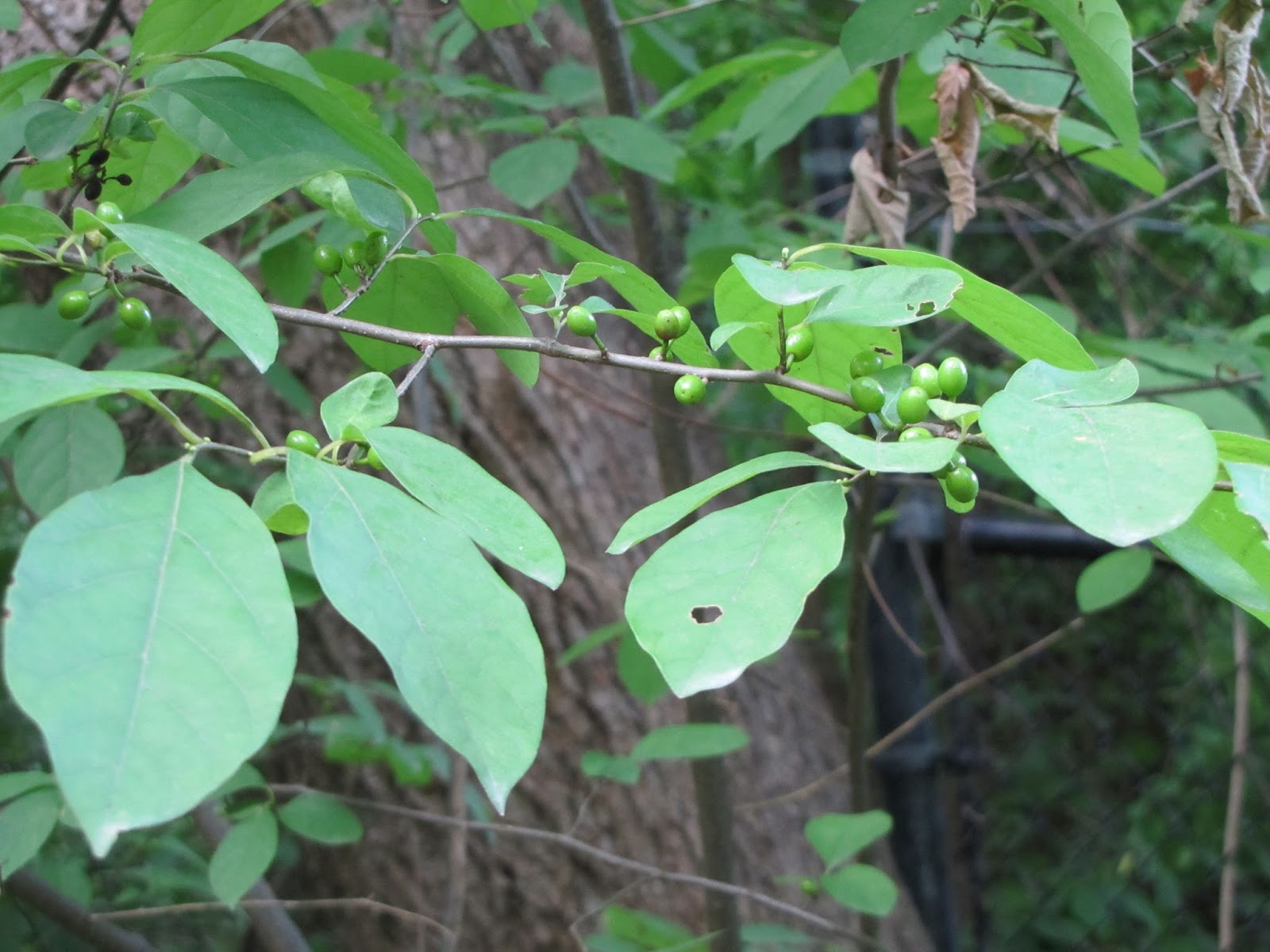
One of the many Spicebushes (Lindera benzoin) near where I work in Maryland.The ones along this trail are about six feet or so tall and wide, although they can get twice that size. Ovate leaves are alternate, and lots of oval berries sprout along the branches.


Here's a closer view of a Spicebush branch, showing the many berries. They're green right now, and turn red when ripe.


A Gift With A Bonus

This all started with a gift from my boss: a small potted Spicebush that came with a bonus: a caterpillar already in residence. My boss had bought several bushes for his yard and ended up not needing them all. Most had already been visited by breeding Spicebush Swallowtails, who depend on  spicebush as their larval host plant. Knowing that I love raising caterpillars, he offered one of the extra bushes to me.
A folded leaf containing my new Spicebush Swallowtail caterpillar. The caterpillar makes this shelter by laying silk across the leaf, so the sides will close up as the silk dries out and shrinks. Pretty crafty!


I brought the bush and caterpillar home, and over the next few weeks raised the caterpillar to a butterfly. By the time I released the adult butterfly, I was hooked on my second caterpillar species. I was having so much fun, I forgot to even take photos as the caterpillar grew up.
Gleefully releasing my first-ever Spicebush Swallowtail. The branch inside the cage is spicebush that I'd hoped would be a pupation site, but of course my caterpillar decided to adhere to one of the cage walls instead. It worked out though!


I’m currently in between generations of Black Swallowtails, so my caterpillar craving has gone unanswered for a while. It seemed like Spicebush Swallowtails might make a good supplement to the Black Swallowtails.

Now everywhere I go I’m checking spicebushes for the tell-tale leaf shelters. Spicebushes are native and grow throughout the eastern United States, so I'm seeing a lot of them anywhere I hike. I did actually find one tiny caterpillar while I was visiting my mom in Ohio a few weeks ago. (I was too excited to remember to photograph it, though!)
           

Extra Defenses

I mentioned that the caterpillars hide by rolling up in leaf shelters, which is cool enough. What’s even more amazing to me is that they only come out to eat at night. Before this summer I had no idea there were nocturnal caterpillars! While I was raising the one I got from my boss, after sunset I’d sneak into my now-dark home office and flip on the light to surprise the caterpillar and catch a glimpse of it. As I mentioned, though, I neglected to photograph the caterpillar as it changed over the days.
I peeled open the leaf shelter to photograph the caterpillar when I first received it. Surely I'm not the only one who thinks the newly forming eyespots are kind of adorable!

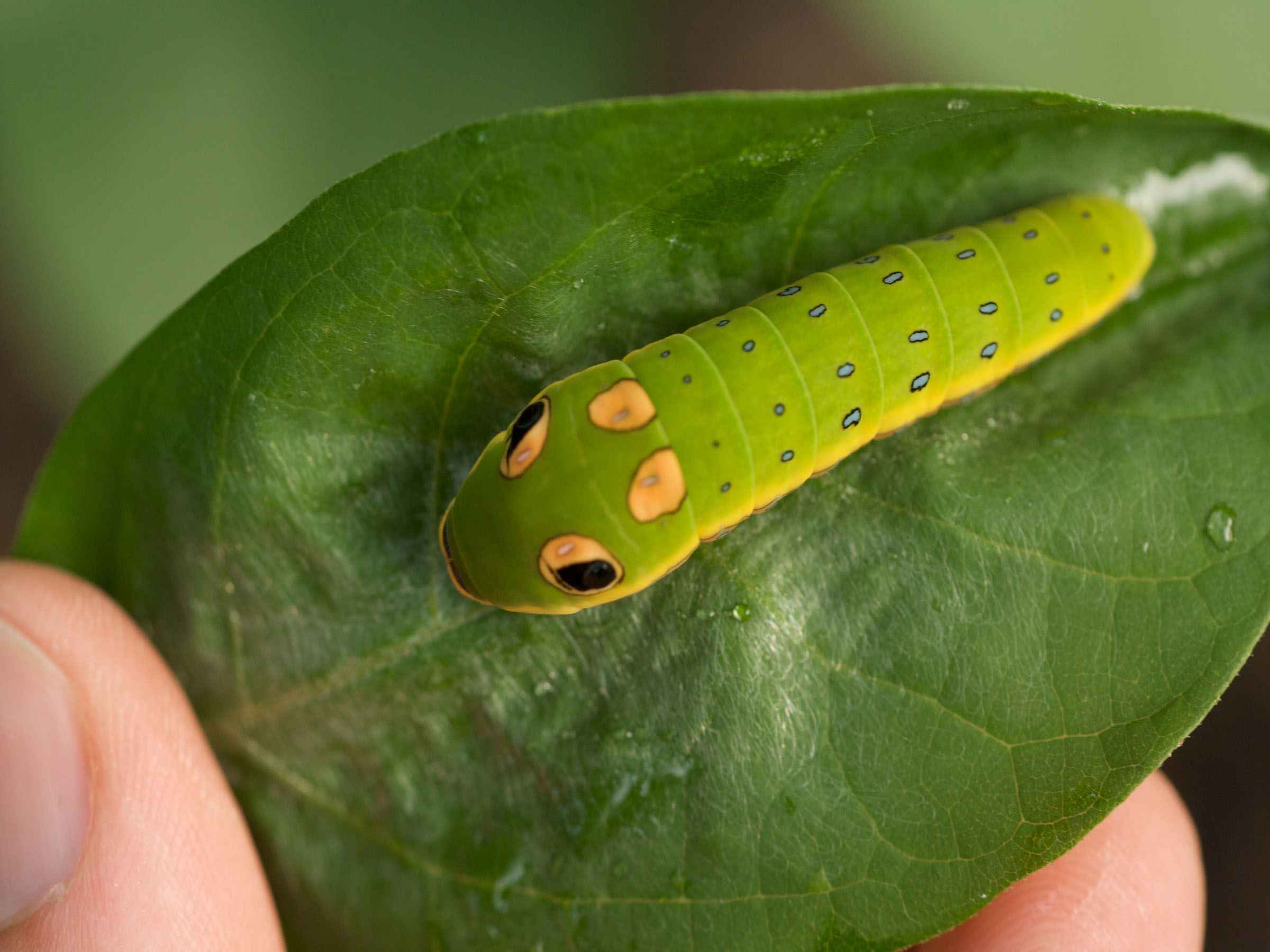
The caterpillars also have special disguises just in case they get seen: the early instars are bird-dropping mimics, like many other swallowtail species. Later instars have these really cool fake eyes that make them look like tiny fierce snakes. They hide inside their leaf shelter with their head pointing up so the snake eyes will look back at any predator smart or curious enough to peek inside the shelter. Yikes! As you see in the above image, my caterpillar was a middle instar that had both the bird poop camouflage and fake eyes starting to show, complete with false light reflection. Pretty cool.

Since I didn't photograph my caterpillar in later instars, here's one taken by Hagerty Ryan, U.S. Fish & Wildlife Service [Public Domain], via Wikimedia Commons. Those eyespots have gotten much more prominent!

I Have Hope           

So I’ve spent a lot of time over the past few weeks looking for these awesome little critters. But I haven’t found any others besides the one in Ohio. I have found many other tiny things hiding in similar leaf shelters, however: mortally offended spiders as well as a terrified tree cricket, for example. I’ve also found lots of empty leaf shelters whose caterpillars have long since moved on, and I’ve seen tons of nibbled leaves that give me hope. I’m sure not all the nibbling is done by Spicebush Swallowtail caterpillars, of course, some is also done by beetles and other hungry insects. But I have been seeing a lot of adult Spicebush Swallowtails flying around Brookside Gardens lately, nectaring on the many flowers in bloom. So there must be caterpillars eventually, right?
Adult Spicebush Swallowtail nectaring on Cardinal Flower (Lobelia) at Brookside Gardens, in Wheaton, MD.


For that matter, there must also be eggs at some point. The Spicebush Swallowtail’s eggs are usually laid on the underside of spicebush leaves, and are very pale so they blend in. Yet another piece of evidence of the sneakiness of  these canny creatures! Honestly, I don’t even bother to look for eggs on the spicebushes, they are so well camouflaged I feel like it would be hopeless unless I actually get to watch the butterfly oviposit.
Three tiny white eggs on the pale underside of Spicebush leaves. Photographed at the Wings of Fancy Live Butterfly and Caterpillar Exhibit at Brookside Gardens, Wheaton MD (see below for exhibit details). The red ribbon is added by staff to call attention to points of interest like small caterpillars and eggs. Look to the right of the ribbon to find the eggs, if you don't see them at first!


Still Searching

For now I’ll just keep looking for the hidden Spicebush Swallowtail caterpillars, and keep coming home late for dinner. It’s a good thing I’m using my slow cooker a lot this summer, I’ve already started the meal eight hours ago and I know it will be done whenever I get home.

Have you ever spotted Spicebush Swallowtail caterpillars in the wild? Leave a note in the comments if you have! If I manage to find another one I’ll remember to take a picture this time to share with you all. But even if I never find another caterpillar, I’m still enjoying the daily treasure hunt. It’s a very peaceful, mellow way to wind down after work. I hope you too have a chance to see the tiny hidden things in nature, no matter how sneakily they might be disguised.

If You Want To Visit Wings of Fancy

If you're interested in checking out the Wings of Fancy exhibit for yourself, it runs through October 25, 2015. Normally it's May through mid September, but the schedule is different this year. The exhibit is at Brookside Gardens in Wheaton, MD, and is open seven days a week from 10:00 am to 4:00 pm. Tickets are $8 per adult and $5 per child age 3-12. You can purchase your tickets at the gift shop in the Conservatory. Please keep in mind that parking may be limited at the moment; consult the Brookside Gardens web page (www.brooksidegardens.org) for any updates or for suggested parking alternatives. The street address for the Conservatory and the exhibit is 1500 Glenallan Avenue, Wheaton, MD 20902.

I personally think one of the best things about the exhibit is the Caterpillar House, where we have various larval hostplants with eggs and/or caterpillars on them, as well as a special container for chrysalises once the caterpillars get to the wandering stage. The species in the Caterpillar house change periodically, but are always North American native species. It's so cool to see the caterpillars up close, plus the display also has photos of each caterpillar species in adult form.

The Conservatory (where Wings of Fancy is located) often gets very hot in the summertime, as it's a greenhouse. But this year with the later season I'm hoping we get lots of comfortable cooler days to enjoy the exotic butterflies. I hope you get a chance to visit too!

Saturday, November 23, 2013

Recap-- I'm back!

Hi again all, it's been a long time since I had the time/energy to post. But I haven't been completely neglecting my nature explorations over the past several months. Here are a few photos and stories for you. Enjoy, and hopefully I'll get back on a regular posting track soon!

A not-very clear shot of the first ever Rose-breasted Grosbeak to visit my yard feeder, back in May. Yay! I was so excited I hauled my husband over to the window to show him. He's not as bird-crazy as I am but he politely admired the bird with me. Awww. :-)

We found this spotted turtle at Huntley Meadows, sunbathing on a moss-covered log in the woods rather far from the water. I snapped several photos of the less-than-impressed turtle, as I have only ever seen one spotted turtle before (and that was injured on the road, so hardly counts). Eventually the turtle got sick of the paparazzi, however, and scuttled off into the underbrush.

 I take a walk at lunchtime every day at Brookside Gardens, and much of the summer I watched hummingbird clearwing moths (exact species unidentified). One day in July, however, I discovered something completely new to me: that the moths actually mate while flying, and continue to fly around in tandem for quite a while! I knew dragonflies & damselflies did this, but had never realized any moths did. This was the best shot I managed to get of the mating pair-- look about a third of the way down from the center top of the image.  Pretty cool.

 Here's a clearwing moth a bit closer, since you can't make out much detail in the paired shot above. They're really fun to watch as they hover and zip around. I spent many of my lunch hours trying to get good photos of them.

 I continued raising several generations of Black Swallowtails at my house, allowing dill (their larval foodplant) to practically take over my vegetable garden. Here's a shot of a chrysalis mere hours before the butterfly ecloses. You can really see the spots and stripes on the wing through the newly transparent chrysalis shell.

 Here's the butterfly an hour or two after eclosure. Behind it you can see a more recent chrysalis that's not yet transparent (so not eclosing anytime soon) and a caterpillar that's about to pupate as well. I invested in cheesecloth butterfly cages this summer, which are much easier to use than the tupperware, paper towel, and rubber band set-up I used last summer.

 Getting ready to free a butterfly. I bring the cage outside, still zipped up, then when we're safely out of doors I open it and reach in to coax the butterfly onto my fingers. If my husband is home to share the experience with me, sometimes he photographs the occasion, like for these shots.

A closer view of the butterfly being released. This one is a female-- you can tell by the extensive blue on the hindwings. Male Black Swallowtails have more yellow there. 

Dill wasn't the only thing I grew in my garden, even if it sometimes seemed that way. I planted the zucchini on purpose, but the delicata squash and other winter squash in this picture were actually volunteers from the home-made compost I added to the soil. So was the tomato; I planted a few tomatoes on purpose but none of them did as well as the volunteers did. Go figure! The delicata squash was delicious, by the way, especially sliced and roasted with a bit of salt. I'm definitely growing some on purpose next year!


 Another photo from my lunchtime walks at Brookside Gardens. I like to take photos of interesting and/or beautiful sights and share them in the evenings with my husband. Sort of like show and tell, I guess! His grandmother is in a nursing home at the moment, and can't get outside very much let alone see anything beautiful from her window. So I also like to share my Brookside Gardens pictures and stories with her when we visit.


I'm not a very strict weeder in the garden, I tend to let a lot of plants remain that technically shouldn't be there. Violets, shown here, are very hard to eradicate once they've moved in. However, several fritillary butterflies' caterpillars eat violets, so I always keep way too many violets in the garden. I've done this for years with no evidence that it was working, but this summer I finally found the spiky little caterpillar of a Variegated Fritillary. Woo-hoo! My lackadaisical weeding has been vindicated.


 This last picture isn't exactly in the way of nature studies, but it's too funny not to share. Earlier this fall my cat, Caleb, developed some sores that he kept biting and scratching. So the vet decreed he needed to be in this e-collar for a few weeks. Boy, did Caleb hate it! He did manage to figure out how to eat, drink, sleep, and use the litterbox successfully (the fact that it was a floppy collar, not one of the hard plastic ones, helped). But he despised the experience and thoroughly resented us for putting him through it, as you can see above. Poor kitty!

So that's some of what I've been up to since my last post. I hope you enjoyed the trip through my memories! I'll try to post again soon.

Sunday, April 14, 2013

Thrills and Trills

Certain sounds just mean spring to me. The calls of newly arrived Eastern Towhees mixed with those of the last few White-throated Sparrows and Dark-eyed Juncos, for example.
Eastern Towhee enjoying a well-deserved sunflower seed in my yard

White-throated Sparrow still hanging around my yard


Dark-eyed Junco also scarfing down those sunflower seeds, still in my yard


But one of my favorite sounds, and for that matter events, of the spring is the mass courtship and mating of American Toads.  As soon as the weather warms up enough, the ponds at Brookside Gardens fill up with toads looking for love. The males make this amazing trill that's surprisingly loud. This year's breeding event took place last week. Of course I spent every lunch hour or spare minute down at the pond for the three days it lasted, enjoying the ethereal trills. Just a little of what it looked and sounded like on day two:


Here too is a photo of the masses of eggs covering the pool's bottom the day after that video.

Lots and lots of eggs... and some toads still locked in an embrace

American Toads lay eggs in long curly strands, not big clumps like frog eggs. Most of the ones you see here have been covered with fine silt kicked up during the mating frenzy. The newer ones are clear with the eggs visible as a line of tiny black dots at the center, like the strand curled around the stick to the upper left of the mating pair.

I'm sure most of the tadpoles will become food for some other creature long before they become adult toads, but it's still so fun and thrilling to watch. I'm eager to watch the development of embryos and then tadpoles over the next several weeks. Hooray for spring!

Wednesday, May 9, 2012

Winter Flowers

Well, it's been a while since my last post. For those of you who've been wondering, I'm ok, just busy. I'm still in grad school and also got a part-time job this spring. The spring semester just finished, though, so I have a bit of free time at last. Woo-hoo!

As I've mentioned in past entries, this winter was significantly milder than usual. But still, come January and February I was aching for bright flowers. Brookside Gardens to the rescue! The Winter Garden at Brookside Gardens is an outdoor bed that holds lots of super-early blooming flowers. This year apparently things bloomed a couple weeks earlier than usual, but I wasn't complaining!

Japanese flowering apricot (January 14)

Hellebore (January 14)

Witch Hazel (February 10)

Pussywillow!! (February 10)

Winter Aconite (February 10)
Admittedly, few of these early bloomers are native to our area, but sometimes any flower will do!

Today's site: Brookside Gardens, Wheaton MD.

Blogger Widget