IIt’s been raining all morning today as well as the last two days. In addition it's been cool outside, good soggy fall weather. It really makes me want to cuddle up with hot mulled cider and a small kitten to catch up on blog reading. :-) If you’re feeling the same way, here are a few of my favorite blogs you should go visit.
For gorgeous nature photos, check out Nick's Nature Pics-- A Field Naturalist's Photo Journal.
For thorough and fascinating wildflower profiles as well as tales of raising rabbits and homesteading, check out Bluetooth Hollow.
For amazing close-up photos and natural histories of bugs in the U.K., check out BugBlog.
While you're reading and admiring these fabulous blogs, why not indulge in your favorite comfort food? Here are a few of my favorite easy meals or snacks for a chilly rainy day, that actually aren't all that bad for you (bonus!)--
1. I like to microwave a mug of cider with a cinnamon stick in it, for instant mulled cider.
2. Air-popped popcorn is really good drizzled with olive oil and dusted with plenty of Cajun spice and a bit of salt.
3. Cheesy grits with a dash of hot sauce and more Cajun spice.
4. Stew that's been simmering all day in my slow cooker.
5. Fresh warm homemade bread with butter. Here's my favorite bread recipe, for the bread machine no less! Can't be much easier than that.
Stay warm, all.
Saturday, October 3, 2015

Monday, September 21, 2015
Leaf Template Craft-- with free printable!

Happy autumnal equinox, folks! Today I’m posting from the road, on my way home from a successful butterfly expedition (with side trip to Disney World) through North Carolina, South Carolina, Georgia and Florida. I’ll report on that soon, but today I have a craft to share with you.
Last year I wanted to start decorating our house for the
season's change, but without spending too much money or going to excessive trouble. For
the autumn, I decided to cut out some leaf shapes in dark reds, oranges,
yellows and browns and tape them up in our windows and on our walls. Voila,
easy seasonal decoration!
I wanted my leaves to be as accurate as possible (I do work
at a public garden, after all). So I pulled out my favorite tree guide: The
Tree Identification Book, by George W. D. Symonds. I found the pages with some of my
favorite leaves and used their images to help me cut out leaves from colored
cardstock. (I purchased cardstock from Michael’s for maybe 50 to 75 cents per
sheet.) I cut them all freehand, rather than time-consuming tracing and
transferring. That meant I had a lot of rejects, but several came out pretty
well! It felt very creative and fulfilling. What helped was folding the
cardstock in half the long way,
then cutting out the leaf so that the fold made a spine. Unfortunately, that
meant all my leaves were symmetrical, unlike real leaves. But it reduced the
complication of cutting the intricate outlines. I also cut out big and little
acorns, often out of the scraps left after cutting the leaves.

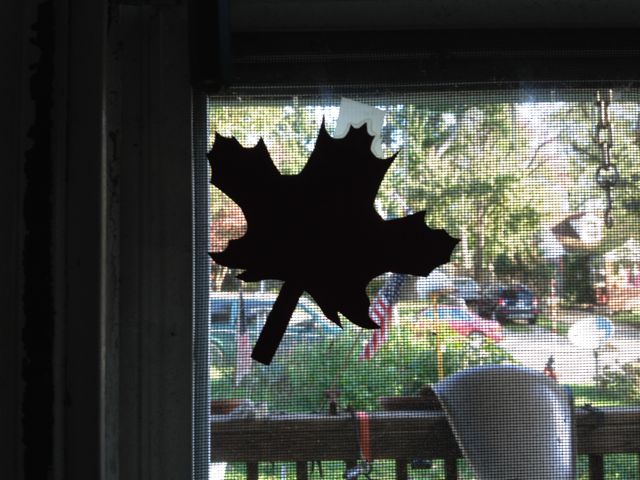

But seeing as the equinox is today, if you haven’t made
decorations yet you probably want something even less complicated than trying
to cut out a free-hand leaf. So for you, my fine procrastinating friends, I’ve
made printable outlines from my best examples, for you to use as guides. You could trace these if you
wish, or print them directly on colored paper or cardstock, or simply print out
one copy each and then use it as a template for cutting.
I labeled the individual leaves as to my best guess what
leaf I was copying. (I don’t rmember specifically at this point, and didn’t
label the leaves when I first made them.) The page with several smaller leaves
includes two different acorns, a ginkgo leaf, a red oak, a white oak, and probably
a chestnut oak. Of course leaves often vary considerably in the wild, so don’t
worry about inaccuracy when you’re cutting them out. Individuality makes them
more real!
Hope you make lovely fall decorations with these printables. I would love to see photos of your projects if you use these templates. Post
your photos in the comments. Happy autumn, everybody!


Sunday, September 20, 2015
International Rock Flipping Day-- Dry Spiders and Random Kittens

Last Sunday (September 13) was International Rock-Flipping Day. I had every intention of participating and posting my results
promptly. I led training for some new volunteers most of Saturday, then at the last minute I found out one of my colleagues
at Meadowside Nature Center was in desperate need of help at the Paw-Paw
Festival the next day. I had intended to visit the festival on my own anyway so of course I
offered to help out.
I had expected to work only a few hours and then head home
to flip some rocks as well as pack
for an upcoming trip. But as the festival got rolling I learned why my coworker
was so desperate—they were short several staff members and didn't even have all the volunteers they'd expected.
So of course I couldn’t leave the festival like that; I wanted visitors to have
a good time. Actually I had a great time, mostly helping out at the Colonial
Games booth where I taught visitors to play Graces, showed them fun toys like
Jacob’s Ladders, and generally had a fun time goofing around. I also got to help out at the Paw Paw Tasting tent, where we had two different cultivars available for tasting. Scooping out bite-size portions while wearing non-latex gloves was quite messy! Both cultivars (Shenandoah and Allegheny) were very tasty, I highly recommend them.
So I finally got around to flipping a few rocks the NEXT
day, and then we left for a week-long trip the day after that. (I’m posting this from
the road, as a matter of fact). So apologies to all the IRFD folks for my
tardiness! But here at last, exactly a week late, is my tale of rock-flipping.
It’s been extremely dry lately in Rockville, I think my rain
gauge has collected maybe a quarter-inch of rain in the last month. So I was
concerned that I’d find very few interesting critters or fungi or whatever
beneath rocks in my yard. instead, we headed to nearby Lake Frank [links to
older Lake Frank entries, e.g. Which I wrote about here and here?] to flip
rocks at the water’s edge. I hoped for more interesting critters sheltering
there, perhaps some snoozing snails or interesting arthropods.
 |
| One of the first rocks I flipped-- nobody home. |
Instead, the first few rocks I flipped were barren.
I didn’t want my first participation in IRFD to be so dull, so we moved down
the shore to try another spot closer to the actual water. Here we found three fat
worms-- one out of the soil and two barely peeking their heads out. I’m not sure if they normally live here or were escapees from a
fisherman’s bait bucket. Lake Frank is extremely popular for fishing, and we
frequently find emptied bait containers, to say nothing of discarded fishing
line and occasionally even hooks. Blech. We clean the latter two up when we
find them, of course, hoping to limit the number of wildlife that might be
injured or killed.
 |
| Three fat earthworms: one peeking out near the top of the image, one sprawling near the lower center, and the third peeking out at the bottom right corner. The fat one hastily squirmed across the beach toward better shelter, the peeking ones stayed completely still, probably hoping we wouldn't notice them. |
I wasn’t quite satisfied, however, so I tried another couple
rocks. First I found a translucent filament clinging to a rock, which at first
I hoped was fungus but turned out to simply be a piece of subaquatic
vegetation; either partway decomposed or else simply not having enough
chlorophyll due to its being covered by the rock.
 |
| Tiny translucent fragment of vegetation, pinched between my fingers here. |
The next rock, however, had
my best find: a trio of wolf spiders who were mightily displeased at my
uncovering their hiding spot. (Sorry, guys!)
 |
| One of the hunting spiders we found staying high and dry on the bottom of a rock. Sorry I couldn't get a better photo; we didn't want to disturb the spiders too much. |
We kept the rock flipped just long
enough to take a few photos, and then of course replaced it carefully as we had all
the rest. This of course is an essential part of IRFD etiquette—since you’re
disturbing somebody’s home, you ought to be diligent and careful in replacing
it just the way you found it, hopefully without squashing anybody. I got a semi-decent photo of the biggest one, and a crappy photo of the middle-size spider (which isn't even worth posting here).However, the
littlest spider scurried away before we could even snap a picture. I hope it
found its way either to a better spot (with fewer competitors maybe) or else
crept back as soon as we were gone.
My dutiful husband was getting a little impatient now, so we
decided to call it a day and continue with the second purpose to our hike:
hunting for ripe paw-paws. (I’d brought home a delicous paw-paw from the
festival on Sunday and we hoped to snag a few wild ones on our hike.) We found a few
paw-paw trees, not many, though, and none of them had any sign of fruit, ripe
or otherwise. This wasn’t terribly surprising, though—paw-paws are absolutely
delicious and are devoured by nearly every animal that lives around here:
squirrels, chipmunks, deer, foxes, raccoons, possums, birds, etc. So we were
disappointed but now realize we ought to look for paw paws earlier in the
season: maybe starting in late August instead of two weeks into September. We’ll
remember that for next year! If you ever have a chance to try a paw-paw, do!
When ripe they’re creamy-custardy, and taste a bit like a cross between a
banana and a mango. Yum! They do have many large seeds, however, so watch out
for that. It’s easiest to cut one in half, fish out the seeds, then eat the
pulp with a spoon or your fingers. Messy but delicous!
Anyway, our first try at International Rock-Flipping Day didn't turn up much appropriate wildlife (ha! see what I did there?). But we did find other interesting critters on the same trip:
 |
| We found two adorable twin boy kittens, both all black, hanging around the parking lot when we arrived. They were curious and affectionate, and clearly well fed. We think they live in one of the houses nearby, and were maybe hoping for handouts from fishermen returning to their cars. We checked back the next day just in case they'd been abandoned, but they were nowhere to be seen. We felt equal parts relieved and disappointed. They were just so cute! |
 |
| We also saw this azure butterfly flittering around our rock-flipping area. It landed on a rock; does that almost count as a participant in International Rock-Flipping Day? :-) |
So all in all we had a lot of fun, both snuggling the adorable kittens and looking for muddy denizens, even if we found hardly any of the latter. Hopefully this post is better late than never!

Wednesday, September 16, 2015
10 Easy Tips For Safe and Healthy Hiking
Last week we had a somewhat scary incident at work. It ended well, but we were lucky that it wasn't worse. Folks that should have known better made mistakes that could have severely endangered one of my colleagues.
It’s been very hot and humid, and a call came over the radio asking if we had any popsicles in the Visitor Center. I answered no, but we did have ice packs—would that help? It turned out a new employee had pushed herself too hard while stringing lights for our winter lights display, and had gotten dangerously overheated. The two senior staff working with the light crew radioed that they’d bring this employee, Susan, into the Visitor Center, and then go fetch popsicles for her from another building. Ok, fine. I figured they had the situation under control and I could go take my lunchtime walk.
It’s been very hot and humid, and a call came over the radio asking if we had any popsicles in the Visitor Center. I answered no, but we did have ice packs—would that help? It turned out a new employee had pushed herself too hard while stringing lights for our winter lights display, and had gotten dangerously overheated. The two senior staff working with the light crew radioed that they’d bring this employee, Susan, into the Visitor Center, and then go fetch popsicles for her from another building. Ok, fine. I figured they had the situation under control and I could go take my lunchtime walk.
However, when I got outside, I encountered both staff members trundling cheerfully up the
hill in their golf cart. Poor overheated Susan was nowhere to be seen. I asked
what happened to her and was told she’d been sent into the Visitor Center. Since I had come
out mere moments before I was a bit puzzled by this. It turns out they’d essentially abandoned her to walk in on her own while both of her acting supervisors fetched popsicles. Yikes. I returned to the Visitor Center to check on her whereabouts. She had indeed made it inside, but was slumped uncomfortably on a bench in the corner of our lobby. I brought her into the library to a more comfortable chair, and refilled her warm, stale water bottle with fresh cold water. I also got an ice pack for her to
hold against the back of her neck.
Eventually staff returned
with the popsicles. I helped Susan open one, and chatted with her while she ate it. Several minutes later, the cold
water, ice pack, popsicle and some salty peanuts helped to make her feel well
enough to return to work.
This all got me thinking about how if even outdoor
professionals can sometimes miss safety actions sometimes (like not realizing Susan should have been at least escorted inside, if not given a ride in the golf cart), what about the rest
of us? What if she’d been worse off than we realized and nobody had checked on
her? How should we make sure we and our hiking companions stay safe and healthy
when we’re exploring the outdoors, especially if we don’t have a lot of
experience at it?
To answer that, I came up with my top ten tips to stay safe and healthy when you’re
hiking.
 |
| If you're careful and prepared, you can find gorgeous scenes like this one while you're out hiking. |
10 Easy Tips For Safe and Healthy Hiking
1. Hike with at least one buddy, if not two or three. Everybody should pay attention to everybody else, and watch for warning signs of overexertion, heat or cold exposure, and so forth. This is especially important since one of the early signs of overexposure (to either heat or cold) is confusion. your own judgement may not be reliable if you're starting to suffer from heat exhaustion, for example. If you're hiking on your own, try to take extra precautions like carrying an extra layer in the wintertime, freezing one of your water bottles in the summer to make sure you always have cool water to drink, and so forth.
2. Make sure you have a printed map of the trail(s) you’re hiking. Also know what to do if you accidentally wander off the trail: DON’T keep heading forward in hopes that you’ll encounter another trail. Instead, you should turn around as soon as you realize you’re lost, and try to retrace your steps until you find the trail again. Even a map that’s drawn to scale can sometimes make large distances look deceptively small. Most of the time you’ll be closer to the trail behind you than the next one ahead of you.
At a Virginia State Park where I worked for several years, I once encountered a group of visitors who were upset that they had gotten lost on our property. They were a walking club who apparently were more used to city or suburban walks, rather than out in the forest. They hadn't been paying too much attention to our trail markers, accidentally veered off the trail, and then when they realized they were in the middle of nowhere, decided to keep on wandering rather than turning around. So of course it took them more than 45 minutes to come out of the forest onto one of our roads. Don't let that happen to you!
3. Carry a cell phone with you for calling for help, but also have a whistle in case you have no signal on the trail. If you do need to call for help and have barely one bar, know that text messages are easier to get through on low signal than actual voice calls are. Anyway, don’t depend on your cell phone for the trail map or for calling for help. Battery life is inevitably limited, even if you do have signal. If you're lost and need help, a universal signal for help is three blasts on your whistle. You’ll probably be able to blow the whistle longer than you would be able to holler for help.
4. Carry water with you—probably more than you think will be necessary, especially in summer.
I recently went on an amazing guided hike to find butterflies, and definitely didn't have enough water with me. I'd packed my usual single bottle, not taking into account that it was extra hot outside, plus the trail was almost completely in the open, with no cooling shade anywhere to be found. I ran out of water before we even reached the halfway point of the hike! I was lucky that the rest of the hike was merely uncomfortable, it could have been worse. I can tell you for sure I've never been more grateful for warm water than when I got back to my car, to drink the emergency bottle of water I keep there. It had warmed in the sun, of course, but I was so thirsty I really didn't care.
5. Make sure you have at least a few basic First Aid supplies, such as bandaids, some ibuprofen/aspirin/etc., whatever you think would be helpful for you and your companions. In my experience, bandaids are often one of the most important items to bring when you're going hiking. They can mean the difference between a mild "hot spot" on your heel, and a nasty blister or sore that is so painful and uncomfortable, you lose all enjoyment of the hike.
6. Be aware of when it will get dark, and calculate how much time you have to hike accordingly. Unless you plan on night hiking, don’t start a trail that will take you three hours when there’s barely one hour of daylight left.
7. Also be sensible about the weather: not just what it's like when you leave your house, but what it's expected to be at your hiking location for the next several hours as well.
I’m not saying don’t hike at all when it’s raining; in fact rainy hikes can be pretty interesting as long as you are wearing a good raincoat and waterproof boots. But if there’s thunder and lightning, you really shouldn’t start a long hike until the storm is well past. It’s just not worth the risk of lightning striking you or a nearby tree.
If there are really high winds when you want to hike, it’s more of a judgement call. Some locations with lots of dead or dying trees, loose branches, etc. would be too dangerous to hike if the winds are above 40 mph or so. Not only might you get struck by a falling tree, but the trail could be blocked by a fallen tree making it difficult to get back safely or easily. Other locations, however, would be uncomfortable but not too dangerous, like hiking along the ocean or through a large field. Here's a post from a few years ago about hiking after a hurricane, when I found the trail completely blocked by a large fallen tree.
If it’s very hot or cold out, wear appropriate clothing! Also see the next tip for things to keep in mind as you hike. At the same Virginia State Park where I used to work, I once encountered an entire field trip of high school students who had all dressed for warm classroom conditions, rather than the cool breezy spring day it was outside. They were freezing in the breeze off the water, and later when a (totally expected) rainstorm blew up, they were all unprepared. Not one had brought a jacket or even a sweatshirt. Poor things, they were miserable and missed out on a lot of the fun activities we had planned for them. Don't let this happen to you!
8. Know danger signs to watch for in your hiking companions.
In the summertime, know what the early signs of heat exhaustion, heatstroke, and dehydration look like.These include
- Dizziness
- Confusion
- Nausea
- Weakness
- Fatigue
In the wintertime, know what the early signs of overexposure, frostbite, and so forth look like as well. These include:
- Shivering
- Numb hands and fingers
- Confusion
- Clumsiness or unsteadiness
- Slurred speech
9. Make
sure you take breaks now and then! It might even be better to get back a little
after dark than to push on so desperately without resting that exhaustion
causes disorientation and clumsiness for the last part of your hike. Please
don’t overexert yourself or your companions. Even if you’re hiking for exercise
and fitness, it’s not worth getting sick like my coworker above, or so
overtired you make a stupid mistake.
A bonus of an occasional stop is you experience more of your lovely surroundings than you might while charging down the trail. That tiny scarlet leaf fluttering down, or the quiet chirping of bird in the trees above you, are things you might not notice until you stop for a few minutes to breathe.
A bonus of an occasional stop is you experience more of your lovely surroundings than you might while charging down the trail. That tiny scarlet leaf fluttering down, or the quiet chirping of bird in the trees above you, are things you might not notice until you stop for a few minutes to breathe.
10. Finally, beware of what pilots call Get-there-itis: I have to get somewhere so I’m going to go regardless of how many warning signs I’m seeing. For our purposes, this translates to “I came here to hike, I’m going to hike no matter how much of a bad idea it is to go out right here, right now.” Be flexible with your plans if you’re faced with the unexpected.
 |
| Be prepared to be flexible if trail conditions or weather conditions aren't what you expected! |
Obviously some of these tips will be more important for you than others depending on the age, experience level, and fitness level of you and your companions. They’re all worth reviewing and keeping in mind, however, no matter how expert you may be. I also think many first aid tips and techniques are worth reviewing periodically, such as heat-related issues at the beginning of spring and summer, then cold-related issues at the beginning of fall and winter.
As long as you are able to stay reasonably safe, I hope you
have fun exploring nature! I know
for me, spending time outside is refreshing and helps restore my happiness
potential. More and more these days I’m feeling that we have a large hand in
creating our own happiness, so spending more time outside can really help that. Although there can be danger out there on the trail, especially if you're careless, it’s just so easy to behave
safely and sensibly. Keep these ten tips in mind and you won't have a small thing like weather or
lack of water turn an otherwise pleasant day into a disaster.
So are you planning to go hiking this season? How do you make sure you and your companions stay safe and healthy along the trail?
So are you planning to go hiking this season? How do you make sure you and your companions stay safe and healthy along the trail?
Wednesday, September 9, 2015
What Happened When I Pushed Myself Beyond My Comfort Zone
"Do one thing every day that scares you."
--Eleanor Roosevelt
This year I’ve been pushing myself to do things that are
outside my comfort zone, much more than usual. Having the Butterfly Big Year as an overall goal has really
helped to motivate me, at least in terms of going places that I might otherwise
have rationalized away as too far, too inconvienient, etc. Each time I try something that scares me, and I succeed in enjoying myself anyway, helps me the next time too.
Last weekend I drove an hour each way to get to Soldier’sDelight N.E.A., a park with a unique serpentine barren ecosystem that isn’t found elsewhere in
Maryland. I’d heard good things about Soldier’s Delight from other friends but
hadn’t yet visited it myself. The real motivating factor this time was that
there would be a guided butterfly hike. The chance to go butterfliying with
folks much more experienced than I was something I couldn’t pass up. I’ve been
struggling this year with conclusively identifying some skippers; if I couldn’t
be sure what I saw in terms of species, I wasn’t letting myself add it to my
Big Year list. So I hoped in addition to seeing some of the endemic
specialties, maybe I would see some of the more cryptic species that would be conclusively
identified for us by the expert. Yeah!
We started off in the Visitor Center to view a quick
slideshow of many local butterflies. I was disappointed to learn that some of
my target species are in flight only early to midsummer, and would not be found
on this late summer/early fall day. Oh well, I should pay more attention to the
broods and flight seasons given in my field guide next time. For example,
“Flies in early spring or summer, one brood” means I better find it by July at the latest, or else give up on that species for the year. If I do another Big Year next
year I’ll definitely be more strategic in planning forays. After the slideshow
we hit the trail.
 |
| Heading down the scrubby trail; this is probably the most shade we had all afternoon. |
The day was brutally hot and humid, more like an August day
than early September. My one water bottle was not nearly enough; in the future
I think I’ll update my normal pack contents to include two water bottles on hot
summer days rather than my usual one. The pack I use has compartments for two
bottles; usually I use one of those compartments to hold small items like a
magnifying class, my binoculars cleaner, and a small flashlight. But in order
to be safe and healthy on the trail I really ought to have more water with me
in the summertime. At least the recent heat and lack of rain meant there were few
if any mosquitoes, so that was a small blessing.
Many of the other attendees were avid butterflyers and
naturalists; it was fun to meet them. We also had some beginners along, so a good mix of folks. The experienced folks mostly had high-end cameras with
lenses that seemed to go on forever. My little point-and-shoot seemed pretty piddly in
comparison! They got some pretty awesome photos of many of the specialty
species we saw, while I got only one or two clear shots. It takes me much
longer to get my camera in focus on the tiny butterfly, and I didn’t want to
fall too far behind. My priority was to experience and explore the ecosystem with a guide,
so I didn’t let myself fall too far behind just for a better photo. Another trip I might spend longer
trying to get decent shots.
 |
| Leonard's Skipper on Liatris-- this butterfly is ONLY seen in late summer/early fall. Very cool! |
We saw several great butterflies, including three that are
new for my Big Year List. Yay! The Leonard Skipper pictured above was most
attendees' goal for this trip. We saw several of them, including a mated pair, very
cool! I added Crossline Skipper and Dun Skipper to my year list as well, both
very plain, cryptic species. I’ve wondered before if I saw Crossline Skipper
but couldn’t be sure without another verification. It was great to have other
observers to help ID and corroborate. We also saw Swarthy Skipper, which I saw
while visiting my mom in Ohio. Mom and I found Swarthy Skippers at
Battelle-Darby Creek Metro Park, which showcases the mid-western prairie
ecosystem. So I found it interesting that it was also here in this relict
prairie ecosystem in Maryland. It’s been very dry here in Maryland, so the wildflowers
weren’t quite as lush as they might have been. We did see stubborn plants like
liatris, boneset, and others that could get by without too much nutrients
anyway, as they needed to be able to grow in the shallow soils native to that
area.
I learned from the slideshow that some of the early spring
butterflies I missed this year are common at Soldier’s Delight at the right
time of year. I am definitely coming back next spring, whether I do a Big Year
or not. I’ve never seen Falcate Orangetip in the wild, and its larval host is
common enough in the right area of Soldier’s Delight that I should finally be
able to check that off my life list. Woo-hoo! So even though it’s an hour away
from my house, I’ll definitely be making multiple trips back next year. I can’t
wait to see it in the spring.
Have you been exploring any areas that are new to you this
summer, or otherwise getting out of your comfort zone? I hope you’re pushing
yourself to grow and expand your experiences. It’s worth the initial anxiety. I
wish I could say it gets easier each time; it hasn’t gotten much easier for me.
But the more I do it, the harder I’m willing to push myself the next time to
get over that mountain of uncertainty.
Maybe that’s what people mean when they say it gets easier.
Thursday, September 3, 2015
Seen at Brookside Gardens
It's been kind of a rough week, so I don't have any pithy insight for you all today. Just pretty eye candy from my recent lunchtime walks. Hope you enjoy! I'll be back on Monday with, I hope, something a little more meaningful.
Hope you all can get outside and explore! There's a lot to be seen if you just take a minute to look around.
This post linked up with Saturday's Critters #93--
 |
| A color-coordinated butterfly that landed on my ankle at Wings of Fancy yesterday. I walk through the exhibit daily to check on our volunteers, since I'm the assistant volunteer coordinator. Life is so hard! :-) I'll have to find out what species this is. |
 |
| Female praying mantis with a deformed leg. She didn't seem to have any difficulty moving around, although here she's just waiting hopefully for a tasty fly or moth to land on the wood aster flowers. |
 |
| Cute little Gray Hairstreak on some fuzzy Ageratum, or Mistflower. |
 |
| Twelve-spot skimmer I found cruising around the stream at Brookside Gardens. |
 |
| More creepy than pretty, massive quantities of Milkweed Tussock Moth caterpillars had overrun this common milkweed. Yeesh, they're like a little fuzzy army. |
 | |
| A pretty pink moth on a lovely coreopsis. Hopefully that makes up for the invading caterpillars, above. |
 |
| Check out the aphid on the side of this monarch caterpillar! I presume it was only incidentally riding on the caterpillar, rather than actually hoping to get any food substance from the caterpillar itself. You can see lots more of the aphids elsewhere in this shot. |
This post linked up with Saturday's Critters #93--
Monday, August 31, 2015
9 Plants That Will Add Fireworks To Your Fall Butterfly Garden
 |
| An American Lady enjoying the nectar of a Liatris flower. |
Fall can sometimes be a disheartening season. The days are growing shorter, evenings darker, and the summer's bounty is drying up. But there are still a whole lot of insects busy at work out there, Monarch butterflies and honeybees being two of the most charismatic and well-known. If you're gardening specifically to support pollinators like these, you should think about adding fall-blooming plants to your garden. Here are nine of my favorite plants and plant groups for fall blooms in the butterfly garden:
1. Joe Pye Weed (Eupatorium species). A very tall plant stretching 5 to 7 feet high, the reddish-pink fuzzy blooms are often covered with Tiger Swallowtails and other butterflies.
I also grow native Boneset (Eupatorium perfoliatum) in my garden, but find that its white flowers are not as popular with butterflies as the pink flowers are. Many kinds of bees do love the Boneset flowers, though. Be warned, Boneset is a pretty aggressive reseeder in my experience. I pull seedlings out of the driveway, the lawn, and my vegetable garden every year. My Joe Pye Weed isn't very good at reseeding, on the other hand.
 |
| Joe Pye Weed at Brookside Gardens, with several skippers and a bumble bee |
2. Ironweed (Vernonia species). I love the vibrant purple of Ironweed flowers! Like Eupatorium, they look like fuzzy little clusters. I'd say they are less popular with my pollinators on a pure total insects basis, but probably on a ratio of pollinators per square inch they're pretty close.
To be honest, I'm not sure whether I'm growing New York Ironweed (Vernonia novaboracensis) or Tall Ironweed (Vernonia gigantea), or even another species, since I got them at a plant swap a few years ago, where they were labeled simply "Ironweed."
Vernonia, like Eupatorium, is very tall, so I grow both against a fence between my yard and my neighbor's yard. The contrast of the purple with a butter-yellow Eastern Tiger Swallowtail or orange Monarch Butterfly is really something. For that matter, they'd look pretty sharp in a bouquet with the next two flowers.
 |
| Ironweed with a Peck's Skipper, a Tawny-Edged Skipper, and a honeybee |
3. Goldenrod-- Solidago genus. There are tons of different goldenrod species. Some have flat-topped clusters of flowers, while others are like wands or fans. Some grow very tall while others stay fairly short. All of course have the classic tiny yellow individual flowers that are so popular with bees and butterflies. This is another plant that has been a vigorous spreader in my garden.
Different species of goldenrod seem to have very different bloom times; some varieties I see at Brookside Gardens are already in bloom, while my plants are still budding up. So the earlier varieties could help to feed the last local generation of Monarch butterflies in my area, while the later ones can help migrators as they pass through the area in a couple weeks or so.
 |
| Bees also love goldenrod, as evidenced by the bulging pollen basket of this bumblebee! |
4. The state flower of Maryland, Black-Eyed Susan (Rudbeckia hirta), is another great flower for your late summer and early fall pollinators. There are actually several different varieties of Rudbeckia, and it seems like more are developed each year by plant breeders. I would use any one in order to add a cheerful pop of yellow to the butterfly bed, and do in fact grow at least two or three varieties. Goldfinches love the seeds of these if you allow the flowers to ripen, so you'll also have the bright yellow flashes darting through your garden to add to the flowers' own beauty in that case.
 |
| Black-eyed Susan with a hungry Pearl Crescent |
5. Several native Asters are good additions to a late-season pollinator garden. New England Asters (Aster novae-angliae) are covered with purple daisy-like flowers. New York Asters (Aster novi-belgii) has flowers that range from purple to pink to white. Both of these asters are very popular with bees and butterflies.
 | |
| New England Aster with bee |
6. I used to think that Liatris were native only to the Midwest, but it turns out there are several species that are native to the midAtlantic. Dense Blazingstar (Liatris spicata) and Rough Blazingstar (Liatris aspera) both bloom in late August through at least September. During my recent visit to Meadowside Nature Center in Rockville, MD, Liatris flowers were highly popular with skippers as well as bees of many types. Both species grow medium-tall stalks of pinkish to purplish flowers. They're nowhere near as tall as the Joe Pye Weed or Ironweed, though, so they might be a nice counterpoint in your pollinator garden. (I did not note the exact species of the Liatris I used for this post's lead photo, but clearly it was satisfactory to the American Lady butterfly!)
 |
| Dense Blazingstar with skipper |
7. Woodland Sunflower (Helianthus strumosis) is just as popular with songbirds as it is with pollinators. It's another fairly tall plant, holding clusters of bright yellow flowers up to six feet off the ground. Sunflowers are one of my all-time favorite flower groups: the cheery yellow always puts a smile on my face. Plus it turns out they are particularly important for many of our native bee species and other pollinators, according to the Xerxes Society.
 |
| I couldn't find a Woodland Sunflower to photograph, but this Syrphid Fly sure thinks this similar looking flower is a great source of nectar anyway! |
8. Cardinal Flower (Lobelia cardinalis) Until now, you might have wondered at my purple and yellow color theme so far. Cardinal Flower, however, is a vivid scarlet and is beloved by hummingbirds as well as many bees and butterflies. I often see Spicebush Swallowtail nectaring on the Cardinal Flowers at Brookside Gardens, like the one below. Unfortunately, Cardinal Flower seems to be not as vigorous a plant as some of the others on my list. The Prairie Nursery seed catalog warns, "Short-lived, it may require replanting every few years, but is well worth the effort." I did indeed experience this: the Cardinal Flower I planted lasted maybe two or three years before disappearing. If you don't have any red blooms in your late-summer garden it might be worth adding this to your garden, to help support migrating hummingbirds as they pass through your yard, as well as to round out your color scheme.
 |
| Spicebush Swallowtail on Cardinal Flower |
9. Asclepias or Milkweed species are nearly mandatory for any pollinator garden plant list, in my opinion. There are so many to choose from, regardless of where in the US you live. Although their flowers are probably going to wind down near the end of August, I think they still merit a mention here as they will certainly attract Monarch butterflies, a fireworks-like species if there ever was one! You may still have breeding Monarchs in your area in August and September, as I often do, so if you hope to attract them for the food you might as well get them to stay for their larval host plant. Then when their offspring are ready to migrate, or when the migrating monarchs from further north come through your area, they will certainly be glad of the late-season buffet you are providing with the above list of plants.
 |
| This Monarch caterpillar is so plump, I think it must surely be close to pupation! This late in the season, it might be destined to be a migrating butterfly and will soon be on its way to Mexico. |
Did I leave out any of your favorite fall flowers? Let me know in the comments.
Catalogs I consulted for this entry:
- Wildseed Farms Sells most if not all of the plants listed here. Their FAQ also has lots of good information about planting and maintaining wildflower gardens.
- Prairie Nursery's American Natives This is a wholesale site, but it does have a lot of good plants and information. You could probably use this as a reference and then look for individual or local retailers who carry their plants and seeds.
- Brookside Gardens, in Wheaton, MD.
- Meadowside Nature Center, in Rockville, MD.
Subscribe to:
Posts (Atom)