Monday, July 30, 2018

Many, Many Mergansers!


By now, you've probably seen Brent Cizek's viral photo of a hen Common Merganser leading a long train of about 50 fuzzy little babies. (If not, check it out at his photography website, plus his followup visit a couple weeks later, when the group had grown to 76 ducklings. He found the incredible family in Minnesota's Lake Bemidji.

Why was the group so big? This isn't a case of an insanely large nest. Rather, most of the babies probably had different mothers. Common Mergansers often merge multiple hens' broods under the care of one hen-- although not usually quite so many babies at the same time! The new group of babies is called a creche.

It's even possible the hen in Cizek's photo might not actually be the mother of any of the ducklings, but rather their grandmother. Now that's one busy grandma! Baby mergansers can feed themselves as soon as they hatch, so at least she doesn't have to provide food for all her fluffy little followers.

large group of young Common Mergansers on a river reflecting the sunset.
Turns out Common Mergansers on the C & O Canal form creches too!
And remember the merganser family I wrote about back in May? Victor and I saw a large merganser creche reminiscent of Cizek's, when we took a sunset stroll at the C & O Canal a month after our first sighting. These mergansers looked to be about half-grown-- older than the fuzzballs Cizek photographed, but still clustering together as ducklings will. We counted at least forty individuals, which seems to be a large but not atypical group for Common Merganser creches. Presumably some of them were the seven little fluffballs we saw a month before.

I'm really glad to see further evidence of a healthy breeding population in our area. Although most field guides list the Common Merganser as only a winter resident in the MidAtlantic area, the Maryland Biodiversity Project states that they're increasing along the Potomac as a breeder. Cool!

Large group of Common Mergansers swimming to the left on a river reflecting the sunset
Should we go this way?


The group of Mergansers now swimming to the right in a tight cluster
No, wait, maybe over here.


The group of mergansers swimming to the right, some still in a tight cluster but the back of the group getting strung out in a line.
Yep, this looks like a good direction.


Friday, July 27, 2018

Surprise Moth Survival


Happy National Moth Week, all. To celebrate, I thought I'd share my experience raising a Promethea Moth, and how it seemingly came back from the dead.

Last summer I tried my hand at raising some moth caterpillars in addition to my usual Black Swallowtail butterflies. I have several spicebushes (Lindera benzoin) in my yard, and there’s more in the park down the street. So when I found this cluster of stripey caterpillars on the underside of a spicebush leaf, I was very intrigued!

Three yellow-and-black striped caterpillars cluster together on the vein of a leaf
The young caterpillars feed together early in their development, when they're striped like this.


Later the caterpillars changed their appearance and behavior. Rather than stripes, they now had black and yellow knobs on them, and no longer clustered together. Apparently this is common for this species: my guidebook says that Promethea Moths are gregarious when young, then wander off solo as they get older.

Three fat caterpillars on leaves, one leaf showing chew marks. The caterpillars are pale green with black and yellow bumps.
They also eat a lot of spicebush in order to grow so big and fat!


Only one of the three caterpillars made it all the way to cocoon; I’m not sure why. In fact, I only had two butterfly chrysalids to overwinter as well, one Spicebush Swallowtail and one Black Swallowtail. To be honest, I can’t remember why, although since I did finish up my Masters degree last fall I might have been too busy to check the garden as often as I usually do! 

Anyway, fast forward to this spring. In April, when the nights here are generally above freezing (usually about 40) but the days are starting to warm up, I put any overwintering chrysalids outside (I described this HERE). I put all three of my pupae in a single cage and hung it on our front porch. I thought I had it well secured, but my set-up couldn’t withstand the insane winds that came with a week of storms in May. (Neither could our roof, but that’s another story.)

I didn’t realize the cage was gone right away, but toward the end of the week I suddenly noticed it was missing. It took us a few days of searching before we finally found it next door, in a deep puddle in our neighbor’s yard. The cage was nearly flattened as well. When I opened the cage to see if anything was salvageable, I found two soggy, lifeless butterflies. They must have eclosed shortly after the cage blew away, but of course were trapped inside with no way to get food. Poor things. The moth cocoon still seemed intact, even if it too was soaking wet. I put it in a clean, dry cage and set that in my office, hoping just maybe the pupa was still alive.

I kept checking the cage every few days, but there were no signs of life for almost two months. I had just about decided that the pupa must have drowned after all. But then while tidying my office, I accidentally bumped the cage. Suddenly a large, very agitated moth was flying around inside! I had given up too soon on my pupa, but luckily hadn’t gotten around to putting it outside for decomposers to pick over. For once, procrastination comes to the rescue!

Anyway, I shouted for Victor to grab the camera, and we went outside to free the moth. After a brief exploration of my leg, the moth decided to perch on an antique bike that hangs on our front porch. Although its camouflage wasn’t as effective here as it would have been on a tree branch, the moth stayed there peacefully for several hours through the heat of the day. It wasn’t until mid-afternoon that it took off, when I inadvertently disturbed it by whistling for one of our cats. (I wonder if whistling normally bothers moths? Interesting.)

Large dark brown moth with pale yellow edges on my shorts-clad leg
"Hmm, not quite right for my first day out."

Large moth perches on the wheel of a bicycle hanging from the porch ceiling
"Ahh... that's better."

A furry, fat-bodied moth with large feathery antennae clings to a bicycle tire
Check out those fantastic antennae! Gorgeous.


Large brown moth hangs on a bicycle tire. The moth's wings are dark brown with pale creamy markings on the edge and a brown eyespot on the upper wing.
I'm pretty sure my moth was a male. Males are dark brown, with markings along the edge of their wings, where females are reddish with markings on their entire wings, as shown & described here and here.


I last saw the moth flying up over my house, toward the canopy of an oak tree that grows in between our house & the next house. An oak tree is a much better place for a moth to spend the rest of the daylight, anyway. I hope it did well! Silkmoths like the Promethea don't live terribly long in adult form. In fact they don't even have mouthparts, since they don't eat anymore once metamorphosing! No wonder they are such little pigs as larvae. Should my moth find a mate, of course, the spicebushes are ready and waiting to feed plenty of caterpillars. I'll certainly update here if I get a second generation.

So even though I failed to overwinter butterflies this year, I succeeded with my very first moth attempt! Pretty cool. Hope you had a good National Moth Week too!

Thursday, June 28, 2018

Are You My Mother? (merganser edition)


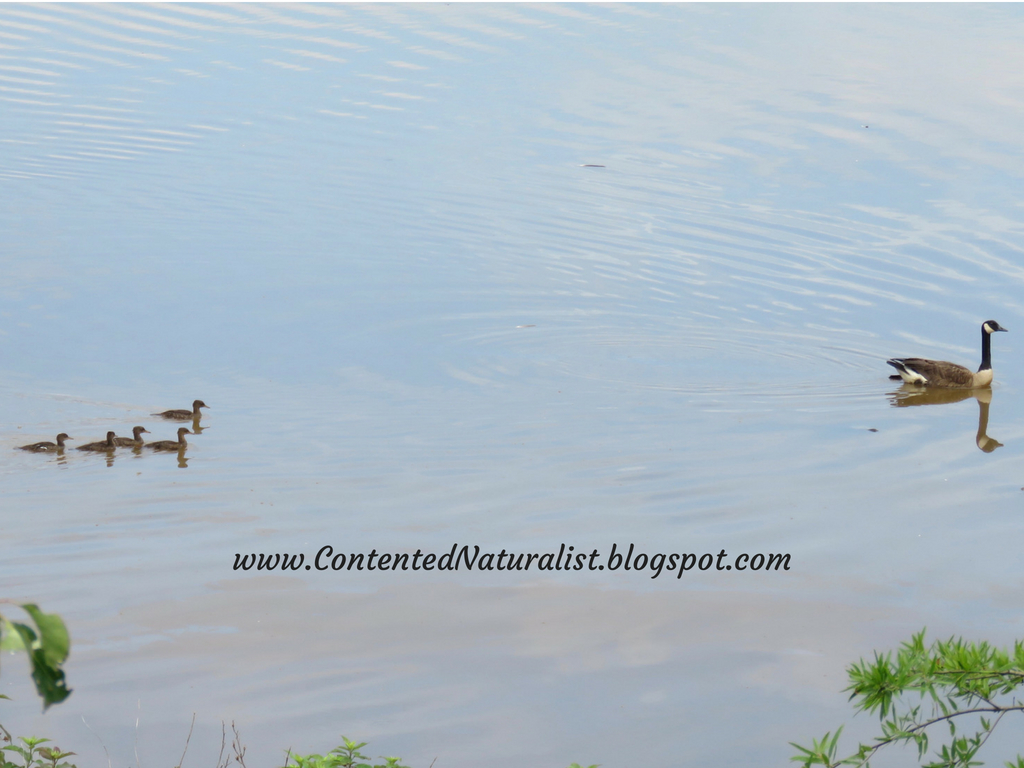
On a recent trip to Huntley Meadows, Victor & I got to see something that not only checked off one of my target species, but was somewhat puzzling. We were on the boardwalk lookout tower when I spotted a Canada Goose swimming along with a group of smaller birds trailing it. “Oh look, goslings!” I said, before I got a good look at the birds. In fact, it was a group of Hooded Mergansers following the goose as if they thought they were indeed goslings themselves. How funny!

Huntley Meadows is an unusual breeding spot for Hooded Mergansers, who normally breed much further north. They've been here for several years now, though, and seem pretty settled in.

I initially thought the appearance of family relations must have been only coincidental, something I imagined or added to the scene without a real basis in actuality. But when I was looking for more information on the algal bloom we also observed there (link here), I found photos of a Canada Goose apparently acting as nanny to a family of Hooded Mergansers both this year and last year, posted on the Huntley Meadows Community Facebook group.

My ornithologist friends suggested a few theories for what’s going on. Hooded mergansers are known for brood parasitism, where the mother bird lays her eggs in someone else’s nest, leaving that nest’s mom to raise her chicks. However, the difference in size between mergansers and Canada Geese makes this seem somewhat unlikely. When I looked closer at my photographs I also realized that the mother merganser was accompanying the juveniles and the Canada Goose, so she didn’t totally abandon her clutch. Another possibility is that the mergansers somehow imprinted on the Canada Goose. This is my favorite so far. I wonder even if the mama merganser herself imprinted on the Canada Goose, when she was young, and now has taught her own babies to do the same.

The mother is at the back of the group in this shot, slightly larger than the juveniles.
Either way, however, I still wonder what the Canada Goose thinks about it! What do you think might have led to this odd partnership? Feel free to suggest more theories in the comments.

Sunday, May 20, 2018

Merganser Mama

Update: We went back to the C & O Canal a month later, and found a huge group of about 40 half-grown Common Mergansers, probably including the ducklings from this family. So of course, I wrote about them again.
  
Victor & I went hiking along the C & O Canal recently. My main intent had been to snag a bunch more new bird species for my year list, since spring migration is in full swing. I was indeed successful-- warblers and other songbirds were singing everywhere. I can't identify every one by call, but I was able to recognize several, and managed to confirm a few others I wasn't sure about by using the Merlin app from Cornell Lab of Ornithology. (This is a great field app, I highly recommend it! I have a post in the works about how I use it, so stay tuned.)

But in addition to the Indigo Buntings, Blackpoll Warblers, Yellow Warblers, Red-eyed Vireos, and Yellow-billed Cuckoos that I logged on eBird that morning, I finally was able to check off a longtime birding bucket list item: seeing a Merganser carrying her babies on her back! I knew mergansers do this sometimes, as do loons and grebes, but I'd never observed it in the wild. Now I have!

When we first entered the trail at Seneca Creek, Victor immediately pointed out a female Common Merganser paddling toward the Potomac. I trained my binoculars on her and discovered she was trailed by several little babies! In fact, one of those babies had already climbed on her back for a break. Victor & I took turns snapping lots and lots of photos as she hustled toward the larger body of water.  As she swam along, more and more of her babies clambered on her back. SO CUTE! Even though I also saw my first ever Magnolia Warbler that morning, the mergansers were still the highlight of the trip.


Not all of our photos came out-- it was pretty humid and misty out, and that gave the camera a bit of difficulty focusing, I think.  But here are a few of the better ones. Enjoy!

Female Common Merganser swims along with one spotted duckling on her back and six more paddling behind.
One baby is riding comfy on the middle of mama's back. Everybody else is hustling to keep up.

Female Common Merganser swims along, with three fuzzy ducklings riding on her back and four paddling behind.
Now three babies have made it onboard.


Female Common Merganser swims on still, gray water, with four fuzzy ducklings riding on her back and three more behind.
Four babies are on her back at this point, with a couple still paddling madly along.

Female Common Merganser swims away into the mist, with seven fuzzy ducklings riding cozily on her back.
Finally, all seven babies are tucked up on top of Mama.  So off she goes into the Potomac. Farewell!

Monday, May 7, 2018

Butterflies by Group—Recognizing in the Field


There are some tips and tricks to identifying butterflies in the field, as I mentioned in my last post, "Butterflies for Beginners." Another good way to improve your butterflying skills is to learn the general characteristics of different types of butterfly. Once you've narrowed a new butterfly's ID to a basic group, finding the right species account in your field guide will be much quicker and easier. 

Spicebush Swallowtail

  • Swallowtails
    • Large, strong fliers
    • Rounded “tails” off hindwings


Cabbage White
  • Whites & Sulphurs
    • Medium size
    • Often fly erratically
    • Usually perch with their wings closed, showing the pattern on their underwings
    • Species in our area [MidAtlantic] usually have a few darker markings on a whitish/yellowish/orange background.


Juniper Hairstreak


  • Hairstreaks
    • Small
    • Erratic flight
    • Most species have thin hairlike “tails” off their hindwings, thought to be false antenna to trick predators
    • Often rub their hindwings together while perched, making those tails wiggle like antenna
    • Elfins
      • Univoltine (single-brooded)
      • Only flight is in early spring, roughly April
      • Tailless
      • Patterned in all browns
      • Not quite as fast fliers as other hairstreaks

Eastern Tailed-Blue

  • Blues & Azures
    • Small
    • Whitish/gray underwings, blue/gray/white upperwings
    • Beware the Eastern Tailed-blue, which has tails like a hairstreak—even rubs its hindwings together just like hairstreaks do.

Great Spangled Fritillary

  • Fritillaries
    • Medium to large
    • Patterned in oranges & browns
    • Most of our fritillaries have obvious silver spots on their underwing, except for the Variegated Fritillary.


  • Crescents—only one species in our area, Pearl Crescent
    • Small
    • Orange & black

  • Checkerspots—only 2 species in our area, Silvery Checkerspot and Baltimore Checkerspot (rare)
    • Medium
    • Orange & black

  • Anglewings
    • I highlighted our two local species, Eastern Comma & Questionmark, in a “Tricky ID” blog post for my butterfly survey project.
    • Distinctive shape
    • Upperwing orange with black markings
    • Underwing dead leaf mimic
    • Silver mark on underside of hind wing- shape determines E. Comma or Q. Mark
    • Fond of non-nectar food sources, but may also be seen at flowers

American Lady
  • Distinctive Brushfoots
    • Brushfoot—front pair of legs reduced in size and covered with hairs, often doesn’t touch perch
    • Brushfooted butterflies also include Fritillaries, Crescents, Checkerspots, Anglewings. “Distinctive” don’t fit with the other categorizations though, so best to look at the silhouettes in your field guide and familiarize yourself with species photos.
      • Mourning Cloak
      • Red Admiral
      • Painted Lady
      • American Lady
      • Common Buckeye
      • Red-spotted Purple
      • Viceroy
      • Monarch

  • Satyrs
    • Medium size
    • Brown, with eyespots
    • Often have very bouncy flight
    • Typically found in woodland clearings or near forest edges
    • Likely eat from non-flower sources, some species will come to flowers though.

Silver-spotted Skipper
  • Spread-wing Skippers
    • Medium size
    • Includes Silver-spotted Skipper, Duskywings, Cloudywings
    • Don’t usually “jet plane” like smaller grass skippers, although they can

Sachem skipper in the "jet plane" posture

  • Grass Skippers & Skipperlings
    • Small
    • Oranges & browns
    • Note the “jet plane” posture they often assume: forewings held vertically, perpendicular to their horizontally spread hindwings
    • Often the pattern seen on upper hindwing is diagnostic, so try to get looks at both the jet plane and closed postures if you can
    • Several species are very similar! It’s a challenge to discern subtle differences.

Sunday, May 6, 2018

Butterflies for Beginners

Spicebush Swallowtail nectaring on milkweed at Huntley Meadows, in Alexandria, VA

Today's post was originally published for the butterfly survey project I run, over at Woodend Sanctuary in Chevy Chase, Maryland. Since the weather has been nice and warm for several days now, we're starting to see quite a bit of butterfly activity. There are hundreds of different kinds of butterflies, of many shapes and sizes. It can seem kind of bewildering at first when you're learning how to identify them. Over the years I've found several strategies can help you make sense of it all, though-- in particular learning what you need to look for. So to help you out, here is my general strategy on how to butterfly an unfamiliar butterfly in the field.

Size
The first observation to make when you see a new butterfly is its relative size. Our largest butterflies, swallowtails, tend to be about 3 or 4 inches across. Our smallest, blues and azures, are barely an inch across. The rest are somewhere in between. A birding trick that also works for butterflies is to use a familiar butterfly to help you remember an unfamiliar butterfly's size. Cabbage Whites are probably our most ubiquitous butterfly, and their medium size make them a great comparison.


Cabbage Whites are about 3 inches across when their wings are open, or 1.5 inches when their wings are closed like in this photo.  

Color(s)
Next you want to check out the main color of the butterfly. If it’s flying you may only get a general impression, e.g. darkish, or somewhere between white and yellow. Don't worry too much if you can't see details just yet.


A Peck's Skipper was posing nicely when I went to take the shot, but then of course took off as soon as I pressed the shutter release. But if this was what I actually saw in the field, I could guess it was a skipper because of the small size and the orange-and-black coloring.
  
Flight Style
While the butterfly is in flight (which it almost certainly is), take a look at *how* it flies. Some kinds of butterflies have easily recognizable flight patterns that can help you identify them, especially in combination with their general size.

  • Blues and Hairstreaks fly very erratically, switching directions every few seconds.
  • Swallowtails and Fritillaries fly more strongly and steadily than the smaller Blues & Hairstreaks.
  • Satyrs and Browns have a distinct “bouncy” style of flight—that is, veering up for a ways and then back down, then up again. 
 Once the butterfly finally comes to a rest, perhaps on a flower to nectar or on a sunny leaf to bask, you should look more closely at its colors and markings. The exact shape, size, and location of markings (stripes, spots, and /splotches/) varies from species to species. Some species that look relatively similar, like Spicebush and Pipevine Swallowtails, are easy to tell apart when you know which field marks are different. Pipevine Swallowtails have big round orange spots on the underside of their hindwings (the right-hand image below), while Spicebush Swallowtails’ spots are smaller and differently shaped.


You should remember that butterflies often have different markings on their upper (dorsal) side than on their under (ventral) side. Also take note of whether the markings are on the forewings (the pair of wings closest to the butterfly’s head) or the hindwings (closest to their abdomen). This will be important when you're reading descriptions of possible butterflies in your field guide, or looking at photos or drawings to compare them to your butterfly.

Finding butterflies in the field

But of course, all the skills in the world won't help you if the butterflies are nowhere to be found, right? Or, for that matter, if you can't get close enough to see them well. So here are a few tips to help you get better looks at butterflies than you might otherwise.

Sun-- Don't let your shadow pass over the butterfly you're watching. A sudden shadow tells the butterfly a predator may be looming above and about to strike. It's a great way to startle a previously resting butterfly into flight.

Speed-- Move slowly and steadily when approaching a butterfly for a photo. You can walk at any speed you like most of the time, but when you're trying to sneak closer to a resting butterfly, sudden movements might startle it into flight. (In fact, I often first spot a butterfly when it startles and takes into the air from wherever it was resting beside the path. Then I have to watch and/or chase it in hopes it will land again somewhere.)

Stillness (part 1)-- Butterflies are much easier to identify and photograph when they're not in flight. Although they do seem to spend most of the time in the air, you're not likely to get a sharp photo of a flying butterfly. Although (with practice)you can identify butterflies in flight as you pick out certain field marks that help you rule out possible IDS, your camera is unlikely to be able to capture those field marks in focus enough for an iNaturalist confirmation. So a better plan is to follow the butterfly, ready to look more closely and/or photograph it as soon as it sets down on a flower or leaf.

Stillness (part 2)-- If you get frustrated at chasing airborne butterflies, you could also try lying in wait for them. Select a flowering plant and wait discreetly nearby. Any butterflies that stop for a sweet meal will be easy to view and photograph. There's no guarantee that your specific plant will host butterflies while you watch, but it's still worth a try if chasing butterflies isn't working for you.

Happy butterflying! Let me know what you see, or if you have any questions about butterflies, in the comments.

I found this Monarch nectaring on some New England Asters at Brookside Gardens in Wheaton, MD.

Sunday, March 11, 2018

How A Rare Bird Mix-up Turned My Face Red

With spring nearly upon us, and the weather starting to warm (just a bit), the ducks that have wintered here are about to head north. That means, of course, that the time remaining to see them is dwindling. But it also means birders might luck into a few rarities that drop in for a few days of rest on their northward migration.

With that in mind, and having seen recent alerts from eBird about a Red-necked Grebe near the C&O Canal, Victor and I decided to bird a bit of the C&O this weekend. The weather was gorgeous when we set out—clear and sunny, a bit cool still but great for hiking. The grebe had been reported at both Violette’s Lock and Riley’s Lock, just a mile or so apart. We’ve seen huge gatherings of wood frogs near Violette’s Lock before, so started there, hoping maybe a few frogs would have ventured out of hibernation already. But the creek lacked any indication of mating frogs when we were there, so no luck on the amphibian front. On we went to birding.

I scanned the stretch of the Potomac for any interesting birds. Dozens of gulls studded the water (probably all Ring-billed, although I didn’t examine every single individual), but no interesting waterfowl could be seen. We headed downstream along the trail, stopping any time a break in the trees gave a good look at the river. Still, however, nothing but gulls. We encountered another birder heading upstream; he told us Horned Grebes and a Ruddy Duck were at Riley’s Lock, but he hadn’t been able to find the Red-necked Grebe. We wished him good birding, and kept hiking.


A Ring-billed Gull sits on the Potomac River
One of the many Ring-billed Gulls we saw that day

When we reached Riley’s Lock, we found that four Horned Grebes were indeed present and easily found. They only stayed above water for a few seconds at a time, though, frequently diving after minnows. This made close observation and photography tough, but thankfully Victor got some decent pictures. We left the lock and continued upstream.

Two Horned Grebes, in non-breeding plumage, sit together on the Potomac River
Two Horned Grebes in between dives.

Soon I spotted a few nice songbirds in the trees—several Bluebirds and Yellow-rumped Warblers among them. I didn’t see any early migrating warblers (the Yellow-rumps are here year-round), but they were still nice ticks. We also found a few Gadwall and Mallards enjoying the sunshine in a pond.

 
A male Eastern Bluebird sits on a twig, with the patchy bark of a Sycamore tree behind it
One of the Eastern Bluebirds sits in front of a Sycamore tree's patchy bark.

A yellow-rumped warbler sitss on a thin branch with blue sky behind it
This Yellow-rumped Warbler seemed to be examining us as much as I observed it!

A male and female Gadwall ducks sit together in a muddy brown pond
A male & a female Gadwall on the muddy pond. The male's black butt is a handy field mark.

On our way back, the horned grebes were still at Riley’s Lock, and had been joined by a much larger bird. This new bird had a longer, heavier bill, and had more white on the front of its neck. Could it be my longed-for Red-necked Grebe? I convinced myself it was, and even logged it in eBird and told another birder we encountered when we were almost back to our car. I was so excited I neglected to check for other possible IDs.

A red-throated loon, in non-breeding plumage, sits on the Potomac River
The way this bird tilts its bill upward is one of the key field marks for the Red-throated Loon in winter. I should have realized that, if I'd bothered to think about other possible IDs.

A red-throated loon, in non-breeding plumage, faces left on the Potomac River
Another view of the loon, still tilting its bill upward. The throat is only red in breeding plumage, seen in the summertime.


It wasn’t until I got home and checked our photos that I realized we had actually spotted a Red-Throated Loon, also listed as rare for our area this time of year. I had to edit my ebird checklist to correct my mistake. It’s correct in their data base now, but I still feel embarrassed about jumping to conclusions. Moral of the story: just because you wanted to find a particular species doesn’t mean you did! 
Always double check your ID and rule out other possibilities, before declaring you’ve spotted a lifer bird. I wish I'd done that before reporting the Red-necked Grebe on eBird!

So I never did spot the Red-necked Grebe that day, but I think the loon was a decent consolation prize. Kind of a funny coincidence that they both had “Red” in their name. It made my 91st bird species for the year, and the Horned Grebes were my 90th. I’m almost half-way to my goal of 200 bird species for the year! I know the more I get, the harder it will be to add a new species. I’m still hoping to make that nice fat number by December 31, though.

Are you seeing any interesting birds in your area as the spring migration gets started? I’d love to hear about them in the comments. Also, please let me know if you have any questions about birdwatching or birding equipment. I’ve been birding for most of my life, so I may have forgotten what it’s like to be a beginning birder. But I’d love to help you all get started or become more advanced birders!
Blogger Widget