Showing posts with label reptiles. Show all posts

Saturday, November 23, 2013

Recap-- I'm back!

Hi again all, it's been a long time since I had the time/energy to post. But I haven't been completely neglecting my nature explorations over the past several months. Here are a few photos and stories for you. Enjoy, and hopefully I'll get back on a regular posting track soon!

A not-very clear shot of the first ever Rose-breasted Grosbeak to visit my yard feeder, back in May. Yay! I was so excited I hauled my husband over to the window to show him. He's not as bird-crazy as I am but he politely admired the bird with me. Awww. :-)

We found this spotted turtle at Huntley Meadows, sunbathing on a moss-covered log in the woods rather far from the water. I snapped several photos of the less-than-impressed turtle, as I have only ever seen one spotted turtle before (and that was injured on the road, so hardly counts). Eventually the turtle got sick of the paparazzi, however, and scuttled off into the underbrush.

 I take a walk at lunchtime every day at Brookside Gardens, and much of the summer I watched hummingbird clearwing moths (exact species unidentified). One day in July, however, I discovered something completely new to me: that the moths actually mate while flying, and continue to fly around in tandem for quite a while! I knew dragonflies & damselflies did this, but had never realized any moths did. This was the best shot I managed to get of the mating pair-- look about a third of the way down from the center top of the image.  Pretty cool.

 Here's a clearwing moth a bit closer, since you can't make out much detail in the paired shot above. They're really fun to watch as they hover and zip around. I spent many of my lunch hours trying to get good photos of them.

 I continued raising several generations of Black Swallowtails at my house, allowing dill (their larval foodplant) to practically take over my vegetable garden. Here's a shot of a chrysalis mere hours before the butterfly ecloses. You can really see the spots and stripes on the wing through the newly transparent chrysalis shell.

 Here's the butterfly an hour or two after eclosure. Behind it you can see a more recent chrysalis that's not yet transparent (so not eclosing anytime soon) and a caterpillar that's about to pupate as well. I invested in cheesecloth butterfly cages this summer, which are much easier to use than the tupperware, paper towel, and rubber band set-up I used last summer.

 Getting ready to free a butterfly. I bring the cage outside, still zipped up, then when we're safely out of doors I open it and reach in to coax the butterfly onto my fingers. If my husband is home to share the experience with me, sometimes he photographs the occasion, like for these shots.

A closer view of the butterfly being released. This one is a female-- you can tell by the extensive blue on the hindwings. Male Black Swallowtails have more yellow there. 

Dill wasn't the only thing I grew in my garden, even if it sometimes seemed that way. I planted the zucchini on purpose, but the delicata squash and other winter squash in this picture were actually volunteers from the home-made compost I added to the soil. So was the tomato; I planted a few tomatoes on purpose but none of them did as well as the volunteers did. Go figure! The delicata squash was delicious, by the way, especially sliced and roasted with a bit of salt. I'm definitely growing some on purpose next year!


 Another photo from my lunchtime walks at Brookside Gardens. I like to take photos of interesting and/or beautiful sights and share them in the evenings with my husband. Sort of like show and tell, I guess! His grandmother is in a nursing home at the moment, and can't get outside very much let alone see anything beautiful from her window. So I also like to share my Brookside Gardens pictures and stories with her when we visit.


I'm not a very strict weeder in the garden, I tend to let a lot of plants remain that technically shouldn't be there. Violets, shown here, are very hard to eradicate once they've moved in. However, several fritillary butterflies' caterpillars eat violets, so I always keep way too many violets in the garden. I've done this for years with no evidence that it was working, but this summer I finally found the spiky little caterpillar of a Variegated Fritillary. Woo-hoo! My lackadaisical weeding has been vindicated.


 This last picture isn't exactly in the way of nature studies, but it's too funny not to share. Earlier this fall my cat, Caleb, developed some sores that he kept biting and scratching. So the vet decreed he needed to be in this e-collar for a few weeks. Boy, did Caleb hate it! He did manage to figure out how to eat, drink, sleep, and use the litterbox successfully (the fact that it was a floppy collar, not one of the hard plastic ones, helped). But he despised the experience and thoroughly resented us for putting him through it, as you can see above. Poor kitty!

So that's some of what I've been up to since my last post. I hope you enjoyed the trip through my memories! I'll try to post again soon.

Tuesday, August 9, 2011

Wildlife Watching Tip: Act Like A Detective


I love Teasel, but their bloom can herald a midsummer lull in wildlife sightings.


I spent the last week visiting my mom in Columbus, OH.  Although I had a cold the whole time, we did manage to get a couple hikes in, exploring nearby Highbanks Metro Park and Antrim Park.  Both times we didn’t get started until mid to late morning. Due to the time of day, the season, and a high number of other hikers, I had a hard time finding wildlife much larger than insects.  I had hoped we’d at least find some birds in the forest canopy, but they were few and far between. So I used Wildlife Watching Tip #2: Act Like A Detective. I looked for the signs left behind by wildlife to deduce their identity and activity.  I also like to use senses other than sight to reveal the presence of wildlife.

The first kind of clues I look for show that wildlife that was here recently, but has since moved elsewhere.  Animals that are nocturnal, for example, or who have crossed my path several hours or days ago, will still have left their sign behind.  We looked for tracks, scat, and partially-eaten plants. Nibbled leaves or stems can indicate the activity of rabbits, deer, and of course insects. Caterpillars were few and far between, but we did find tracks of raccoons and a tiny shorebird.

Raccoons patrol the shore of the Olentangy River.

A shorebird had been here too.


Other wildlife might still be nearby, just hiding very well.  Sometimes they’ve left the same kind of sign I mentioned above, other times I like to use senses other than sight to detect them.

A lot of wildlife will give its location away by sound: birdsongs, insect chirps, and frog or toad trills.  That might seem obvious but quite often there’s enough accumulated natural and human noise to blur it into mush.  You have to focus on one kind of sound against the background, or even one individual in particular, and tune out the rest. Some wildlife is less than stealthy in their movements too, and may betray their location by rustling through the leaves or grass. Whether you can identify an animal by sound or not, these clues all can lead you to the animal’s behavior and location. Squirrels or chipmunks are the most common cause of rustling sounds in my neck of the woods, but birds like towhees, ovenbirds, and robins also rummage in fallen leaves to find tasty food. I’ve also found skinks and snakes by sound as they scurry or slither through the forest.  

Chipmunk freezing in place so I won't notice him. It didn't work.


The sense of smell is one of my favorite detecting tools.  Of course skunks have the most infamous scent, but other animals have notable (and less painful) scents as well.  My favorite wildlife smell memory comes from a hike I took in suburban Reston, Virginia several years ago.  I found a deadfall across the trail that led gently upward toward the understory.  I decided to scramble up it for fun and check out the former treetop.  When I got there, there weren’t many branches left (the tree had been dead for a long time) but I discovered a small herd of deer browsing obliviously, and fragrantly, ten or fifteen feet below me.  It was so neat to perch there and watch them in secret! They smelled a lot like cows. I’ve also heard that deer smell musky in the rut season but haven’t experienced that yet. Sadly, in Ohio my nose was pretty much out of commission due to my cold so I can’t report on any scents we might have encountered.

I like to smell wildflowers too, but this bindweed was already occupied!

And of course since I was having so much difficulty finding, hearing, or smelling much wildlife, I made sure to use Wildlife Watching Tip #1, look out for the little guys. Hunting for clues meant I discovered some cool tiny bugs along the way. I also was able to find a big female praying mantis lurking in some Ironweed. I spotted her because I was searching for caterpillar frass (droppings) on the plants.  I never found frass or caterpillars, but she made up for it!

Adult hover flies pollinate flowers; larva feast on aphids. Don't swat this one!


Shelob? No, a funnel web spider lurking in a fencepost.


Praying Mantis waiting for a tasty butterfly.

Not all our insect discoveries were tiny or hidden either. At Antrim we happened upon a leaf-footed bug and a female Pelecinid wasp. I thought from the way the wasp kept lifting her long abdomen then touching its tip to the leaf that she might be laying eggs in leafminer larvae, but my insect book says they parasitize larvae in the soil, not in leaves. She was neat to watch anyway. 

Pelecinid wasp-- practicing her technique, perhaps?

A belligerent looking Leaf-footed Bug

I also want to give credit to my mom for spotting one of the few vertebrates we saw on our hikes: this young Northern Watersnake in the lake at Antrim Park.  It definitely helps to have more than one spotter when you’re out looking for wildlife!  I also found a tiny Map Turtle basking in the sun toward the end of our walk.  Its carapace couldn’t have been more than four or five inches long, which is about adult size for males. It was very shy, though-- I got only one picture before it plopped back in the water. I do think we saw both reptiles partly because we were already hunting for subtle clues, and partly just by looking in the right spot at the right time. Luck is always a big factor in wildlife watching, but you can certainly help it along by paying attention to your surroundings.

A very fast moving Northern Water Snake.

My first-ever Map Turtle. Yay!

This entry’s locations:

Tuesday, July 12, 2011

Thrills at Merritt Island


On our recent Disney World vacation, we enjoyed Disney’s Epcot, Magic Kingdom and Hollywood Studios parks but never made it over to Animal Kingdom.  You might wonder why a naturalist would give up the chance to visit a zoo that has exciting rides AND live animals. It’s not that I have an ethical bias against zoos, that I didn’t like this park on our last visit, or even that we couldn’t wake up in time to see early-rising animals. Instead, we found just as much discovery, beauty and excitement (maybe more excitement than we’d bargained for) as Animal Kingdom would have offered, with lots less crowds too. 

Instead of Animal Kingdom, we decided to visit Merritt Island National Wildlife Refuge and Canaveral National Seashore, both in Titusville. You need a car to get there from Disney World in Orlando, but it’s definitely worth the hour drive. We arrived at the refuge roughly mid-day. Even that late, there were still lots of animals out and about, including some of my target species.

It had rained every day of our visit so far, and we’d already pushed the Merritt trip back a day.  The morning looked fine when we set out, but soon a huge ominous bank of clouds appeared over the horizon.  By the time we got to the refuge, the air felt like a storm was about to break, and dark angry clouds were nearly overhead.  So we ducked into the VC for the briefest of chats with the staff, then optimistically slathered on bug repellent and entered the short boardwalk trail.  The threatening storm front definitely added as much urgency and danger to our wildlife watching as we found on any thrill ride back at Disney.  Although our pace was rushed, we still found lots of cool critters along the boardwalk: tiny lizards, tropical butterflies, dragonflies, and of course those tremendous spiders I mentioned last entry.

Queen butterfly


Wandering through oaks, palms and Spanish moss.

A non-native Brown Anole

After we finished the boardwalk we could hear distant thunder but still no rain had fallen.  Our next destination was the Scrub Ridge trail, where I hoped to spot a Florida Scrub-jay. We didn’t find any Scrub-jays, but did see several Gopher Tortoises, so named because they dig long burrows. They were pretty shy, and usually we’d spot them from about 15 feet away, at the same time they saw us. At that point they’d trundle hastily into the underbrush. Once under cover they were invisible but we could easily tell their location from the scuffling sounds.  After maybe the fifth similar encounter we couldn’t help but giggle every time we saw or heard another one. Apparently the Gopher Tortoises are pretty important for the scrub ecosystem: lots of other animals use their burrows for homes too, whether as daily shelter or to escape the fires that regularly sweep the area in order for it to remain scrubby, not forested.

Gopher tortoises on the trail. The far one just spotted us.

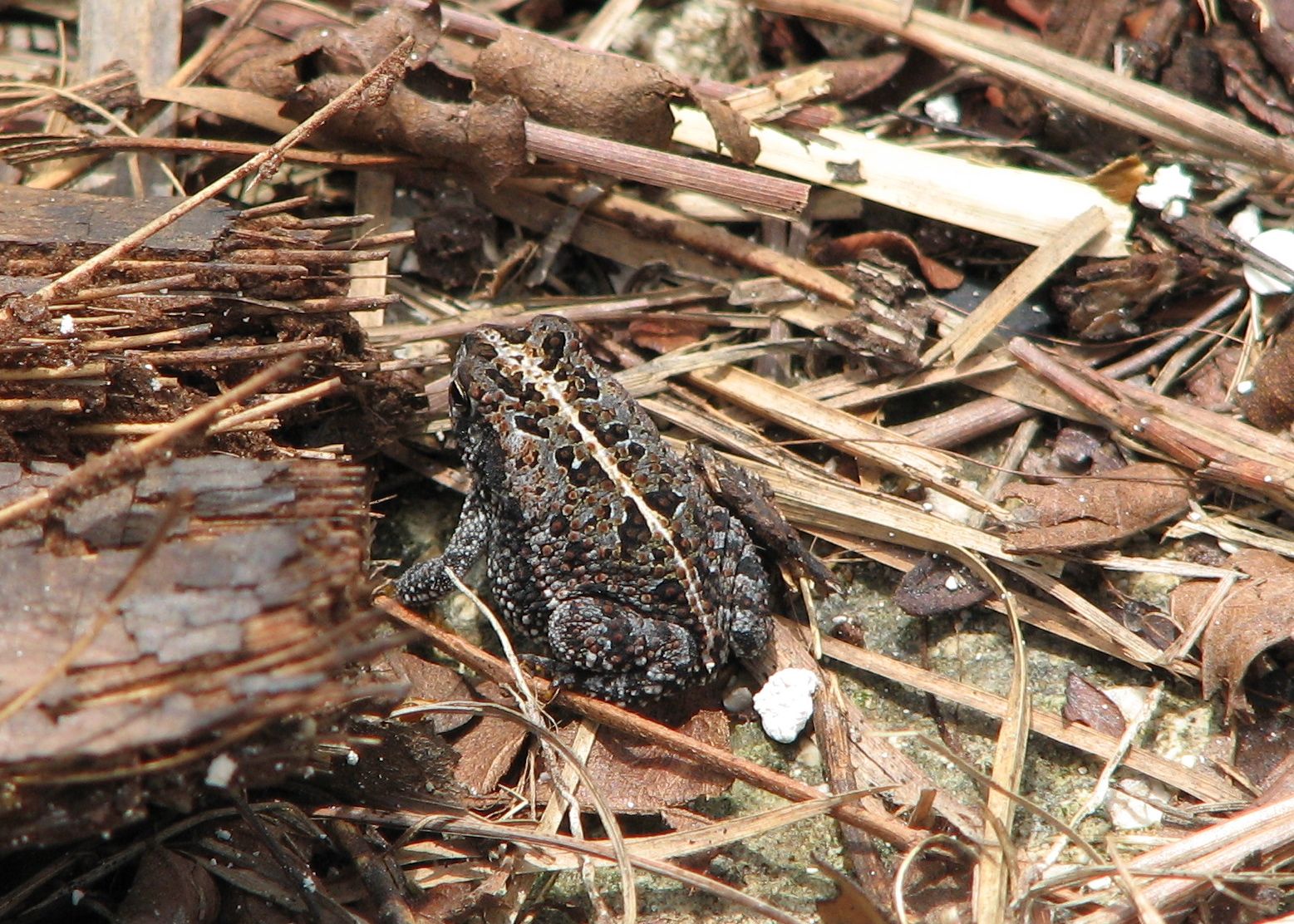
Another animal we saw everywhere on the trail was the tiny Oak Toad, only about an inch long.  They were so abundant in spots, and so well camouflaged, that I barely avoided stepping on a few. I remember thinking the toads seemed nearly to glimmer against the trail (although maybe that was just air shimmer from the heat). These are the smallest native toads in the US, and are one of the few that is active in daytime. Pretty cool.

Oak Toad

Roughly halfway down the trail we decided the clouds looked way too scary and close for comfort, so we turned back. We made it to the car in a cloud of mosquitoes, but still no actual raindrops had fallen.  (Note to anybody considering a visit to Merritt: wear long pants and a long-sleeved shirt even in the hottest weather! My pants did a much better job protecting me from mosquitoes than bug repellant did on bare skin, probably because I kept sweating off the repellant no matter how often I applied it.)

Threatening clouds over the scrub habitat.

Next we headed to look for endangered West Indian Manatees.  I’ve always wanted to see wild manatees. We’d seen captive ones the day before at Epcot’s Living Seas exhibit, but it's just not the same. The area we were directed to was much further away than I had thought; in fact Victor had just said “I think we’ve gone too far, let’s turn back” when I finally spotted a sign for the turn-off. We pulled into the gravel parking lot and joined a couple other families already on the concrete overlook. Right below our feet we saw manatees lolling in the warm shallow water.  Wow! There was even one a bit farther away munching on floating plants.

The manatees were very tough to photograph. Mostly they floated just under the murky water surface, occasionally coming up for air.  We were still anxious about the weather, and hadn’t yet gotten over to Canaveral to see the shuttle, so we didn’t spend a lot of time at the manatee spot.  In the picture below, you can see white scars where the manatees had been hit by motorboats.  That’s pretty common, I’ve heard, and is a big reason why they are on the federal endangered species list.  The captive ones at Epcot were individuals who’d had severe injuries in the wild and were being treated and rehabilitated before release.
Two West Indian Manatees

After the manatees we drove to the adjacent Canaveral National Seashore. We briefly checked out one of the beaches that had good views of the shuttle.  There we also got a closer look at another Gopher Tortoise in the dunes, although it was as shy as the ones on Scrub Ridge trail and quickly scooted back under cover. There wasn’t a whole lot of other wildlife on that beach though; it’s not the season for migratory sandpipers and such.

Space Shuttle Atlantis

Gopher Tortoise hiding in the dunes

After the beach, we headed for Bio Lab Road, recommended to us by Canaveral’s contact station attendant.  This turned out to be roughly five miles of skinny dusty road through marshy habitat, with occasional views of the seashore.  It was thick with wildlife.  Without leaving the car, we saw a Florida Wood Rat, a Marsh Rabbit, a Roseate Spoonbill, two Alligators, an Anhinga, both Great Blue & Little Blue Herons, Tricolored Herons, White Ibises and of course the ubiquitous Golden-silk spiders.
Marsh Rabbit
Roseate Spoonbill
White Ibis and Little Blue Heron

Victor generously drove the whole time, allowing me to be wildlife lookout.  This was my first time birding by car, and to be honest I was skeptical about the idea.  How could I have a productive birding experience if we drove past wildlife before I even spotted it? But Victor was very good at driving slowly and stopping promptly when asked.  Since we only saw two other cars the whole way, we could even safely back up to get better views or photos if we passed something before my mind registered “Hey, there was an alligator back there!”
A lurking alligator

Around 4:00 we turned around and headed back for the refuge.  I had wanted to pick up a T-shirt or two in the gift shop.  But when we got to the VC area (at about ten past 4), we found even the gates into the parking lot were closed and locked.  The posted hours were 10:00-4:30, and nobody answered the phone when we called the listed number.  It was very disappointing and frustrating.  I understand that sometimes things come up, but I really wish staff could at least have posted an explanation if not an apology. I had looked forward to buying that T-shirt as a way to support the park as well as to have a tangible memento of our visit. Instead, I ended up with a sour final impression. I didn’t even have the heart to take a last photograph of those locked gates.

But that’s the only thing that Merritt didn’t do as well as or better than Disney: customer service. And until that point, the customer service at Merritt & Canaveral had been pretty good. Everybody we talked to was polite and helpful, sending us correctly to interesting spots for wildlife. Even those ominous storm clouds never loosed a single raindrop, just added that spark of excitement.

I highly recommend visiting Merritt Island NWR and Canaveral National Seashore. Although you may have to work at it a little more, what with the longer drive and a grittier experience, for both wildlife and excitement I think a visit to Merritt Island & Canaveral beats a visit to Animal Kingdom. We had just as much fun and discovery at Merritt as we would have with Animal Kingdom’s rides and animal exhibits.  Disney might have more animals in total and more guaranteed sightings, but because we discovered all the refuge animals ourselves, Merritt Island felt like more of a genuine adventure.

Side note: I found Merritt via the Great Florida Birding Trail, a compilation of excellent birding sites throughout Florida, with tips for best times and key species or habitats. Virginia has one too, the Virginia Birding & Wildlife Trail.  They’re handy whether you live in the area or are planning a visit. The American Birding Association has compiled a list of similar birding trails throughout the US too. Over thirty states are included. I’ll definitely check the listings before my next vacation.

This entry’s locations:

Tuesday, July 5, 2011

Predators

Last week I was frolicking in Orlando, Florida, with my hubby to celebrate our one-year wedding anniversary. Yay!  We spent most of our time at the Disney parks, but also took a day for some local nature. We drove out to Merritt Island National Wildlife Refuge and Canaveral National Seashore in Titusville. 

A boardwalk trail behind Merritt Island's Visitor Center.

We saw nature as well as the last foreseeable space shuttle at Canaveral.
At one point we drove down Canaveral's tiny, dusty Bio Lab Road in search of birds, Victor driving while I served as wildlife lookout. He isn't as fascinated with birds and bugs as I am, but had mentioned that he'd really like to see an alligator. So when we finally spotted one I was both relieved and excited.  The alligator was resting near a little streamlet along my side of the road.

The first alligator of the trip.

I had a hard time getting my camera to zoom properly on the alligator.  I thought the autofocus was just being persnickety, but when I downloaded the pictures I discovered the real cause: there were several large spiders a few feet from the car, between me and the alligator! The camera kept trying to focus on them, not the more distant reptile.  This photo reminds me of those old picture games I loved when I was a kid, finding various objects camouflaged in a sketch. How many predators can you count here?


From spiders to alligators, there's a predator in Florida for any size!

I count five predators in all, with a possible sixth just creeping in at the top of the spiders' web. These Golden-silk Spiders were each about one inch long including their legs-- pretty small for their species, so I'd guess they're pretty young. We also saw full-grown and honestly gargantuan females on the wildlife refuge.  The females measured about three or four inches long including the legs, with swollen bodies at least one inch long.  Males were barely one-third to one-half that large, and hung near the edge of the females' webs.  Check out this romantic pair:


Yikes! Those are some monstrous hairy-kneed legs.

Although late June/early July is supposedly one of the worst times for wildlife watching in Florida, what with the heat,  voracious mosquitoes, and a relatively low number of bird species in residence, we still had a great and very productive time.  I'll post more about the trip later this week, then resume my usual Maryland-area explorations.

This entry's sites:
Blogger Widget