Showing posts with label C and O Canal. Show all posts

Monday, July 30, 2018

Many, Many Mergansers!


By now, you've probably seen Brent Cizek's viral photo of a hen Common Merganser leading a long train of about 50 fuzzy little babies. (If not, check it out at his photography website, plus his followup visit a couple weeks later, when the group had grown to 76 ducklings. He found the incredible family in Minnesota's Lake Bemidji.

Why was the group so big? This isn't a case of an insanely large nest. Rather, most of the babies probably had different mothers. Common Mergansers often merge multiple hens' broods under the care of one hen-- although not usually quite so many babies at the same time! The new group of babies is called a creche.

It's even possible the hen in Cizek's photo might not actually be the mother of any of the ducklings, but rather their grandmother. Now that's one busy grandma! Baby mergansers can feed themselves as soon as they hatch, so at least she doesn't have to provide food for all her fluffy little followers.

large group of young Common Mergansers on a river reflecting the sunset.
Turns out Common Mergansers on the C & O Canal form creches too!
And remember the merganser family I wrote about back in May? Victor and I saw a large merganser creche reminiscent of Cizek's, when we took a sunset stroll at the C & O Canal a month after our first sighting. These mergansers looked to be about half-grown-- older than the fuzzballs Cizek photographed, but still clustering together as ducklings will. We counted at least forty individuals, which seems to be a large but not atypical group for Common Merganser creches. Presumably some of them were the seven little fluffballs we saw a month before.

I'm really glad to see further evidence of a healthy breeding population in our area. Although most field guides list the Common Merganser as only a winter resident in the MidAtlantic area, the Maryland Biodiversity Project states that they're increasing along the Potomac as a breeder. Cool!

Large group of Common Mergansers swimming to the left on a river reflecting the sunset
Should we go this way?


The group of Mergansers now swimming to the right in a tight cluster
No, wait, maybe over here.


The group of mergansers swimming to the right, some still in a tight cluster but the back of the group getting strung out in a line.
Yep, this looks like a good direction.


Sunday, May 20, 2018

Merganser Mama

Update: We went back to the C & O Canal a month later, and found a huge group of about 40 half-grown Common Mergansers, probably including the ducklings from this family. So of course, I wrote about them again.
  
Victor & I went hiking along the C & O Canal recently. My main intent had been to snag a bunch more new bird species for my year list, since spring migration is in full swing. I was indeed successful-- warblers and other songbirds were singing everywhere. I can't identify every one by call, but I was able to recognize several, and managed to confirm a few others I wasn't sure about by using the Merlin app from Cornell Lab of Ornithology. (This is a great field app, I highly recommend it! I have a post in the works about how I use it, so stay tuned.)

But in addition to the Indigo Buntings, Blackpoll Warblers, Yellow Warblers, Red-eyed Vireos, and Yellow-billed Cuckoos that I logged on eBird that morning, I finally was able to check off a longtime birding bucket list item: seeing a Merganser carrying her babies on her back! I knew mergansers do this sometimes, as do loons and grebes, but I'd never observed it in the wild. Now I have!

When we first entered the trail at Seneca Creek, Victor immediately pointed out a female Common Merganser paddling toward the Potomac. I trained my binoculars on her and discovered she was trailed by several little babies! In fact, one of those babies had already climbed on her back for a break. Victor & I took turns snapping lots and lots of photos as she hustled toward the larger body of water.  As she swam along, more and more of her babies clambered on her back. SO CUTE! Even though I also saw my first ever Magnolia Warbler that morning, the mergansers were still the highlight of the trip.


Not all of our photos came out-- it was pretty humid and misty out, and that gave the camera a bit of difficulty focusing, I think.  But here are a few of the better ones. Enjoy!

Female Common Merganser swims along with one spotted duckling on her back and six more paddling behind.
One baby is riding comfy on the middle of mama's back. Everybody else is hustling to keep up.

Female Common Merganser swims along, with three fuzzy ducklings riding on her back and four paddling behind.
Now three babies have made it onboard.


Female Common Merganser swims on still, gray water, with four fuzzy ducklings riding on her back and three more behind.
Four babies are on her back at this point, with a couple still paddling madly along.

Female Common Merganser swims away into the mist, with seven fuzzy ducklings riding cozily on her back.
Finally, all seven babies are tucked up on top of Mama.  So off she goes into the Potomac. Farewell!

Sunday, March 11, 2018

How A Rare Bird Mix-up Turned My Face Red

With spring nearly upon us, and the weather starting to warm (just a bit), the ducks that have wintered here are about to head north. That means, of course, that the time remaining to see them is dwindling. But it also means birders might luck into a few rarities that drop in for a few days of rest on their northward migration.

With that in mind, and having seen recent alerts from eBird about a Red-necked Grebe near the C&O Canal, Victor and I decided to bird a bit of the C&O this weekend. The weather was gorgeous when we set out—clear and sunny, a bit cool still but great for hiking. The grebe had been reported at both Violette’s Lock and Riley’s Lock, just a mile or so apart. We’ve seen huge gatherings of wood frogs near Violette’s Lock before, so started there, hoping maybe a few frogs would have ventured out of hibernation already. But the creek lacked any indication of mating frogs when we were there, so no luck on the amphibian front. On we went to birding.

I scanned the stretch of the Potomac for any interesting birds. Dozens of gulls studded the water (probably all Ring-billed, although I didn’t examine every single individual), but no interesting waterfowl could be seen. We headed downstream along the trail, stopping any time a break in the trees gave a good look at the river. Still, however, nothing but gulls. We encountered another birder heading upstream; he told us Horned Grebes and a Ruddy Duck were at Riley’s Lock, but he hadn’t been able to find the Red-necked Grebe. We wished him good birding, and kept hiking.


A Ring-billed Gull sits on the Potomac River
One of the many Ring-billed Gulls we saw that day

When we reached Riley’s Lock, we found that four Horned Grebes were indeed present and easily found. They only stayed above water for a few seconds at a time, though, frequently diving after minnows. This made close observation and photography tough, but thankfully Victor got some decent pictures. We left the lock and continued upstream.
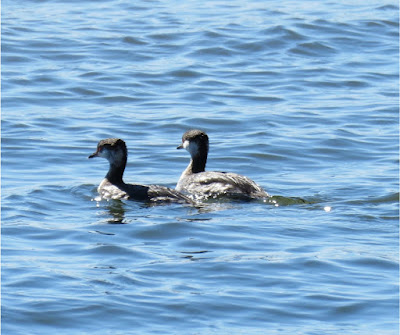
Two Horned Grebes, in non-breeding plumage, sit together on the Potomac River
Two Horned Grebes in between dives.

Soon I spotted a few nice songbirds in the trees—several Bluebirds and Yellow-rumped Warblers among them. I didn’t see any early migrating warblers (the Yellow-rumps are here year-round), but they were still nice ticks. We also found a few Gadwall and Mallards enjoying the sunshine in a pond.

 
A male Eastern Bluebird sits on a twig, with the patchy bark of a Sycamore tree behind it
One of the Eastern Bluebirds sits in front of a Sycamore tree's patchy bark.

A yellow-rumped warbler sitss on a thin branch with blue sky behind it
This Yellow-rumped Warbler seemed to be examining us as much as I observed it!

A male and female Gadwall ducks sit together in a muddy brown pond
A male & a female Gadwall on the muddy pond. The male's black butt is a handy field mark.

On our way back, the horned grebes were still at Riley’s Lock, and had been joined by a much larger bird. This new bird had a longer, heavier bill, and had more white on the front of its neck. Could it be my longed-for Red-necked Grebe? I convinced myself it was, and even logged it in eBird and told another birder we encountered when we were almost back to our car. I was so excited I neglected to check for other possible IDs.
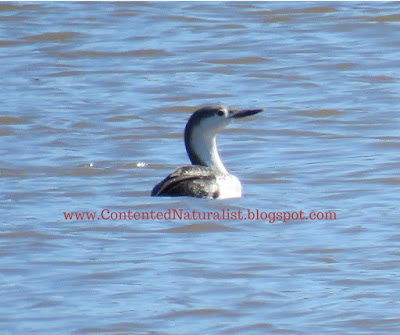
A red-throated loon, in non-breeding plumage, sits on the Potomac River
The way this bird tilts its bill upward is one of the key field marks for the Red-throated Loon in winter. I should have realized that, if I'd bothered to think about other possible IDs.

A red-throated loon, in non-breeding plumage, faces left on the Potomac River
Another view of the loon, still tilting its bill upward. The throat is only red in breeding plumage, seen in the summertime.


It wasn’t until I got home and checked our photos that I realized we had actually spotted a Red-Throated Loon, also listed as rare for our area this time of year. I had to edit my ebird checklist to correct my mistake. It’s correct in their data base now, but I still feel embarrassed about jumping to conclusions. Moral of the story: just because you wanted to find a particular species doesn’t mean you did! 
Always double check your ID and rule out other possibilities, before declaring you’ve spotted a lifer bird. I wish I'd done that before reporting the Red-necked Grebe on eBird!

So I never did spot the Red-necked Grebe that day, but I think the loon was a decent consolation prize. Kind of a funny coincidence that they both had “Red” in their name. It made my 91st bird species for the year, and the Horned Grebes were my 90th. I’m almost half-way to my goal of 200 bird species for the year! I know the more I get, the harder it will be to add a new species. I’m still hoping to make that nice fat number by December 31, though.

Are you seeing any interesting birds in your area as the spring migration gets started? I’d love to hear about them in the comments. Also, please let me know if you have any questions about birdwatching or birding equipment. I’ve been birding for most of my life, so I may have forgotten what it’s like to be a beginning birder. But I’d love to help you all get started or become more advanced birders!

Tuesday, July 19, 2011

Summer strategy


It can be tough to bird in the summer, what with the obscuring leaves on the trees and a relative paucity of birdsong compared to spring and fall.  The strain on my neck from craning after treetop birds doesn't always seem worth the number of species I usually get this time of year.  So on many summer hikes I focus on the lower levels of the forest instead. This is also a good idea when taking a walk with a non-birding friend, e.g. my husband.  He’s tolerant of my being a nature geek when we hike together, but real birding with its stops and starts, and its long periods of watching a treetop in hopes that the tanager/warbler/whatever will pop into sight, would probably try his patience.


"I'm sure there's an oriole in there somewhere!"


I put this theory to work last week when we had some wonderfully cool weather (highs in the mid 80s rather than mid 90s or above) and Victor and I took a short hike along the C&O canal. I'll admit I still had to pull myself away from a few tantalizingly hidden birds, but there was so much else going on in the forest, I didn't feel I was missing out.


Milepost markers dot the trail.


It was a joy to be able to hike in the peak of summer without being soaked in sweat.  Even the black vultures were out enjoying the sunshine.  We found several of them basking in the parking lot with their wings opened, reminiscent of cormorants. I thought they looked very gawky and silly, but it must have been comfortable for all of them to be doing it.


I often see black vultures when I hike the C&O, but not usually like this!


Once we started the trail, we found that any sunny, still spot in the canal was covered with duckweed, and so were most of the turtles who’d hauled themselves onto logs to bask in the sunshine.


Turtles, fish, ducks, and even beaver may eat duckweed.

Also enjoying the canal was a green heron perched on a branch just above the duckweed-covered surface. We spotted it there when we walked upstream, and it was still there when we came back, taking advantage of a great fishing spot.  Periodically it would stretch forward, balance there for a while, then lightning fast snake its head down and snatch a minnow from the surface.  Yum!


Aiming...

Success!


The air was full of insect life.  Tiny beetles and bees swarmed any wildflowers, and dragonflies darted along the trail hunting them. We saw Eastern Amberwings and male (slate blue) and female (grass green) Eastern Pondhawks.  While photographing a perched female Pondhawk I also discovered a tiny Green Treefrog motionless on a nearby leaf.  Despite my inadvertently jostling its branch a couple times, the frog never even blinked.  It was very well camouflaged; I would have been completely unaware had it not been for the dragonfly perching a few inches away.


This female Pondhawk was amazingly tolerant of me.

You don't see me...


Butterflies including Tiger Swallowtails, Northern Pearly-eyes and Zebra Swallowtails flitted along the trail as well. Paw-paw trees make up much of the forest understory along the C & O; since their leaves are the only thing that Zebra Swallowtail caterpillars eat, you won’t see the black and white butterflies without them around. Talk about your picky eaters! 


A mud-puddling Tiger Swallowtail
Looks like this Pearly-eye lost a few bits of wing to a hungry predator.

Zebra Swallowtails sport fashionable red antennae.

The paw-paw fruit won't be ripe until late August.

We also found a tree with nearly twenty cocoons where caterpillars had rolled leaves around themselves.  I didn’t want to disturb their metamorphosis, so I didn’t unroll any. Thus I may never know what species of caterpillar this was. From the size (roughly half-inch diameter at the widest end) I’m guessing one of our large silkworm moths, maybe Promethea or Polyphemus. I managed to get one photo looking straight into the cocoon, with a just-distinguishable face looking out. Does anybody recognize what these were? I’d sure love to know. I’m kind of wishing I had unrolled one just a little to see what was inside. Please leave a comment if you think you know what they were.


Mystery pupa

Go away, I'm busy!

Last but not least, we saw several gorgeous spiderwebs beside the trail, some in the process of being rebuilt.  All belonged to a kind of orb spider called Arrow-shaped Micrathena. They rebuild at least some of their web every day, typical for orb spiders. They’re nowhere close to the size of the Golden-silk spiders we saw in Florida; instead these little guys were only about a quarter of an inch big.  Their shape however is pretty interesting: their abdomen is a bulgy triangle with little spikes.  We watched one spider who’d only completed about five of its outer spirals so far, and was busily spinning the rest.  Apparently they always leave a hole at the center of their web so they can easily switch back and forth between sides.  I suppose that could provide protection against flying predators who want to snatch them right off the web, or it could allow the spider to reach its own newly-snagged prey more quickly.  Pretty clever!

Each circuit took about twenty seconds to make.


This entry’s location:


Blogger Widget