Showing posts with label milkweed. Show all posts

Sunday, August 21, 2011

I Don't Want To Be a Cicada


Mist-cloaked Lake Frank after a night of rainstorms.

Originally I was going to stay home on Friday.  My husband wanted to borrow my car and I figured I’d hang out with the cats, get some cleaning done, that sort of thing.  But at the last minute he decided to take his own car after all, and the expected rain looked like it would hold off til early afternoon.  So I took this as a sign that I should go hiking.

We’d had some fierce torrential thunderstorms Thursday afternoon and night, so I wanted to see how Lake Frank looked. I also thought I might get neat photographs of raindrops clinging to leaves. There was indeed still a lot of moisture everywhere, but most of it was suspended in the air. The weather started somewhere between misty and hazy, as you can see above, but ended up just plain hot and sticky by mid-day. I did get a few interesting shots though, including some of droplets on perched damselflies.  Zoom in on the damselfly shots to really see the mist.

I love when mist catches sunbeams like this.

This damselfly carried only one mist droplet.

This one has a whole family of droplets to carry!

I spent most of my day in two spots at the park.  One was a shallow inlet that held Mallards, Wood Ducks, a Green Heron, a newly arrived Spotted Sandpiper and basking Painted & Red-bellied Turtles. I had to wade through thigh-high wet grass to get there, but it was worth getting a bit damp. I perched on a hunk of lumber near the shore, probably a fisherman’s seat, and got to observe the undisturbed animals from fairly close.  Even though the air was too hazy to make for fantastic photos, I still had a great time watching the animals, especially the Green Heron while it hunted minnows.  I love Green Herons, they are so energetic and interesting.

The fluffy white debris is molted mallard feathers. Messy little beasts.

Check out that gargantuan Red-bellied Turtle, must be at least the size of a Mallard! The sandpiper is on the short log in the foreground.

I also spent a lot of time in some semi-reclaimed parking lots.  These expansive swaths of asphalt have been abandoned for years, it looks like, and are in the process of returning to weedy wilderness. Although I did meet a few hikers just back from four years out of state, who were shocked and saddened at the lots’ abandonment, I love it. It’s amazing to see wildlife fighting to take the area back, sprouting clumps of milkweed here, rambling blackberry vines there. I’ve found lots of cool plants and animals in these parking lots this summer, and today didn’t disappoint. I found several humongous Cicada Killer wasps (Sphecius speciosus) in the parking lots, one individual even carrying prey!

Cicada Killer on the hunt.


Apparently the female Cicada Killers dig long burrows ending in cells which they stuff with paralyzed cicadas.  One egg is laid per cell, and in a few days the eggs hatch into small but ravenous larvae who feast on the cicadas for a couple weeks before pupating through the winter. I watched the wasps patrol a tangle of tall grasses on a former road median.  It was hard to get a good look at them, let alone many photographs, as they skimmed swiftly through the grassy tops and swooped down into the denser parts of the tangle.  I wasn’t exactly sure of the ID, especially since I didn’t have a bug field guide with me, until I finally saw the individual with prey. She landed heavily on the grasses and then clambered deep into the tangle, presumably heading for her burrow. Way cool.

Cicada Killer with prey.


Also in the former parking lots I spotted a lurking Praying Mantis, a Gladiator Katydid (what a great name!), a passel of milkweed bug nymphs, a robber fly, and blooming goldenrod, mullein and thistle, plus plenty of birds and butterflies. Not bad for a patch of asphalt.

This mantis was browner than the ones I saw at Meadowside, so not as well camouflaged.

Gladiator Katydid on milkweed.

A robber fly, I think Promachus rufipes. Fierce looking but it won't sting you.

Tiny Milkweed Bug nymphs haven't yet developed their black wings.

Bees were loving the goldenrod, including this one with bulging pollen baskets!

I have to say, this makes the second hike in a row where I witnessed a rather horrible death of a cicada.  Is there a pattern here?  I know one thing for sure-- I don’t want to reincarnate as a fat, juicy cicada!

This entry's park: Lake Frank, Rock Creek Regional Park, Derwood, MD 

Friday, June 24, 2011

Wildlife Watching Tip: Look for the Little Guys

A distinct lack of wildlife... but appearances can be deceiving!


All wildlife watchers have run into this problem before: where the heck is the wildlife? You started out on the trail eager and excited with your binoculars and camera in hand.  But a few hours later you came back sweaty and disappointed.  Nothing interesting showed its face, not a single deer, fox, raccoon, snake or even rabbit. You encountered a million mosquitoes, but the biggest animal you saw was a gray squirrel just like the ones you see in the back yard. It's very discouraging, especially if you’re trying to encourage a love of nature in any reluctant companions.  But there are a few tips  I’ve picked up in my own nature explorations.  Since one of my goals with this blog is to get other folks outside and enjoying nature, this entry is the beginning of a series of wildlife watching tips.

The first secret to wildlife watching satisfaction is to expand your definition of wildlife.  You’re probably walking past tons of wildlife and you don’t even know it. Instead of grumbling, "Where'd the wildlife go?" you can discover all the bizarre but tiny creatures that lurk nearby. I still love seeing big charismatic and/or cute animals too, but they're often really hard to find. They may be nocturnal, or are just very shy, and especially if you have kids with you it’s hard to be quiet enough to sneak up on them.  Even birds are tough sometimes.  They're great fun to watch, and are certainly easier to find than most of the larger wild animals that live in my area. But often they too are frustratingly hidden, even taunting me from high leafy treetops. So my latest strategy for trailside happiness is something on an even smaller scale.  I'm watching bugs and spiders!


The Rabid Wolf Spider, totally harmless to humans.


A Flower Longhorn beetle.


Many of the spiders and insects that I have found trailside are beautiful, weird, and totally fascinating.  They’re small and unobtrusive, but there’s actually just as much color and conflict in the insect world as in the world of larger animals. Until recently I had focused my insect interest almost exclusively on butterflies.  Then this summer I decided to look a little deeper. During the past couple weeks I’ve found some weird and wonderful beetles, spiders, dragonflies, and many others that I can’t even identify yet.

Pink-spotted Lady Beetle. Also known as: "Wow, a pink ladybug!"

I have no idea what this bug is. It's pretty fierce looking but only 3/4 inch long.


The best places to look for bugs tend to be meadows and marshes.  Marshes are abuzz with dragonflies and damselflies, all hunting prey, pursuing each other, mating and laying eggs.  If you’ve ever seen a dragonfly repeatedly dipping the end of her tail in water, you’ve watched her lay eggs.  Dragonfly and damselfly nymphs grow up underwater, voraciously hunting other aquatic bugs and tiny critters just like the fierce predators they’ll be as airborne adults. When they’re mature they crawl out of the water and molt into adult form.


There were tons of dragonflies and damselflies in this marshy spot.

An Eastern Amberwing at rest, along with unidentified damselflies.

A female Ebony Jewelwing. Males don't have the white spots on the wings.

These two male Amberwings were chasing each other all over the place.


Meadows with their numerous wildflowers are chock full of insects like beetles and butterflies eating sweet flower nectar, munching on succulent leaves, or hunting other bugs, to say nothing of mating and laying eggs.  The best weather for bug hunting is a sunny, calm summer day.  The warmth of the sun will bring out more bugs than you’ll get on a cloudy day, and a calm windless day is ideal so the bugs themselves aren’t sheltering out of your sight.  But even cloudy or breezy days can hold lots of amazing bugs. Many of this entry’s photos were taken on a totally cloudy day.  

Streamside meadows are ideal for bug watching.

I found a lot of mating bugs recently too, like this pair I couldn't identify.

Hummingbird Moth enjoying the milkweed flowers.


I do recommend using a good set of close-focus binoculars if you want to go bugwatching, by the way. You'll probably be able to get within a few feet of most bugs, but some of them are so small you'll still need help getting a really good look. A magnifying glass may come in handy too.


I have no idea what this tiny bug is! Very weird looking. It jumped, too.

Of course some insects will sting or bite, so please be sensible and use caution. Also, I apply plenty of bug repellant when I go hiking since mosquitoes and ticks are vicious in my area. But I’m careful to keep the repellant off my fingers and palms so that if I do touch a bug, say a sleepy butterfly, a praying mantis, or a brightly colored beetle, I won’t cause them any harm.  I hope you will consider doing the same if you go bug hunting.

And of course, the best part of bug watching is even when you're looking for the little guys, sometimes you'll get lucky and still see one of those bigger animals too. Hooray for watching all of nature!


I was totally exhausted and heading back to the car when I saw this buck.
 
Happy wildlife watching!

Friday, June 17, 2011

Eye Candy

As I mentioned in my last post, milkweed has come into bloom at Lake Frank.  Butterflies are just going nuts over it, and I admit I'm fond of the heady fragrance myself.  Here for your viewing pleasure are some of the  butterflies and birds I encountered near the milkweed stands on Monday and Tuesday.  One of these days I've got to convince some milkweed to grow in my own yard!

Silver-spotted Skipper on an unidentified flower near the milkweed.


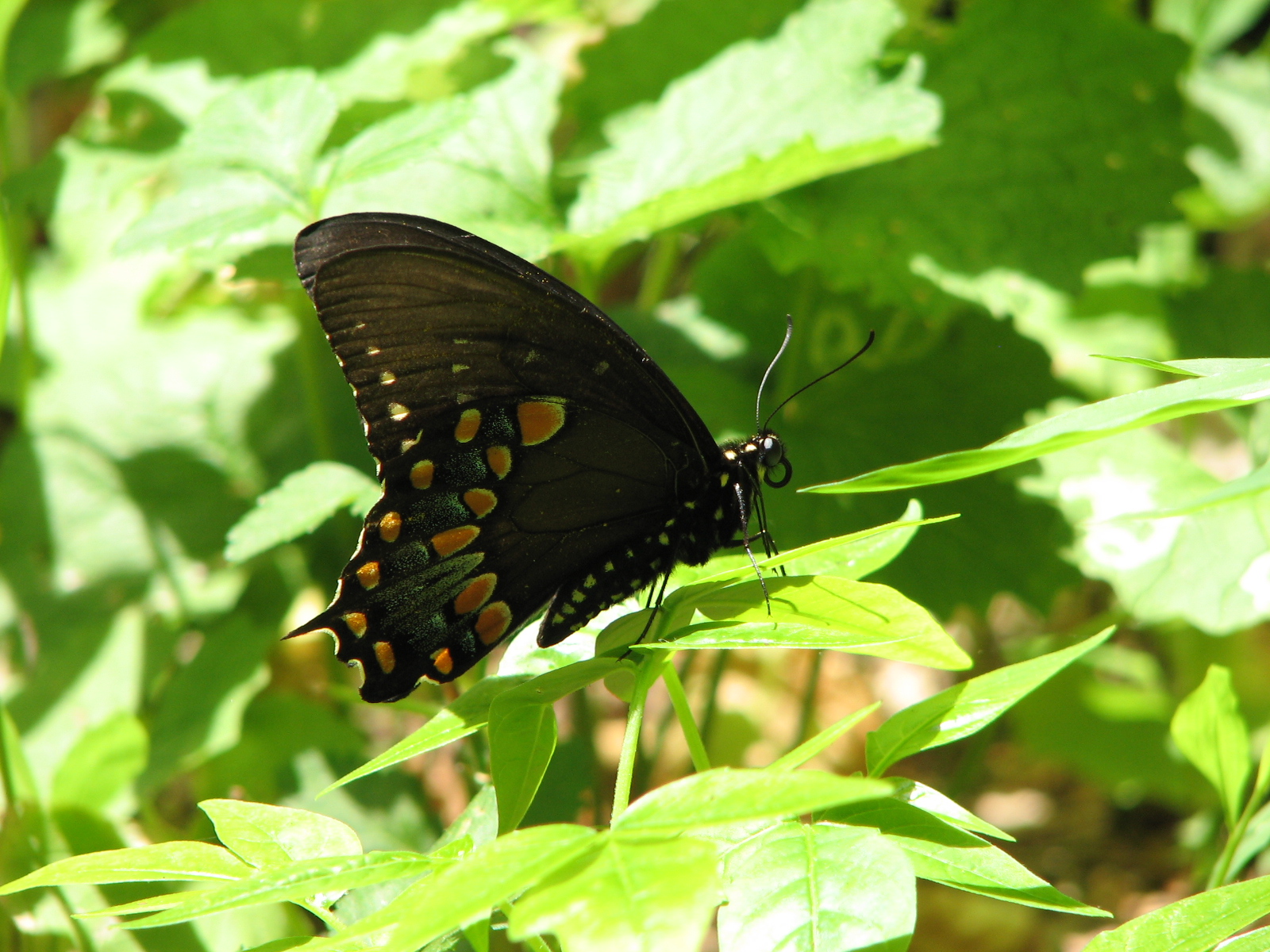
Spicebush Swallowtail basking in a sunny glade beside the trail.

Great Spangled Fritillaries-- the most common butterfly at the milkweed right now.

Northern Pearly-eye in another trailside spot of sun.

A banded House Wren. Wonder who's doing the banding around here?

This sleek Eastern Kingbird scoped out the multitude of bugs near the milkweed.

A Comma looking for tasty salts on the gravelled trail.

This bouncy Little Wood-Satyr only held still long enough for ID and a hasty photo.


This entry's park: Lake Frank, Rock Creek Regional Park, Derwood, MD

Thursday, June 16, 2011

My (unintentional) Off-trail Adventure


A perfect day for a hike!


It’s been gorgeous this week, with cool nights and slowly warming days, temps peaking barely in the mid 80s. I visited Lake Frank on both Monday and Tuesday. The first day I focused on some blooming milkweed and their attendant butterflies (more on that in a later post). But the next day I came back with a specific goal: I wanted to hike all the way around the lake-- none of this hiking part way and turning back.  In order to do this, I had to bypass my normal “stop and look at everything” philosophy.  Usually I let myself get distracted by things like tiny wildflowers, odd fungi or that secretive Ovenbird I just KNOW is around here somewhere. This time I wanted to explore beyond just my few favorite spots.


Map courtesy Montgomery County Department of Parks, www.montgomeryparks.org


Lake Frank has a somewhat confusing network of trails. There’s the formal park trails, usually well-kept, well-trodden and clearly marked. One section of the Lakeside trail is even paved. Then there are unmarked “connector” trails between the formal trails and nearby neighborhoods.  Both of these types of trail are indicated on the map.  But there are also unmarked fishermen’s access trails down to the water’s edge, plus the usual wildlife trails where deer have trodden recognizable if faint pathways.  Some of the fishermen’s trails are nearly as wide and well-used as the formal trails, while others are barely as wide as the deer trails.  So there’s a somewhat helter-skelter aspect to finding the trail at times. 


One of the semi-official connector trails.


The first and last third of my intended route are quite familiar to me, but I had never hiked the middle section. I had a copy of the map in my pack and thought my route would be straightforward.  Well, not quite.  The trails near a spot I’ve nicknamed the owl grove get hopelessly criss-crossed, and of course most of them are the unofficial or wildlife kinds.  I came to one fork where both paths looked well-trodden.  The right hand trail headed toward where I thought the owl grove was, so that’s the one I took. I followed it through the forest, up and down hills that overlooked the lake, and somehow completely bypassed the owl grove.


One of the nest boxes in the owl grove.


I’ve spent time in the grove before, but not recently, and apparently have forgotten the exact path to get there. After cresting a final hill I descended into a meadow that borders a stream.  I think I entered that meadow once a few months ago while searching for the year’s first spring peepers, but the grasses are now waist-high or taller and I was very disoriented.

I found several spots where I could be on the map.  My intended trail crossed a small stream, then followed a larger one, dancing between the stream’s edge and a meadow, finally crossing the large stream before heading back to the lake shore.  If I was at the big stream, I should keep the river on my right in order to go the correct direction.  But if I was at the small stream instead, I should keep the stream on my left until I reached the crossing.  I could hear children’s distant laughter to my left. Perhaps they were near the nature center and I should head that way, or instead they could be in one of the neighborhoods that border the park and thus be of no use for navigation. It wasn’t much help. I eventually concluded I was at the small stream since I hadn’t crossed any stream yet, or so I thought. I decided to continue to my right, after first checking out the meadow a bit.  I briefly followed the trail upstream, finding yet more milkweed and lots of neat bugs and birds.


Red Milkweed Beetle-- on milkweed, naturally.


Then I resumed hiking through the forest.  Suddenly the trail disappeared in scraggly underbrush.  Huh? I climbed a hill and discovered below me a section of lake shore that I recognized from two hours ago! I must have backtracked on yet another one of the deer trails. Arrgh. I returned to the meadow again. It was looking less and less like I would make a successful circumnavigation of the lake.

I tried once more to figure out where I was on the map.  It was just about noon, so I couldn’t use the sun to determine north.  (Apparently I need to add a compass to my hiking gear!) Finally I realized I could figure out my position and direction by just observing the stream. It seems so obvious now.  The way the streambed curved in front of me seemed on closer inspection to match one part of the map’s big stream. If I were there instead of at the small stream, then walking upstream would keep the river on my right and would put me on the right trail. Aha! I should have just kept going after my initial upstream exploration.  When I reentered the forest by hiking upstream I even found proper trail blazes again, the first I’d seen since way back at the initial trail fork. I’ve never been so relieved to see a simple trail marker before!


Hooray for trail blazes!


Knowing for sure where I was really cheered me up. I felt better with each recognizable landmark and especially the labeled trail intersections.  But then as I continued along, I noticed dark clouds starting to build.  Even if I knew exactly where I was on the map, I’d still be just as soaked if a storm caught me on the trail. I picked up my pace, and soon found myself on the paved part of the trail, right next to one of yesterday’s milkweed patches.  I knew I could make good time from here as long as I ignored the temptations of the milkweed. 


I don't like the looks of this...


When I finally made it back to the dam at the south end of the lake, I realized the dark clouds weren’t actually moving very fast.  I relaxed and took a slower pace the rest of the way to the car.  It didn’t even start raining until long after I made it home. Although I took more time than I’d hoped, and I walked quite a bit farther than intended with all the detours and backtracking, I still achieved my goal! I feel like overcoming my lack of navigation skills made it a bigger accomplishment than following the correct trail would have been. Plus, if I hadn’t done all the detours and backtracks, I wouldn’t have been in the right place at the right time to have these wonderful little encounters:


I found this Common Yellowthroat after my first upstream exploration.

This Wood Duck family explored the lake only briefly.

A  Hummingbird Moth joined the butterflies the second time I walked upstream.


I guess it’s like they say, the journey can be more important than the destination.  Of course the eventual destination is pretty crucial, like getting back to my car, but the quirks and mistakes in my route probably made the hike more fun than if I’d stayed on the correct trail the whole way.  Now to get me that compass, and try following the trail loop again soon!

Today’s park: Lake Frank, Rock Creek Regional Park, Derwood, MD
Blogger Widget