Showing posts with label Huntley Meadows. Show all posts

Thursday, June 28, 2018

Are You My Mother? (merganser edition)


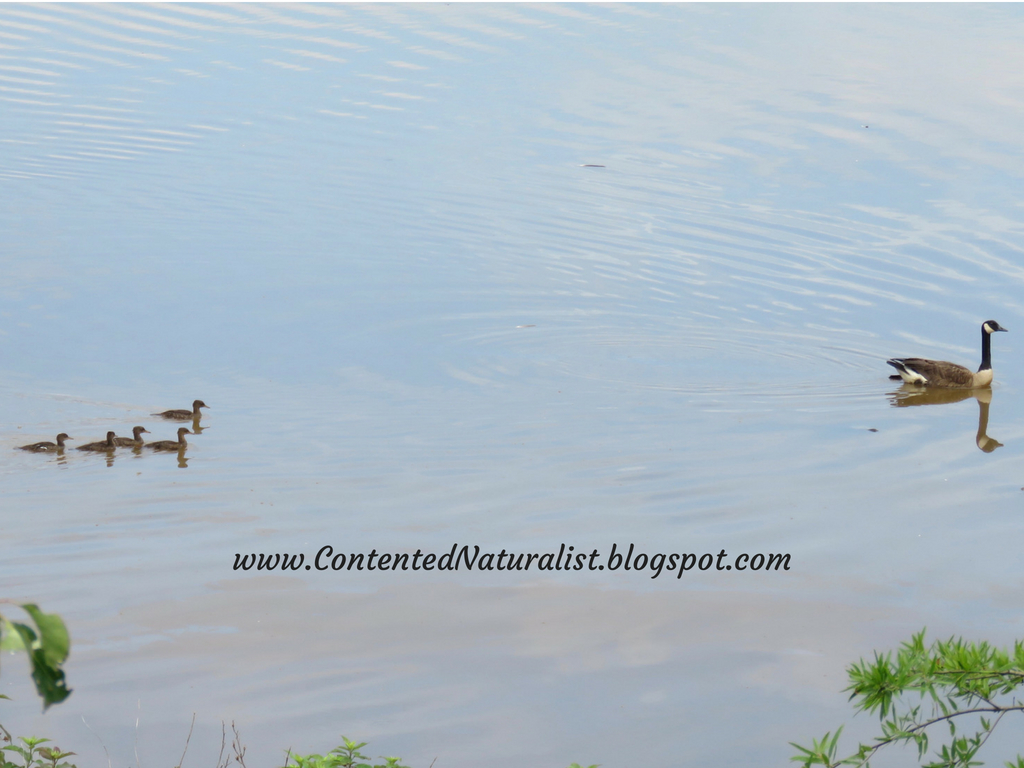
On a recent trip to Huntley Meadows, Victor & I got to see something that not only checked off one of my target species, but was somewhat puzzling. We were on the boardwalk lookout tower when I spotted a Canada Goose swimming along with a group of smaller birds trailing it. “Oh look, goslings!” I said, before I got a good look at the birds. In fact, it was a group of Hooded Mergansers following the goose as if they thought they were indeed goslings themselves. How funny!

Huntley Meadows is an unusual breeding spot for Hooded Mergansers, who normally breed much further north. They've been here for several years now, though, and seem pretty settled in.

I initially thought the appearance of family relations must have been only coincidental, something I imagined or added to the scene without a real basis in actuality. But when I was looking for more information on the algal bloom we also observed there (link here), I found photos of a Canada Goose apparently acting as nanny to a family of Hooded Mergansers both this year and last year, posted on the Huntley Meadows Community Facebook group.

My ornithologist friends suggested a few theories for what’s going on. Hooded mergansers are known for brood parasitism, where the mother bird lays her eggs in someone else’s nest, leaving that nest’s mom to raise her chicks. However, the difference in size between mergansers and Canada Geese makes this seem somewhat unlikely. When I looked closer at my photographs I also realized that the mother merganser was accompanying the juveniles and the Canada Goose, so she didn’t totally abandon her clutch. Another possibility is that the mergansers somehow imprinted on the Canada Goose. This is my favorite so far. I wonder even if the mama merganser herself imprinted on the Canada Goose, when she was young, and now has taught her own babies to do the same.

The mother is at the back of the group in this shot, slightly larger than the juveniles.
Either way, however, I still wonder what the Canada Goose thinks about it! What do you think might have led to this odd partnership? Feel free to suggest more theories in the comments.

Tuesday, April 14, 2015

I'm Doing a Butterfly Big Year

Butterfly #2: this Mourning Cloak at Huntley Meadows.

A lot of birders I know are big into lists. They keep lists of all the birds they’ve seen in their lives (Life Lists), all the birds they’ve seen in a state or county, even separate lists each year for multiple states and regions, like my county list for 2015 vs for 2014 etc. It’s a great way to casually track changes from year to year if you do it long enough.
I love making lists--tasks to do, including sub tasks and sometimes sub-sub tasks for each of those tasks (Zeno’s paradox, anybody??), places I want to see, veggies to grow, etc.—but for wildlife I mostly only keep life lists. Some birders I know keep more detailed lists: yearly ones, or even smaller lists for each state, county, etc. for every single year. Whew! I just keep a bird life list, a butterfly life list, and kind of loosely a reptile/amphibian list. I also keep a yard list for birds, but I haven't kept any year lists before.
I've heard of folks doing a “Big Year” where they try to see as many bird species as possible in a single year. You might have seen the movie a few years back about this. Recently I was reading through a local butterfly blog and discovered that a few years ago, some butterflyers in my area did a butterfly Big Year for Maryland. What a cool idea!
I’ve decided that this year I will try my own Butterfly Big Year, not just in Maryland but anywhere I travel this spring & summer. I expect most overall will come from parks here in Maryland or nearby in Virginia & DC, though. Yesterday while gardening I had three different species visit my yard already: Cabbage White, Mourning Cloak, and Variegated Fritillary. Yay!   This weekend I also spent time down at Huntley Meadows, where I saw only a Mourning Cloak high up in the trees, shown above.
Last year (2014) was a pretty poor year for butterflies in my area: low numbers for most species were reported by nearly everybody I know in the butterfly watching community. Will this year be better? I hope so. Even if not, I think keeping track of my totals will be fun. Wish me luck! I’ll post my progress here periodically, so check back from time to time and follow along.

Saturday, November 23, 2013

Recap-- I'm back!

Hi again all, it's been a long time since I had the time/energy to post. But I haven't been completely neglecting my nature explorations over the past several months. Here are a few photos and stories for you. Enjoy, and hopefully I'll get back on a regular posting track soon!

A not-very clear shot of the first ever Rose-breasted Grosbeak to visit my yard feeder, back in May. Yay! I was so excited I hauled my husband over to the window to show him. He's not as bird-crazy as I am but he politely admired the bird with me. Awww. :-)

We found this spotted turtle at Huntley Meadows, sunbathing on a moss-covered log in the woods rather far from the water. I snapped several photos of the less-than-impressed turtle, as I have only ever seen one spotted turtle before (and that was injured on the road, so hardly counts). Eventually the turtle got sick of the paparazzi, however, and scuttled off into the underbrush.

 I take a walk at lunchtime every day at Brookside Gardens, and much of the summer I watched hummingbird clearwing moths (exact species unidentified). One day in July, however, I discovered something completely new to me: that the moths actually mate while flying, and continue to fly around in tandem for quite a while! I knew dragonflies & damselflies did this, but had never realized any moths did. This was the best shot I managed to get of the mating pair-- look about a third of the way down from the center top of the image.  Pretty cool.

 Here's a clearwing moth a bit closer, since you can't make out much detail in the paired shot above. They're really fun to watch as they hover and zip around. I spent many of my lunch hours trying to get good photos of them.

 I continued raising several generations of Black Swallowtails at my house, allowing dill (their larval foodplant) to practically take over my vegetable garden. Here's a shot of a chrysalis mere hours before the butterfly ecloses. You can really see the spots and stripes on the wing through the newly transparent chrysalis shell.

 Here's the butterfly an hour or two after eclosure. Behind it you can see a more recent chrysalis that's not yet transparent (so not eclosing anytime soon) and a caterpillar that's about to pupate as well. I invested in cheesecloth butterfly cages this summer, which are much easier to use than the tupperware, paper towel, and rubber band set-up I used last summer.

 Getting ready to free a butterfly. I bring the cage outside, still zipped up, then when we're safely out of doors I open it and reach in to coax the butterfly onto my fingers. If my husband is home to share the experience with me, sometimes he photographs the occasion, like for these shots.

A closer view of the butterfly being released. This one is a female-- you can tell by the extensive blue on the hindwings. Male Black Swallowtails have more yellow there. 

Dill wasn't the only thing I grew in my garden, even if it sometimes seemed that way. I planted the zucchini on purpose, but the delicata squash and other winter squash in this picture were actually volunteers from the home-made compost I added to the soil. So was the tomato; I planted a few tomatoes on purpose but none of them did as well as the volunteers did. Go figure! The delicata squash was delicious, by the way, especially sliced and roasted with a bit of salt. I'm definitely growing some on purpose next year!


 Another photo from my lunchtime walks at Brookside Gardens. I like to take photos of interesting and/or beautiful sights and share them in the evenings with my husband. Sort of like show and tell, I guess! His grandmother is in a nursing home at the moment, and can't get outside very much let alone see anything beautiful from her window. So I also like to share my Brookside Gardens pictures and stories with her when we visit.


I'm not a very strict weeder in the garden, I tend to let a lot of plants remain that technically shouldn't be there. Violets, shown here, are very hard to eradicate once they've moved in. However, several fritillary butterflies' caterpillars eat violets, so I always keep way too many violets in the garden. I've done this for years with no evidence that it was working, but this summer I finally found the spiky little caterpillar of a Variegated Fritillary. Woo-hoo! My lackadaisical weeding has been vindicated.


 This last picture isn't exactly in the way of nature studies, but it's too funny not to share. Earlier this fall my cat, Caleb, developed some sores that he kept biting and scratching. So the vet decreed he needed to be in this e-collar for a few weeks. Boy, did Caleb hate it! He did manage to figure out how to eat, drink, sleep, and use the litterbox successfully (the fact that it was a floppy collar, not one of the hard plastic ones, helped). But he despised the experience and thoroughly resented us for putting him through it, as you can see above. Poor kitty!

So that's some of what I've been up to since my last post. I hope you enjoyed the trip through my memories! I'll try to post again soon.
Wednesday, June 1, 2011

The Best Thing About Butterflies


To me, the best thing about butterflies is that they get up at a decent hour.  Usually early morning is the best time to hike if you’re looking for wildlife.  Take birds for example: they’re liveliest right around dawn. I know a lot of dedicated birders who think nothing of getting out the door at five am or earlier (on their day off, no less). I, however, am not a morning person-- and that’s putting it mildly.  It takes a couple hours of groggy consciousness and several cups of coffee before I’m safe to venture outside of the house. So I have a hard time chasing wildlife at oh-dark-thirty. But butterflies are after my own heart: they’re most active when the sun’s already been up a few hours.  Hooray!

When I discovered that butterflies keep a reasonable schedule I fell in love.  I have been photographing them for a couple years now.  The common image of butterflies is graceful bits of color drifting from flower to flower.  But it turns out that’s not the entire truth: some butterflies don’t actually drink flower nectar at all! They get their nutrients from things like mud, dung (yep, really), oozing tree sap, overripe fruit and even rotting carrion. So much for the delicate “I eat nothing but flowers” image!  Here’s a group of mud-puddling Eastern Tiger Swallowtails I found at Lake Frank, in Rock Creek Regional Park:


Even nectivorous butterflies like the Swallowtails also visit other sources for minerals.  I’ve read that males in particular need to visit mud seeps in order to replenish certain nutrients that they lose during sex.  So were these butterflies all post-coital studs, or maybe young bachelors anticipating hot dates? It's fun to imagine so, even though I know I’m anthropomorphizing just a tad.

Another convenience of butterfly watching that’s particularly nice on hot summer days is that you don’t even have to leave the shade to find them. I visited Huntley Meadows recently and found this bright Eastern Comma in the cool woods:


Commas are named for a white curlicue on the underside of their hindwings that looks like the punctuation mark.  Here you can barely make out the silvery-white C shape-- look to the right of the rearmost leg, halfway between the body and the edge of the wing:


I also found a Northern Pearly-eye a few yards further down the trail:


Both the Comma and the Pearly-eye are non-nectaring species. They were probably looking for some tasty mud along the trail. Sometimes you could be lucky enough to have a butterfly decide you make a good breakfast!  Many butterflies will land on your skin in search of your salty sweat. A naturalist’s trick that I have not yet mastered is to wipe a bit of sweat onto your fingertip to coax a butterfly onto your hand.  It never works when I do it deliberately, but sometimes a butterfly will surprise me. I had a Hackberry Emperor land on my pants leg once during a very warm hike at Sky Meadows State Park. Here you can even see its proboscis extended:


And one more butterfly from Lake Frank, a little Zabulon Skipper. Check out the cool way it’s holding its wings:


Grass skippers like the Zab often pose in this jet plane position, with their hindwings held more-or-less perpendicular to their forewings.  I don’t know why they do this-- maybe it communicates something to other grass skippers, since only species in the subfamily Hesperiinae do this. Grass skippers aren’t very big, at most an inch long, but they’re pretty common.  You can probably find them in your own garden or even on your lawn, or try a nearby park.  The jet plane posture is really something, and they’ll often pose obligingly for photographs. I’ve found grass skippers throughout Maryland and Virginia, and the maps in my Kaufman butterfly guide imply any location in the continental US will be in the range of at least one grass skipper.

Parks from this entry:


Check them out!
Blogger Widget