Friday, June 28, 2019

The Saga of a Soggy Caterpillar

How long can you hold your breath? The current human record for holding one's breath is 24 minutes and three seconds, by professional diver Aleix Segura Vendrell. Wow! I can't hold mine for much longer than a minute. But even Mr. Vendrell's effort pales in comparison to insects-- some insects actually can hold their breath (that is, not inhale) for days! According to this article in Annals of the Entomological Society of America, larvae of various Cicindela Tiger Beetles can survive being submerged in hypoxic (low oxygen) water for between 60 and 120 hours. Wow.

But the tiger beetles have evolved that ability to survive, since their larvae burrow into sand which is liable to flood for days. What about solely terrestrial insects? Like, say, butterflies and their larvae? Turns out even they can survive a bit of dousing, or at least one of my caterpillars this summer did.

First instar Black Swallowtails are barely larger than the type on a park brochure!

One day I came home and checked on a day-old Black Swallowtail caterpillar like the one shown above, only to find that it had slipped under the surface of the water reservoir instead of staying on its dill sprig. (Note to self: watch out with tiny caterpillars and tiny dill sprigs!) My heart nearly stopped. I had even watched this egg being laid by the butterfly right beside me as I weeded the garden, so I was especially attached to this particular caterpillar. I had no idea how long the caterpillar had been underwater-- it could have happened hours ago. But just in case, I fished out the little body. How on earth do you give CPR to a millimeters-long caterpillar? For that matter, I don't know if you even could  do CPR for caterpillars. Like other insects, they breathe through multiple openings, called spiracles, along their sides. Mouth-to-mouth wouldn't exactly work.

Out of desperation, I just blew gently on the soggy, limp little black caterpillar. And it started to move! As the line from Monty Python and the Holy Grail goes, "I'm not dead yet!" I transferred the caterpillar carefully to a fresh sprig of dill, and kept it under close observation for a few days.

Once it was clear my caterpillar was out of danger, I became curious. Could caterpillars hold their breath at will? How, and for how long? This question sent me down a rabbit hole of research. I haven't yet found information specific to caterpillars, but did find one intriguing paper from 2005: "Insects breathe discontinuously to avoid oxygen toxicity," by Stefan K. Hetz and Timothy J. Bradley (Nature 433, 516-519). The researchers suggested that unlike us continual-breathers, insects keep their spiracles closed most of the time, opening them briefly and infrequently to release carbon dioxide and inhale just enough oxygen. The original paper is behind a paywall, but it's summarized in this article at LiveScience. So my caterpillar didn't hold its breath, exactly, so much as just keep its spiracles closed and use the oxygen already in its system, while it was underwater. Pretty cool!

Over the next few weeks, the caterpillar munched down all the dill I could provide, and grew quite normally. Despite the underwater episode, it actually turned out to be one of my largest caterpillars ever. Now, I don't actually measure my caterpillars, either their length or their overall weight-- I take a fairly hands-off approach most of the time. But just eyeballing, it seemed larger  than the other caterpillars I had raised a few days before.

So fat and happy! And no longer soggy in the least.

It pupated not long after I took this photo, and then successfully eclosed yesterday: a healthy female. Even my husband remarked that the butterfly seemed larger than usual, corresponding with its large larval size. After a few minutes of warming up in the sunshine, off it fluttered. Hooray!
The freshly eclosed Black Swallowtail, ready to fly off into my yard.

So moral of this story is: don't give up, even if your caterpillar falls into the water. They're amazingly resilient. No wonder they and other insects are predicted to take over the world someday!


Saturday, January 26, 2019

The Best Time To Hang a New Birdfeeder

No birds yet! The dropping level of seeds indicates the squirrels have visited, however.

A common frustration with wild bird feeding is how long it takes birds to notice (and visit) a new feeder. For those first several days, when the only attention you’ve attracted is from the neighborhood squirrels, it’s all too easy to wonder if the birds hold some grudge against you, or if you did something wrong.

In fact, this is totally normal. It can take a while for birds to even notice something new, and then longer before they feel safe venturing closer. Annoying, but typical. When I first put my back yard feeders up, mentioned in this post, it was almost three weeks before I saw many birds on them!

However, there is one trick you can use to get faster attention to a new feeder. The secret is low competition, great advertising, and honestly, a little bit of luck-- because the absolute best time to hang a new feeder is right after a snowstorm.

When fresh snow blankets the ground, the birds’ usual sources of food will be covered up as well. Without their favorite spots competing with your new feeders, the birds should be quicker to try something unfamiliar, to say nothing of desperate for something to eat.

Not much to eat here!


The snow also gives you a perfect opportunity to advertise your new feeder. First, pack down the snow under your feeder by stomping around, or smushing it down with something flat. (Otherwise the seed will just sink into the soft snow.) Once you have a nice dense layer, sprinkle plenty of black oil sunflower seeds on the packed snow. The dark seed contrasting with the white snow should catch the attention of birds searching for food, hopefully leading to your first feathered customers.

These days when I scatter seed after a snowfall, I have birds within minutes! 
You don't need a huge snowstorm for this method to work. Here the snow was only a couple inches deep.

To attract even more birds to your yard in the winter, you could also put out a heated birdbath. The birds' usual water sources are likely frozen or covered with snow, so a source of fresh water will be very welcome to local birds. You might even attract species that don't eat bird seed, like bluebirds or robins. You can buy a bird bath heater for about $40, or you could put out a pan of fresh water each morning just until it freezes, then bring it back inside to thaw. I recently ordered a heater for my birdbath, so while it didn’t arrive in time for our first snowstorm, I should have it in use before the end of the winter. (Stay tuned!)

In order to survive, birds need the right combination of food, water, and shelter. The more of these that birds can find in your yard, the more likely they’ll show up.  By hanging a new feeder right after a snowstorm, when food is desperately needed, you’ll likely get a faster response than when natural foods are easy to find. Win-win!

I hope you enjoy watching birds in your yard this winter, along with any other animals that might show up, like squirrels, rabbits, deer, and even foxes. I’d love to hear about what you see!
Once the birds are drawn to your yard, they'll soon explore your feeders as well. This Song Sparrow looks pretty cozy as more snow falls.

Wednesday, January 9, 2019

Wildlife Garden Tools: Native Plant Finders

Want to help wildlife in your yard? Try growing the plants they’re already used to in the wild, also known as native plants. For gardeners who aren’t sure how to start building backyard habitat, there are lots of native plant resources online. I’ve compiled a few that I find useful. Whether you’re hoping to attract birds, butterflies, or bees, these sites can help you figure out what to grow.

This Carpenter Bee picked up both pollen and nectar from the Swamp Milkweed in my yard

The National Wildlife Federation's plant finder has you enter your zip code to see a list of native plants for your area, ranked by how many caterpillar species (butterflies as well as moths) each plant supports. Since most birds rely on caterpillars to feed their babies, this site can also help you support birds as well as butterflies and moths. Yum!

The Audubon Society also offers a native plant finder that is based on your zip code. You’ll get a list of plants for your area that are easy to grow and should be available at native plant nurseries. Beside each plant’s description you’ll also see thumbnails of the birds it attracts. Audubon also lists nearby nurseries (and their web sites). identifying types of birds that may be attracted to each suggested plant, and basic appearance and culture needs for each plant. There’s even a “Buy Now” button for each plant, with options of either “buy local” (nearby Audubon chapters that offer plant services, nearby native plant nurseries) or “buy on Amazon.” Before you click “buy on Amazon,” you can follow a link to read tips about buying plants online.

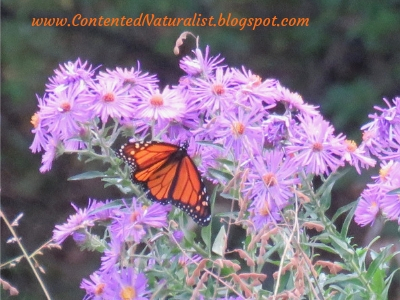
Monarchs love late-booming flowers like these asters.

The Lady Bird Johnson Wildflower Center in Texas hosts helpful resources about native plants on its web site. You can find information about commercially available plants that are native to your state, explore plants that are especially good for bees or for hummingbirds, and even find a list of nurseries that carry native plants. You’re supposed to be able to narrow that supplier list by state or zip code, but that tool seemed broken as I write this. A workaround is just to click “show all suppliers,” and scan the list to find nurseries or seed sources that are near you.

The Mt. Cuba Center, in Delaware, is a native plants botanic garden. While the garden is closed during the winter, the web site has lots of information about native plants for the Mid-Atlantic area. It won’t help you much if you live in another part of the country, but the site does give you much more detail about the specific plants and their culture & habitat needs than National Wildlife Federation’s tool. You can also refine the list by plant type, amount of sun needed, foliage type, and/or flower color, to find just the right plant for your garden.

Lastly, the Habitat Network and Project Yardmap are great resources that unfortunately have just lost funding. All of the articles are still available, and will eventually be moved over to Cornell Lab of Ornithology’s All About Birds web site. Until January 31, 2019, you can still find resources at http://content.yardmap.org/learn/, such as pictures of birds in your area sorted by what kind of food they like. You can click individual birds to find out their specific plant preferences and other habitat needs. 

Goldfinches love seed-bearing flowers like this sunflower. Coneflowers are also popular.

Of course, even better than online plant finders like these would be personal observation and experience. If you’re willing to wait a year or two before deciding, then you could try to find the plants on your list in the wild. That way you can see how it looks through all seasons, and observe how many birds, butterflies, or bees visit.

But you probably don’t want to wait that long. (I know I usually don’t!) So your next best choice would be to ask for advice and impressions from folks who have long experience with the plant. If you don’t have neighbors like this, you could try social media—there are tons of gardeners online who are happy to share our knowledge. You could also ask me in the comments below!

Whatever you choose to do, and whatever plants you select, have fun! Even “failed” gardening still gets us outside and brings us more in touch with nature. So in that sense, there’s really no 100% wrong plant selection.  Just keep planting more, you’ll eventually find the ones that work best.

Friday, January 4, 2019

Achievement Unlocked: My First Mega!

How did you do on your goals for 2018? I managed to complete one of mine in the last few weeks of the year: to spot (and log on eBird) at least 150 different bird species. Yay! My 150th bird wasn’t exactly ordinary, either: a species that’s only been seen in the US one other time. That’s what birders call a mega rarity, or mega. Although I’ve been birding for several decades now, this is the first mega I’ve ever chased.

I’ve seen locally rare birds before, like the Snowy Owls that occasionally make their way south to the mid-Atlantic area. But megas are another level. The American Birding Association (ABA) classifies birds in six levels, or codes, of rarity for the U.S. and Canada.

  • Codes 1 and 2: Regularly occurring North American birds.
    • Code 1 species are widespread and usually numerous.
    • Code 2 species are harder to find because their range is restricted, there are fewer of them, or they are very secretive.
  • Code 3: Rare. These species occur in very low number, but show up annually in the ABA checklist area. Some are visitors, others are year-round residents.
  • Code 4: Casual. These species are usually not observed every year, but have been recorded six or more times, including three or more in the past 30 years. That way a pattern can be discerned.
  • Code 5: Accidental. These are species that have been recorded five or fewer times in the ABA area, or have fewer than three records in the past 30 years. Because of the infrequency of sightings, birds in this group don’t seem to have a pattern of when/why they show up in our area.
  • Code 6: Cannot be found. Species in this group are probably or actually extinct or extirpated from the ABA area, or else all survivors are in captivity.

Of course, each bird species has its own range and preferred habitat, and that may not include all of the ABA territory. So a lot of code 1 or code 2 birds would be exceedingly rare outside of their normal territory, for example finding a code 1 Juniper Titmouse here in suburban Maryland. Generally, though, the higher code birds are harder to find.

The bird that put me at 150 species for the year, a Great Black Hawk (Buteogallus urubitinga), is in the coveted code 5 group. The first time one was seen in the US was in April, 2018, on South Padre Island in Texas. After that, one was found in Maine in August, then seen sporadically until it showed up in Portland in late November. At that point it settled into Deering Oaks Park, a small city park with a multitude of very well-fed squirrels. It even turns out that the Texas and Maine birds are the same individual, with an identical pattern of flecks on the underside of the bird’s wings, as described in BirdWatching.  Now that’s one far-traveling bird—from its normal range in central or South America to Texas, and then all the way up to Maine!

I know several birders who drove from my area all the way to Maine just for the chance to see this hawk. Seeing the bird wasn’t my primary reason for going to Portland this winter, though—I was heading up to visit family for Christmas.

Our trip almost didn’t happen, though. A week before we were supposed to drive up, I developed an extremely painful kidney infection. Ow! I had to go to urgent care while visiting my mom in Florida, and got put on some heavy-duty antibiotics. They couldn’t work fast enough for our next trip to Maine, though, I still wasn’t well enough a week later, when we had planned to drive up. I knew I was truly sick when even the thought of seeing such a rare bird wasn’t tempting.

But we did make it to Maine, only a few days late. I owe a huge thanks to my wonderful husband for doing all of the driving. Thanks, hon!

Anyway, we were busy with family celebrations all day on Christmas, but I kept checking the Cumberland county rare bird alerts, following other birders’ accounts of their sightings and hoping the hawk would still be there the next day.

My first try for the bird was not successful. Victor, my sister Cory, and I drove over to Deering Oaks about 10:00 am, late by most birding standards. We wandered the park, peering up into every tree and shrub, but no luck. A few other groups of birders were there too, some with really high-powered scopes and cameras. One birder pointed out a Red-tailed Hawk in some nearby trees, but nobody had found the Great Black Hawk. We decided to go elsewhere, and maybe try for the hawk again later.

I love that the city posted these signs all over the park, helping ensure folks treated the bird respectfully. The numbers to call in case you observed the hawk in distress are a nice touch too.


The second time we looked for the bird, after some lunch with my dad, luck was finally in our favor. The hawk had been found by others by the time we got to the park. It was easy to spot, by the huge cluster of birders admiring it from a short distance away. The hawk was perched in a tree beside the main road, and seemed totally unfazed by cars driving past mere feet away. A jogger even ran right under its perch, and the hawk seemed only barely curious. It probably had just eaten, and was still feeling the food coma. (Who knew birds got food comas like we do?)

Unfortunately, I had left my camera at home in Maryland. Arrgh! However, a very kind birder who was allowing passersby to look at the bird through his scope, also let me take a hasty digiscoped photo with my cell phone. It’s not the greatest, but hopefully good enough for proof.

The famous Great Black Hawk, perched about 15 feet above the sidewalk.


What a cool experience. Nobody knows how long the Great Black Hawk will stick around. Will Maine’s frigid winter weather be too much for this bird? If it decides to move on, where will it show up next? So much mystery still surrounds it.

If you want to see uncommon birds like the Great Black Hawk, you can sign up for rare bird alerts on eBird-- either for the whole ABA range, or just for a particular county, state or province. You'll need a free eBird account, easy to create if you don't have one already. Then eBird will email you daily or hourly (your choice) about any reported rarities in the area(s) you select.  Although I’d never chased a rarity before, I had such fun seeing this one I set myself a goal to see two more rarities this year. Wish me luck!

By the way, I finished my antibiotics a few days after seeing the Great Black Hawk, and am back to 100 percent.

Wednesday, December 5, 2018

For Birds in Your Yard, Shelter Equals Safety


Some of the birds in my front yard a few years ago, including a leucistic finch. I grew lots of beans that year, as you can see in the background.

If you feed the birds, do you have your feeders in your front yard, your back yard, or both? What kind of shelter is available nearby? Do you grow plants specifically for the birds, or leave plants standing in the fall so birds can still use them? If you want to improve what you offer for wild birds in your yard, a good place to start is looking at what kind of shelter they can find.

In general, you want your yard to feel safe in order for wildlife to come inhabit it. So the more branches you have for birds to perch on, or tangled vegetation for them to hide in, the safer birds are likely to feel in your yard. In theory, that should lead not only to more birds at your feeders, but hopefully also a wider variety of birds showing up in your yard.

Indigo Buntings live in open woodlands, so if you live close to a forest, adding shrubs and bushes to your yard might get one of these beauties to come visit you.

I currently have my bird feeders in our front yard instead of our back yard. I do this because my home office faces the front yard, so that’s where I usually do my feeder watching in the mornings. The front yard also gets more sunlight than the back, so I can grow lots of native plants near my birdfeeders. The plants provide extra food, like I wrote about in this post, and also provide cover and shelter for the birds.

Female Purple Finch really blends in among the Ironweed seedheads. She seemed pretty content munching on those seeds too.

While having the feeders in the front is convenient to watch, it also gives me somewhat of a disadvantage. Pedestrian and car traffic often goes by on the road there, so the birds may be startled away from eating. Also, the very thing that helps me garden in the front, that no trees loom overhead to shade out the sun, might also make little birds feel in danger from a hawk’s overhead attack.

Red-tailed Hawks are common in my area, and would definitely be a threat to my feeder birds.
In the winter we also see Cooper's Hawks like this one. It wasn't very clever at hunting, though-- it sat right out in the open, probably wondering why no more birds were coming to the suet feeder.

So recently I’ve wondered if I might see more or different birds, if I had my feeders in the back yard instead. A large maple tree shelters most of the yard there, joined by a couple small cherry trees, a white mulberry, and other shrubs, plus the large oak tree growing next door. All this provides a wide variety of cover for birds. There’s also the log pile shelter over in the corner that I built a year or two ago and described in this post. Basically, the back yard habitat is older and wilder than the front yard. My gardening efforts in the front are much newer, it's only been a few years since I turned a grassy lawn into garden beds.

This winter I’m going to run a little experiment, by putting additional feeders in the back, and see what shows up there compared to the front. My first back yard feeder has been up for a few days, and I don’t think the birds have tried it yet. The squirrels, of course, discovered it at once. I better make some more squirrel baffles for the back yard! I’ll keep track of my front and back yard birds this winter, and post an update in a few months.

At least the new bird feeder is all metal, so I don't have to worry about chewing damage. Darn squirrels!

As you think about garden plans for next spring, consider adding a couple bushes or shrubs to help wild birds feel safer there. My next-door neighbor’s evergreen holly hedge is always full of talkative little House Sparrows. You can even consider plants that will give your yard “winter interest”—that is, plants with interesting seedpods, bright berries, or colorful bark, so when the leaves all fall you still have something to look at.  Those seedpods and berries can also provide more food for the birds, of course! A few shrubs you and the birds might enjoy are redtwig dogwood, whose bare red bark looks pretty against the snow, and native Winterberry holly, whose scarlet berries are very attractive once the leaves fall. Dried native grasses and their seedpods can be very pretty too.

If you add some extra shelter for your birds, let me know how it goes!

Carolina Wren


Thursday, November 22, 2018

Your Messy Garden Can Feed Hungry Winter Birds

A few weeks ago, I posted about how some uncommon Purple Finches arrived at my birdfeeders, part of an irruption (sporadic migration) from Canada this year. They're here because the spruces & other conifers up north didn’t produce as many seeds as usual. The birds came south looking for more food, and a few found it in my yard. While the Purple Finches were happy to join my usual Cardinals, House Sparrows, and White-breasted Nuthatches in eating sunflower seeds, some birds won’t come to a feeder. If you provide the right kind of natural food and habitat in your yard or garden, though, you may be lucky enough to host more than just “feeder” birds in your yard.

One of the Purple Finches, who seem to have moved on. Perhaps more will show up soon!


For example, some birds are normally insect-eaters. Some of those head south for the winter, but others who breed up in New England are arriving in my area right now. They’re helpful picking off any aphids or beetles still lurking in my garden. I recently watched a Ruby-crowned Kinglet flutter around my yard, presumably plucking insects off the undersides of leaves. I’ve also watched wrens busily exploring under my garden bench and in the eaves of my porch, plucking spiders out of the dark corners. By allowing insects and spiders to live in your yard, you also help feed many birds!

We only see Ruby-crowned Kinglets in the winter around here, so it's always exciting when I spot the first one for the season.
"Hmm, any tasty bugs up there?"

Later, as winter drags on, insects are harder to find. So a lot of these birds will be looking for additional food, such as berries or other small fruit. Shrubs like Serviceberry or Spicebush, and trees like Crabapple or Dogwood provide the food that will help these birds survive the cold. Any of these plants would make great additions to your wildlife garden. I usually recommend native plants, but even some ornamental and non-native plants can provide food. The Bradford Pear in my neighbor’s yard has recently been filled with Robins, Blue Jays, and Starlings devouring its small, hard fruits.
In previous years I've sometimes seen Cedar Waxwings in that tree too, although they haven't shown up yet this year.

Shrubs also collect leaves and other detritus like twigs and bark chips beneath them. That’s where lots of garden invertebrates live, such as snails, sowbugs, spiders and insects. Since birds also like to perch in the branches at night, by planting shrubs you’re essentially providing a birdy bed and breakfast!

Because I let most of my plants die back naturally and don’t do much deadheading (removing old flowers before they become seeds) or other fall “cleanup”, I have lots of different seeds for my winter visitors, in addition to the sunflower seed in my feeders. Some birds that are seed eaters don’t come to feeders, so I can still attract and feed them by taking a hands-off approach in the garden. (Less work for me, too-- bonus!) Currently I have seedheads from Ironweed, Joe-Pye Weed, Boneset, Echinacea, Rudbeckia, and Agastache in my garden. This also means that on days I forget to refill my feeders, there is still food available for the birds.

A Purple Finch female nibbled on some of the Ironweed seeds in between feeder visits.

Finally, birds need water just as much as we do. When the temperature is below freezing, many of the local birds’ usual sources may be frozen over or hard to reach. Providing water can attract many birds that shy away from traditional feeders. If you have a bird bath already, you’ll need to have a way to keep it from freezing over too. I’ve experimented with DIY methods over the years, reluctant to buy a gadget if it wasn’t really necessary. I tried just pouring boiling water onto the ice in my birdbath every morning, for example. The birdbath refroze pretty quickly, though, so that didn’t seem like a very good alternative. In fact, I never saw birds take advantage of the warm water for the short time it was thawed each morning. There probably wasn’t enough time for them to notice the water. So I ended up using an aquarium heater to keep my birdbath thawed. That heater died last winter, though, so I’ll have to get a new one soon.

If you want to provide habitat to help migrating songbirds this fall and winter, it’s really as easy as leaving seeds and fallen leaves in your garden and yard. Remember, messier is better for birds in your garden in the wintertime! I’ve posted before about my messy garden too.

I hope you see interesting birds in your yard and garden this winter! I’d love to hear about them in the comments.

Saturday, November 3, 2018

Happy Owloween!

For Halloween this year I wanted to let my birder and naturalist colors fly. So instead of the usual face on my pumpkin, I decided to carve something appropriately spooky but more from the natural world.

I started a Pinterest board to collect patterns and ideas. Let me tell you, there are some seriously talented pumpkin carvers out there! I found a lot of very intricate patterns-- gorgeous, but I knew I needed to be less ambitions. So I kept looking for something simpler.

I admired lots of bat silhouettes, cats, and spiders before finally spotting a lovely silhouette of an owl with full moon. It looked like getting the exact angle of the shoulders might be tricky, but was still a simple enough shape that I might have a chance at success. I found it in a DIY Network article pin-- the art itself is copyright Paper & Pigtails for DIY Network. I saved the image and resized it to fit my already-purchased pumpkin.

Once I had the size right, I created a stencil by razoring out the negative space. Next I taped the stencil onto my hollowed-out pumpkin and traced the design on with a marker.

I ended up using two knives to carve this pumpkin. One large one for cutting the top off the pumpkin and for taking out big chunks in the design, then a smaller one for finer details and better shaping, like to get my moon actually round, and to refine my owl's eartufts.

I ended up omitting a few details that were too intricate for my knife skills. But I think I came pretty close, and my owl is definitely still recognizable!

My freshly carved pumpkin


The next day, the owl had started to tip over outside of the pumpkin, so we fastened it to the side with a toothpick.  This is something I would note for future carvers-- the tenuousness of the carved owl's connection to the rest of the pumpkin. You may want to strengthen or reinforce the owl right away, rather than wait for it to fall over first.

I liked the design so much I took the stencil and also used it as a Halloween window decoration. We put it behind purple tissue paper and shone a flashlight on it to create this look:

The purple glow is very spooky, don't you think?


I do have one thing to admit, however. Although I love eating crunchy roasted pumpkin seeds, the last few years I've saved my pumpkins' seeds with the intention of roasting them. But then weeks later I still haven't done it,  and the seeds have grown mold in my fridge. Blech! So this year I decided to skip the moldy fridge step and dump all the seeds and pulp into my compost bin. Who knows, maybe next summer one of the seeds will sprout and I'll have volunteer pumpkins by next Halloween!

Cool facts about Great Horned Owls, the species I think is depicted here:
  • They eat skunks! This owl's poor sense of smell actually benefits it when time comes to make dinner from a pungent skunk. It's even been reported that some of these owls leave the smell of a skunk behind on remnants of other prey. 
  • They nest very early in the season. If you live in Great Horned Owl territory and appropriate habitat, you could try putting up a nesting box for these large owls in your back yard. The Nestwatch project from Cornell Lab of Ornithology offers plans for building and posting one if you're interested. 
  • Often, though, a Great Horned Owl pair just takes over an old nest built by another species, as did the pair that I saw in Boyd Hill Nature Preserve, St. Petersburg, Florida last year. (I included the nest in my year-end eBird wrapup post.)
Stay tuned for my attempts to turn the pumpkin into a set of bird and squirrel feeders.
Blogger Widget